

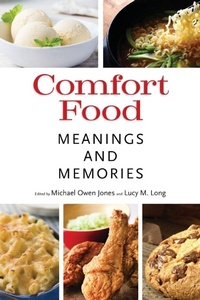
Comfort Food
Meaning and Memories
Published on 30. April 2017
Book
Paperback/Softback
272 pages
978-1-4968-1085-4 (ISBN)
Description
Comfort Food explores this concept with examples taken from Atlantic Canadians, Indonesians, the English in Britain, and various ethnic, regional, and religious populations as well as rural and urban residents in the United States. This volume includes studies of particular edibles and the ways in which they comfort or in someinstances cause discomfort. The contributors focus on items ranging from bologna to chocolate, including sweet and savory puddings, fried bread with an egg in the center, dairy products, fried rice, cafeteria fare, sugary fried dough, soul food, and others.
Several essays consider comfort food in the context of cookbooks,films, blogs, literature, marketing, and tourism. Of course what heartens one person might put off another, so the collection also includes takes on victuals that prove problematic. All this fare is then related to identity, family, community, nationality, ethnicity, class, sense of place, tradition, stress, health, discomfort, guilt, betrayal, and loss, contributing to and deepening our understanding of comfort food.
This book offers a foundation for further appreciation of comfort food. As a subject of study, the comfort food is relevant to a number of disciplines, most obviously food studies, folkloristics, and anthropology, but also American studies, cultural studies, global and international studies, tourism, marketing, and public health.
With contributions by: Barbara Banks, Sheila Bock, Susan Eleuterio, Jillian Gould, Phillis Humphries, Michael Owen Jones, Alicia Kristen, William G. Lockwood, Yvonne R. Lockwood, Lucy M. Long, LuAnne Roth, Rachelle H. Saltzman, Charlene Smith, Annie Tucker, and Diane Tye.
Several essays consider comfort food in the context of cookbooks,films, blogs, literature, marketing, and tourism. Of course what heartens one person might put off another, so the collection also includes takes on victuals that prove problematic. All this fare is then related to identity, family, community, nationality, ethnicity, class, sense of place, tradition, stress, health, discomfort, guilt, betrayal, and loss, contributing to and deepening our understanding of comfort food.
This book offers a foundation for further appreciation of comfort food. As a subject of study, the comfort food is relevant to a number of disciplines, most obviously food studies, folkloristics, and anthropology, but also American studies, cultural studies, global and international studies, tourism, marketing, and public health.
With contributions by: Barbara Banks, Sheila Bock, Susan Eleuterio, Jillian Gould, Phillis Humphries, Michael Owen Jones, Alicia Kristen, William G. Lockwood, Yvonne R. Lockwood, Lucy M. Long, LuAnne Roth, Rachelle H. Saltzman, Charlene Smith, Annie Tucker, and Diane Tye.
More details
Language
English
Place of publication
Jackson
United States
Target group
Professional and scholarly
Product notice
Paperback (trade)
Dimensions
Height: 229 mm
Width: 152 mm
Thickness: 15 mm
Weight
390 gr
ISBN-13
978-1-4968-1085-4 (9781496810854)
Copyright in bibliographic data and cover images is held by Nielsen Book Services Limited or by the publishers or by their respective licensors: all rights reserved.
Schweitzer Classification
Other editions
Additional editions
E-Book
04/2017
Penguin Random House South Africa
€29.49
Available for download
Persons
Michael Owen Jones, Venice, California, has authored more than 160 publications and served for many years as editor of the Folk Art and Artists Series published by University Press of Mississippi. For forty years he taught at UCLA on food customs and symbolism, folk art, organizational symbolism, folk medicine, and other topics.
Lucy M. Long, Bowling Green, Ohio, taught ethnomusicology, folklore, popular culture, American culture studies, international studies, and tourism for over thirty years, primarily at Bowling Green State University, where she pioneered food and culture courses beginning in the mid-1990s. In 2011, she founded the nonprofit Center for Food and Culture.
Lucy M. Long, Bowling Green, Ohio, taught ethnomusicology, folklore, popular culture, American culture studies, international studies, and tourism for over thirty years, primarily at Bowling Green State University, where she pioneered food and culture courses beginning in the mid-1990s. In 2011, she founded the nonprofit Center for Food and Culture.