

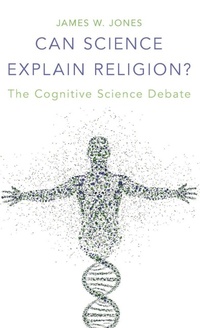
Can Science Explain Religion?
The Cognitive Science Debate
Published on 7. January 2016
Book
Hardback
248 pages
978-0-19-024938-0 (ISBN)
Description
The "New Atheist" movement of recent years has put the science-versus-religion controversy back on the popular cultural agenda. Anti-religious polemicists are convinced that the application of the new sciences of the mind to religious belief gives them the final weapons in their battle against irrationality and superstition. What used to be a trickle of research papers scattered in specialized scientific journals has now become a torrent of books, articles, and commentary in the popular media pressing the case that the cognitive science of religion can finally fulfill the enlightenment dream of shrinking religion into insignificance, if not eliminating it altogether. James Jones argues that these claims are demonstrably false. He notes that cognitive science research is religiously neutral; it can be deployed in many different ways in relation to the actual belief in and practice of religion: to undermine it, to simply study it, and to support it. These differences are differences in interpretation of the data and, Jones suggests, a reflection of the background assumptions and viewpoints brought to the data.
The goal of this book is not to defend either a general religious outlook or a particular religious tradition but to make the case that while there is much to learn from the cognitive scientific study of religion, attempts to use it to "explain" religion are exaggerated and misguided. Drawing on scientific research and logical argument Can Science Explain Religion? directly confronts the claims of these debunkers of religion, providing an accessibly written, persuasive account of why they are not convincing.
The goal of this book is not to defend either a general religious outlook or a particular religious tradition but to make the case that while there is much to learn from the cognitive scientific study of religion, attempts to use it to "explain" religion are exaggerated and misguided. Drawing on scientific research and logical argument Can Science Explain Religion? directly confronts the claims of these debunkers of religion, providing an accessibly written, persuasive account of why they are not convincing.
Reviews / Votes
[T]his volume will be useful to students and scholars alike interested in deepening their engagement with the field of cognitive approaches to religion and will be a useful addition to course or module materials for students studying in this area. * Paul-Francois Tremlett, Religion * certainly deserves the attention of the general public, and offers a welcome antidote to the misrepresentations of cognitive science of religion * Tom Uytterhoeven, ESSSAT *More details
Language
English
Place of publication
New York
United States
Dimensions
Height: 222 mm
Width: 145 mm
Thickness: 18 mm
Weight
488 gr
ISBN-13
978-0-19-024938-0 (9780190249380)
Copyright in bibliographic data and cover images is held by Nielsen Book Services Limited or by the publishers or by their respective licensors: all rights reserved.
Schweitzer Classification
Other editions
Additional editions
E-Book
09/2015
1st Edition
OUP eBook
€14.49
Available for download
E-Book
09/2015
1st Edition
OUP eBook
€18.49
Available for download
Person
James W. Jones is Distinguished Professor of Religion at Rutgers University. He is the author of fifteen books and numerous professional papers, and the editor several of several volumes of collected papers dealing with Religion, Psychology, and Science. He serves on the editorial boards of several publications. He is an ordained priest in the Episcopal Church USA and has maintained a private practice of clinical psychology, specializing in psychophysiology and behavioral medicine.
Content
Acknowledgements ; Introduction: A Voice from the Border of Religion and Science ; Chapter One: Explanations -How Science Seeks to Explain Religion ; Chapter Two: Explaining-What does it Mean to Explain Religion? ; Chapter Three: Physicalism-Is a Purely Physicalist Account Compelling? ; Chapter Four: Beyond Physicalism-Mind and Nature ; Chapter Five: Our Pluralistic Universe - Living on the Border of Science and Religion ; Appendix: Sources, References, and Further Discussions ; Bibliography of Sources Used In Preparing the Text