

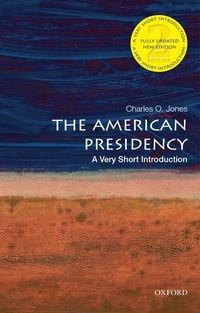
The American Presidency
A Very Short Introduction
2nd Edition
Published on 23. June 2016
Book
Paperback/Softback
208 pages
978-0-19-045820-1 (ISBN)
Description
The American founding fathers were dedicated to the project of creating a government both functional and incapable of devolving into tyranny. To do this, they intentionally decentralized decision making among the legislative, executive, and judiciary branches. They believed this separation of powers would force compromise and achieve their goal of "separating to unify." In the second edition of this Very Short Introduction, Charles O. Jones delves into the constitutional roots of the American presidency to show how presidents faced the challenges of governing within a system of separation of powers.
This updated edition of The American Presidency reviews crucial themes, including democratization of presidential elections, transitioning into and organizing a presidency, challenges in leading the permanent government, making law and policy, and reforming and changing the institution. It also introduces new case studies from the Obama administration, providing compelling insights into contemporary critical issues such as military power, the role of the First Lady, and the new trends in electoral campaigning-including the stunning advances in mass media and campaign technology.
Jones lucidly shows that American presidents are not, and simply cannot be, as powerful as most Americans believe them to be. Accordingly, he stresses the necessity to acknowledge the president's political status and style within the constitutional structure: the president is not the presidency, and the presidency is not the government.
This updated edition of The American Presidency reviews crucial themes, including democratization of presidential elections, transitioning into and organizing a presidency, challenges in leading the permanent government, making law and policy, and reforming and changing the institution. It also introduces new case studies from the Obama administration, providing compelling insights into contemporary critical issues such as military power, the role of the First Lady, and the new trends in electoral campaigning-including the stunning advances in mass media and campaign technology.
Jones lucidly shows that American presidents are not, and simply cannot be, as powerful as most Americans believe them to be. Accordingly, he stresses the necessity to acknowledge the president's political status and style within the constitutional structure: the president is not the presidency, and the presidency is not the government.
Reviews / Votes
"Jones has a section called "Learning to be president" that offers good advice." - Ray Smock, Director of the Robert C. Byrd Center for Congressional History and EducationMore details
Series
Edition
2nd Revised edition
Language
English
Place of publication
New York
United States
Edition type
Revised edition
Illustrations
14
Dimensions
Height: 175 mm
Width: 111 mm
Thickness: 12 mm
Weight
159 gr
ISBN-13
978-0-19-045820-1 (9780190458201)
Copyright in bibliographic data and cover images is held by Nielsen Book Services Limited or by the publishers or by their respective licensors: all rights reserved.
Schweitzer Classification
Other editions
Additional editions
E-Book
06/2016
2nd Edition
OUP eBook
€5.49
Available for download
E-Book
06/2016
2nd Edition
OUP eBook
€5.49
Available for download
Book
08/2007
Oxford University Press Inc
€9.91
Article exhausted; check different version
Person
Charles O. Jones is Emeritus Professor of Political Science at the University of Wisconsin-Madison and Non-Resident Senior Fellow at the Miller Center of Public Affairs, University of Virginia. He served as editor of the American Political Science Review and president of the American Political Science Association. He has written many books on various aspects of the American Presidency.
Content
Preface ; 1. Inventing the Presidency ; 2. The Presidency Finds Its Place ; 3. Electing Presidents (and Other Ways to Occupy the Oval Office) ; 4. Making and Remaking a Presidency ; 5. Connecting to and Leading the Government ; 6. Presidents at Work: Making Law and Doing Policy ; 7. Reform, Change, and Prospects for the Future ; Appendix: Presidents and Vice Presidents of the United States of America ; References ; Index