

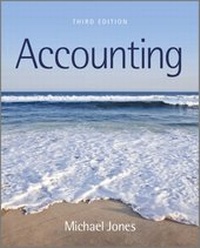
Accounting
3rd Edition
Published on 5. April 2013
Book
Paperback/Softback
764 pages
978-1-119-97718-6 (ISBN)
Description
We asked over 5000 accounting lecturers what would help them teach and students learn?
The results were:
Help with student engagement and varying levels of ability;
Real world examples to be used in class;
Content to break up lectures and engage students.
Accounting 3e has been developed to incorporate these elements and much more!
Accounting 3e provides a very accessible and easy-to-follow introduction and is aimed at students studying accounting for the first time. The book introduces concepts in an engaging and easy-to-follow manner, and examples are tried and tested with many graded questions and answers.
The third edition is updated to reflect IFRS terminologies and format including the reorganisation of the UK standards committee in July 2012. Double entry bookkeeping is included, however, this can be bypassed for students not requiring this.
More details
Other editions
Previous edition
Person
Michael Jones is Professor of Financial Reporting and Director of the Financial Reporting and Business Communication Unit at the University of Bristol, and also author of Financial Accounting, Management Accounting, and Creative Accounting, Fraud, and International Accounting Scandals, also published by John Wiley & Sons, Ltd.
Content
Section A: Financial Accounting: The Techniques.
1 Introduction to Accounting.
2 The Accounting Background.
3 Recording: Double-Entry Bookkeeping.
4 Main Financial Statements: The Profit and Loss Account (Income Statement).
5 Main Financial Statements: The Balance Sheet.
6 Preparing the Financial Statements.
7 Partnerships and Limited Companies.
8 Main Financial Statements: The Cash Flow Statement.
9 Interpretation of Accounts.
10 The Management of Working Capital and Sources of Finance.
Section B: Financial Accounting: The Context.
11 Regulatory and Conceptual Frameworks.
12 Measurement Systems.
13 The Annual Report.
14 Creative Accounting.
15 International Accounting.
Section C: Management Accounting
16 Introduction to Management Accounting
17 Costing
18 Planning, Control and Performance: Budgeting
19 Planning, Control and Performance: Standard Costing
20 Short-Term Decision Making
21 Strategic Management Accounting
22 Long-Term Decision Making: Capital Investment Appraisal
23 The Management of Working Capital and Sources of Finance