

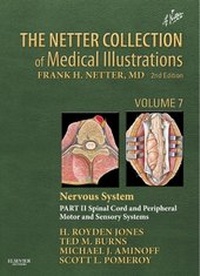
The Netter Collection of Medical Illustrations: Nervous System, Volume 7, Part II - Spinal Cord and Peripheral Motor and Sensory Systems
Part II - Neurologic and Neuromuscular Disorders
2nd Edition
Published on 11. March 2013
Book
Hardback
312 pages
978-1-4160-6386-5 (ISBN)
Description
Spinal Cord and Peripheral Motor and Sensory Systems, Part 2 of The Netter Collection of Medical Illustrations: Nervous System, 2nd Edition, provides a highly visual overview of the anatomy, pathology, and major clinical syndromes of the nervous system, from cranial nerves and neuro-ophthalmology to spinal cord, neuropathies, autonomic nervous system, pain physiology, and neuromuscular disorders. This spectacularly illustrated volume in the masterwork known as the (CIBA) Netter "Green Books" has been expanded and revised by Drs. H. Royden Jones, Jr., Ted M. Burns, Michael J. Aminoff, Scott L. Pomeroy to mirror the many exciting advances in neurologic medicine - offering rich insights into neuroanatomy, neurophysiology, molecular biology, pathology, and various clinical presentations.
"Netter's has always set the Rolls-Royce standard in understanding of clinical anatomy and pathophysiology of disease process, particularly of nervous system. Over 290 pages and with the use of sharp, concise text, illustrations and correlation with up to date imaging techniques, including spinal cord and cranial and peripheral nerve disorders. It is well worth a read." Reviewed by: Dr Manesh Bhojak, Consultant Neuroradiologist, Liverpool Date: July 2014
Get complete, integrated visual guidance on the cranial nerves, spinal cord and peripheral motor and sensory systems with thorough, richly illustrated coverage.
Quickly understand complex topics thanks to a concise text-atlas format that provides a context bridge between primary and specialized medicine.
Clearly visualize how core concepts of anatomy, physiology, and other basic sciences correlate across disciplines.
Benefit from matchless Netter illustrations that offer precision, clarity, detail and realism as they provide a visual approach to the clinical presentation and care of the patient.
Gain a rich clinical view of all aspects of the cranial nerves, spinal cord and peripheral motor sensory systems in one comprehensive volume, conveyed through beautiful illustrations as well as up-to-date neuro-radiologic images.
Clearly see the connection between basic science and clinical practice with an integrated overview of normal structure and function as it relates to neuro-pathologic conditions.
Grasp current clinical concepts regarding the many aspects of adult and child neurologic medicine captured in classic Netter illustrations, as well as new illustrations created specifically for this volume by artist-physician Carlos Machado, MD, and others working in the Netter style.
"Netter's has always set the Rolls-Royce standard in understanding of clinical anatomy and pathophysiology of disease process, particularly of nervous system. Over 290 pages and with the use of sharp, concise text, illustrations and correlation with up to date imaging techniques, including spinal cord and cranial and peripheral nerve disorders. It is well worth a read." Reviewed by: Dr Manesh Bhojak, Consultant Neuroradiologist, Liverpool Date: July 2014
Get complete, integrated visual guidance on the cranial nerves, spinal cord and peripheral motor and sensory systems with thorough, richly illustrated coverage.
Quickly understand complex topics thanks to a concise text-atlas format that provides a context bridge between primary and specialized medicine.
Clearly visualize how core concepts of anatomy, physiology, and other basic sciences correlate across disciplines.
Benefit from matchless Netter illustrations that offer precision, clarity, detail and realism as they provide a visual approach to the clinical presentation and care of the patient.
Gain a rich clinical view of all aspects of the cranial nerves, spinal cord and peripheral motor sensory systems in one comprehensive volume, conveyed through beautiful illustrations as well as up-to-date neuro-radiologic images.
Clearly see the connection between basic science and clinical practice with an integrated overview of normal structure and function as it relates to neuro-pathologic conditions.
Grasp current clinical concepts regarding the many aspects of adult and child neurologic medicine captured in classic Netter illustrations, as well as new illustrations created specifically for this volume by artist-physician Carlos Machado, MD, and others working in the Netter style.
Reviews / Votes
"Netter's has always set the Rolls-Royce standard in understanding of clinical anatomy and pathophysiology of disease process, particularly of nervous system. Over 290 pages and with the use of sharp, concise text, illustrations and correlation with up to date imaging techniques, including spinal cord and cranial and peripheral nerve disorders. It is well worth a read." Reviewed by: Dr Manesh Bhojak, Consultant Neuroradiologist, Liverpool Date: July 2014More details
Series
Edition
2nd edition
Language
English
Place of publication
London
United Kingdom
Publishing group
Elsevier Health Sciences
Target group
College/higher education
Illustrations
Approx. 300 illustrations (300 in full color)
Weight
1470 gr
ISBN-13
978-1-4160-6386-5 (9781416063865)
Copyright in bibliographic data and cover images is held by Nielsen Book Services Limited or by the publishers or by their respective licensors: all rights reserved.
Schweitzer Classification
Other editions
New editions
Michael J. Aminoff | Scott Pomeroy | Kerry H. Levin
The Netter Collection of Medical Illustrations: Nervous System, Volume 7, Part II - Spinal Cord and Peripheral Motor and Sensory Systems
Book
05/2024
3rd Edition
Elsevier
€101.50
Shipment within 10-15 days
Additional editions
H. Royden Jones Jr. | Ted Burns MD | DSc Aminoff MD
The Netter Collection of Medical Illustrations: Nervous System, Volume 7, Part II - Spinal Cord and Peripheral Motor and Sensory Systems
E-Book
06/2013
2nd Edition
Saunders
€64.99
Available for download
Previous edition

Frank H. Netter | Michael J. Aminoff | Scott Pomeroy
The Netter Collection of Medical Illustrations: Neurologic and Neuromuscular Disorders Pt. 2
Nervous System
Book
01/1987
Icon Learning Systems
€97.98
Article exhausted; check for reprint
Persons
Dr. H. Royden Jones was Chair of the Department of Neurology at Lahey Hospital and Medical Center, Burlington, Massachusetts; Director of the Electromyography Laboratory at Boston Children's Hospital; and Clinical Professor of Neurology at Harvard Medical School. Dr. Jones completed residencies in Internal Medicine and Neurology and a fellowship in neurological physiology at the Mayo Clinic. He served over 3 years in the United States Army as Chief of Neurology at 5th General Hospital, Bad Cannstatt, Germany. Dr. Jones was Board certified in neurology, clinical neurophysiology, and neuromuscular medicine. Upon completion of his training he joined the Lahey Clinic in 1972. In 1977 he also joined the neurology department at Boston Children's Hospital, founding the electromyography laboratory in 1979. Pediatric EMG became his major clinical research interest. Dr. Jones was co-editor of three major textbooks on childhood clinical neurophysiology and neuromuscular disorders. He was a co-founder of the biennial International Paediatric EMG Conference based at Great Ormond Street Children's Hospital, London, England. Recognized as one of the top neurologists in the U.S., Dr. Jones was an author and editor of several Netter publications including two editions of Netter's Neurology, The Netter Collection of Medical Illustrations: Nervous System, Volume 7, Part I (Brain) and Part II (Spinal Cord and Peripheral Motor and Sensory Systems), 2nd Editions (volumes in the Netter Green Book Collection). Dr. Jones authored and edited several other Netter publications and contributed over 200 peer-reviewed papers and book chapters. Dr. Jones served 8 years as a director of the American Board of Psychiatry and Neurology, becoming Chair of its Neurology Council in 2004. In 2007 he received the Distinguished Physician Award from the American Association of Neuromuscular and Electrodiagnostic Medicine. Lahey Clinic's Medical Staff Association recognized Dr. Jones in 2010 with its highest honor-the Frank Lahey Award for "commitment to the values of Dr. Frank Lahey: respect, teamwork, excellence, commitment to personal best.? Dr. Jones was named Outstanding Teacher in Pediatric Neurology 2012 - 2013 by the Department of Neurology, Boston Children's Hospital, Harvard Medical School. He also received an award in recognition of his many years of dedicated teaching at Tufts University School of Medicine. Dr. Michael J. Aminoff, Distinguished Professor Emeritus in neurology at the University of California San Francisco, is an internationally recognized neurologist, clinical investigator, and author. His published contributions led to the award of a Doctor of Science degree by the University of London in 2000. He is one of the two editors-in-chief of the four-volume Encyclopedia of the Neurological Sciences (2003; 2014) as well as one of the series editors of the multivolume Handbook of Clinical Neurology. He was editor-in-chief of the journal Muscle & Nerve from 1998 to 2007 and has served on numerous other editorial boards. He was a director of the American Board of Psychiatry and Neurology for eight years and served as board chair in 2011. In 2006, he received the Lifetime Achievement Award from the American Association of Neuromuscular & Electrodiagnostic Medicine and, in 2007, the A.B. Baker Award for Lifetime Achievement in Neurological Education from the American Academy of Neurology. In 2019 he received the Robert S. Schwab Award for outstanding contributions to research in peripheral clinical neurophysiology from the American Clinical Neurophysiology Society. Scott L. Pomeroy is an internationally known expert on the biological origins, treatment and long-term outcomes of childhood brain tumors. He has served as the Chair of the Department of Neurology and Neurologist-in-Chief of Boston Children's Hospital since 2005. Dr. Pomeroy graduated summa cum laude and Phi Beta Kappa from Miami University in 1975 and in 1982 was the first graduate of the M.D., Ph.D. program of the University of Cincinnati. He trained in pediatrics at Boston Children's Hospital/Harvard Medical School and in child neurology at St. Louis Children's Hospital/Washington University of St. Louis. In 1989, he won the Child Neurology Society Young Investigator Award for work done as a postdoctoral fellow of Dale Purves. The Pomeroy lab focuses on understanding the molecular and cellular basis of medulloblastomas and other embryonal brain tumors. Dr. Pomeroy has served as an ad hoc and chartered member of many NIH study sections, as co-Editor of Neurology in Clinical Practice and Associate Editor of Annals of Neurology, as President of the Child Neurology Foundation and as a member of the Dana Alliance for Brain Initiatives. He has received numerous awards including the Sidney Carter Award of the American Academy of Neurology, the Daniel Drake Medal of the University of Cincinnati, the inaugural Compassionate Caregiver Award of the Kenneth Schwartz Center, and the Bernard Sachs Award of the Child Neurology Society. In 2017, he was elected a member of the U.S. National Academy of Medicine.
Author
Children's Hospital, Boston, MA, USA
Professor of Neurology, University of Virginia, Charlottesville, Virginia
Distinguished Professor Emeritus in Neurology; University of California San Francisco, USA
Bronson Crothers Professor, Department of Neurology, Harvard Medical School; Consultant, Pediatric Oncology, Dana-Farber Cancer Institute; Neurologist-in-Chief, Department of Neurology, Boston Children's Hospital, Boston, Massachusetts, USA
Content
SECTION 1-CRANIAL NERVE AND
NEURO-OPHTHALMOLOGIC DISORDERS
OVERVIEW OF CRANIAL NERVES
1-1 Distribution of Motor and Sensory
Fibers, 2
1-2 Nerves and Nuclei Viewed in Phantom
from Behind, 4
1-3 Nerves and Nuclei in Lateral Dissection, 5
OLFACTORY (I) NERVE
1-4 Olfactory Pathways, 6
1-5 Olfactory Receptors, 7
1-6 Olfactory Bulb and Nerve, 8
OPTIC (II) NERVE
1-7 Eye, 9
1-8 Visual Pathways, 10
1-9 Optic Nerve Appearance, 11
1-10 Retinal Projections to Thalamus,
Midbrain, and Brainstem, 12
1-11 Pupillary Light Reflex and the
Accommodation Reflex, 13
OCULOMOTOR (III), TROCHLEAR (IV),
AND ABDUCENS (VI) NERVES
1-12 Oculomotor (III), Trochlear (IV), and
Abducens (VI) Nerves, 14
1-13 Nerves of Orbit and Cavernous Sinus, 15
1-14 Control of Eye Movements, 16
1-15 Control of Eye
Movements-Pathology, 17
1-16 Control of Eye Movements-Pathology
(Continued), 18
1-17 Autonomic Innervation of the Eye, 19
TRIGEMINAL (V) NERVE
1-18 Trigeminal (V) Nerve, 20
1-19 Trigeminal Nuclei: Afferent and Central
Connections, 21
1-20 Trigeminal Nuclei: Central and Peripheral
Connections, 22
1-21 Ophthalmic (V1) and Maxillary (V2)
Nerves, 23
1-22 Mandibular Nerve (V3), 24
1-23 Trigeminal Nerve Disorders, 25
FACIAL (VII) NERVE
1-24 Facial (VII) Nerve, 26
1-25 Muscles of Facial Expression: Lateral
View, 27
1-26 Central Versus Peripheral Facial
Paralysis, 28
1-27 Facial Palsy, 29
TASTE RECEPTORS AND PATHWAYS
1-28 Anatomy of Taste Buds and Their
Receptors, 30
1-29 Tongue, 31
VESTIBULOCOCHLEAR (VIII) NERVE
1-30 Vestibulocochlear (VIII) Nerve, 32
1-31 Pathway of Sound Reception, 33
1-32 Pathologic Causes of Vertigo, 34
1-33 Canalith Repositioning (Epley
Maneuver), 35
1-34 Afferent Auditory Pathways, 36
1-35 Centrifugal Auditory Pathways, 37
1-36 Vestibular Receptors, 38
1-37 Cochlear Receptors, 39
GLOSSOPHARYNGEAL (IX) NERVE
1-38 Glossopharyngeal (IX) Nerve, 40
1-39 Otic Ganglion, 41
VAGUS (X) NERVE
1-40 Vagus (X) Nerve, 42
1-41 Vagus Nerve Branches and
Disorders, 43
ACCESSORY (XI) NERVE
1-42 Accessory (XI) Nerve, 44
1-43 Clinical Findings in Cranial Nerve XI
Damage, 45
HYPOGLOSSAL (XII) NERVE
1-44 Hypoglossal (XII) Nerve, 46
1-45 Intramedullary Course, 47
1-46 Disorders of Hypoglossal Nucleus and
Nerve, 48
SECTION 2-SPINAL CORD: ANATOMY
AND MYELOPATHIES
2-1 Spinal Cord, 50
2-2 Spinal Membranes and Nerve
Roots, 51
2-3 Arteries of Spinal Cord, 52
2-4 Arteries of Spinal Cord: Intrinsic
Distribution, 53
2-5 Veins of Spinal Cord, Nerve Roots, and
Vertebrae, 54
2-6 Principal Fiber Tracts of Spinal
Cord, 55
2-7 Somesthetic System of Body, 56
2-8 Corticospinal (Pyramidal) System: Motor
Component, 57
2-9 Rubrospinal Tract, 58
2-10 Vestibulospinal Tracts, 59
2-11 Reticulospinal and Corticoreticular
Pathways, 60
2-12 Spinal Origin or Termination of Major
Descending Tracts and Ascending
Pathways, 61
2-13 Cytoarchitecture of Spinal Cord Gray
Matter, 62
2-14 Spinal Effector Mechanisms, 63
2-15 Spinal Reflex Pathways, 64
2-16 Motor Impairment Related to Level of
Spinal Cord Injury, 65
2-17 Sensory Impairment Related to Level of
Spinal Cord Injury, 66
2-18 Incomplete Spinal Cord Syndromes, 67
2-19 Acute Spinal Cord Syndromes: Evolution
of Symptoms, 68
2-20 Acute Spinal Cord Syndromes: Pathology,
Etiology, and Diagnosis, 69
2-21 Spinal Tumors, 70
2-22 Spinal Tumors (Continued), 71
2-23 Neuroimaging (MRI) Characteristics of
Spinal Tumors, 72
2-24 Syringomyelia, 73
2-25 Subacute Combined Degeneration, 74
2-26 Spinal Dural Fistulas and Arteriovenous
Malformations, 75
2-27 Cervical Spondylosis, 76
2-28 Cervical Disk Herniation Causing Cord
Compression, 77
2-29 Infectious and Hereditary
Myelopathies, 78
SECTION 3-SPINAL TRAUMA
3-1 Spinal Column, 80
3-2 Atlas and Axis, 81
3-3 Cervical Vertebrae, 82
3-4 External Craniocervical Ligaments, 83
3-5 Internal Craniocervical Ligaments, 84
3-6 Thoracic Vertebrae, 85
3-7 Lumbar Vertebrae and Intervertebral
Disk, 86
3-8 Ligaments of Spinal Column, 87
3-9 Sacrum and Coccyx, 88
3-10 Ligaments of Sacrum and Coccyx, 89
3-11 Distractive Flexion, 90
3-12 Compressive Flexion, 91
3-13 Distractive Extension, 92
3-14 Cervical Spine Injury: Prehospital,
Emergency Room, and Acute
Management, 93
3-15 Traction and Bracing, 94
3-16 Anterior Cervical Spine Decompression
and Stabilization, 95
3-17 Posterior Cervical Stabilization and
Fusion, 96
3-18 Spinal Cord Injury Medical Issues, 97
SECTION 4-NERVE ROOTS AND
PLEXUS DISORDERS
4-1 Cervical Disk Herniation, 100
4-2 Radiographic Diagnosis of
Radiculopathy, 101
4-3 Examination of Patient with Low Back
Pain, 102
4-4 Lumbar Disk Herniation: Clinical
Manifestations, 103
4-5 L4-5 Disk Extrusion, 104
4-6 Lumbosacral Spinal Stenosis, 105
4-7 Spinal Nerves, 106
4-8 Dermal Segmentation, 107
4-9 Thoracic Nerves, 108
4-10 Thoracic Spinal Nerve Root
Disorders, 109
4-11 Diabetic Lumbosacral Radiculoplexus
Neuropathy, 110
4-12 Lumbar, Sacral, and Coccygeal
Plexuses, 111
4-13 Brachial Plexus, 112
4-14 Brachial Plexus and/or Cervical Nerve
Root Injuries at Birth, 113
4-15 Brachial Plexopathy, 114
4-16 Lumbosacral Plexopathy, 115
4-17 Cervical Plexus, 116
SECTION 5-MONONEUROPATHIES
5-1 Compression Neuropathies, 118
5-2 Chronic Nerve Compression, 119
5-3 Electrodiagnostic Studies in Compression
Neuropathy, 120
5-4 Radiologic Studies in Compression
Neuropathy, 121
5-5 Proximal Nerves of the Upper Extremity:
Spinal Accessory Nerve, 122
5-6 Proximal Nerves of the Upper Extremity:
Suprascapular and Musculocutaneous
Nerves, 123
5-7 Median Nerve, 124
5-8 Proximal Median Neuropathies, 125
5-9 Distal Median Nerve, 126
5-10 Distal Median Neuropathies: Carpal
Tunnel Syndrome, 127
5-11 Proximal Ulnar Nerve, 128
5-12 Ulnar Mononeuropathies: Potential
Entrapment Sites, 129
5-13 Radial Nerve, 130
5-14 Radial Nerve Compression/Entrapment
Neuropathies, 131
5-15 Femoral and Lateral Femoral Cutaneous
Nerves, 132
5-16 Iliohypogastric, Ilioinguinal,
Genitofemoral, and Obturator
Nerves, 133
5-17 Gluteal Nerves, 134
5-18 Sciatic and Posterior Femoral Cutaneous
Nerves, 135
5-19 Fibular (Peroneal) Nerve, 136
5-20 Tibial Nerve, 137
5-21 Cutaneous Innervation, 138
5-22 Dermatomes, 139
SECTION 6-PERIPHERAL NEUROPATHIES
6-1 Anatomy of Peripheral Nerve, 143
6-2 Histology of Peripheral Nerve, 144
6-3 Cell Types of Nervous System, 145
6-4 Resting Membrane Potential, 146
6-5 Ion Channel Mechanics and Action
Potential Generation, 147
6-6 Neurophysiology and Peripheral Nerve
Demyelination, 148
6-7 Impulse Propagation, 149
6-8 Conduction Velocity, 150
6-9 Visceral Efferent Endings, 151
6-10 Cutaneous Receptors, 152
6-11 Pacinian Corpuscle, 153
6-12 Muscle and Joint Receptors, 154
6-13 Proprioceptive Reflex Control of Muscle
Tension, 155
6-14 Hereditary Motor and Sensory
Neuropathies (HMSN, i.e., Charcot-Marie-
Tooth Disease), 156
6-15 Hereditary Motor and Sensory
Neuropathy Types I and II, 157
6-16 Other Hereditary Motor and Sensory
Neuropathies (Types III, IV, and X), 158
6-17 Hereditary Sensory and Autonomic
Neuropathy, 159
6-18 Guillain-Barre Syndrome, 160
6-19 Guillain-Barre Syndrome
(Continued), 161
6-20 Chronic Inflammatory Demyelinating
Polyradiculoneuropathy, 162
6-21 Diabetic Neuropathies, 163
6-22 Monoclonal Protein-Associated
Neuropathies: Amyloid Neuropathy, 164
6-23 Monoclonal Protein-Associated
Neuropathies: Distal Acquired
Demyelinating Symmetric (DADS)
Neuropathy, 165
6-24 Vasculitic Neuropathy and Other
Connective Tissue Disorders
Associated with Neuropathy:
Fibrinoid Necrosis, 166
6-25 Vasculitic Neuropathy and Other
Connective Tissue Disorders
Associated with Neuropathy:
Sjoegren Syndrome, 167
6-26 Immunopathogenesis of Guillain-Barre
Syndrome, 168
6-27 Peripheral Neuropathy Cause by Heavy
Metal Poisoning, 169
6-28 Metabolic, Toxic, and Nutritional
Peripheral Neuropathies, 170
6-29 Leprosy and Other Infections Sometimes
Causing Peripheral Neuropathies, 171
SECTION 7-AUTONOMIC NERVOUS
SYSTEM AND ITS DISORDERS
7-1 General Topography of Autonomic
Nervous System, 174
7-2 General Topography of Autonomic
Nervous System (Continued), 175
7-3 Autonomic Reflex Pathways, 176
7-4 Cholinergic and Adrenergic Nerves, 177
7-5 Autonomic Nerves in Head, 178
7-6 Autonomic Nerves in Neck, 179
7-7 Autonomic Distribution to the Head and
the Neck, 180
7-8 Ciliary Ganglion, 181
7-9 Thoracic Sympathetic Chain and
Splanchnic Nerves, 182
7-10 Innervation of Heart, 183
7-11 Innervation of Blood Vessels, 184
7-12 Carotid Body and Carotid Sinus, 185
7-13 Autonomic Nerves and Ganglia in
Abdomen, 186
7-14 Innervation of Stomach and Proximal
Duodenum, 187
7-15 Innervation of Intestines, 188
7-16 Autonomic Innervation of Small
Intestine, 189
7-17 Enteric Plexuses, 190
7-18 Innervation of Liver and Biliary
Tract, 191
7-19 Innervation of Adrenal Glands, 192
7-20 Autonomic Nerves and Ganglia in
Pelvis, 193
7-21 Autonomic Innervation of Kidneys and
Upper Ureters, 194
7-22 Innervation of Urinary Bladder and Lower
Ureter, 195
7-23 Innervation of Male Reproductive
Organs, 196
7-24 Innervation of Female Reproductive
Organs, 197
7-25 Autonomic Testing, 198
7-26 Abnormal Pupillary Conditions, 199
7-27 Clinical Presentation of Autonomic
Disorders, 200
SECTION 8-PAIN
8-1 Somatosensory System, 202
8-2 Somatosensory Afferents and Principal
Fiber Tracts, 203
8-3 Pain Pathways, 204
8-4 Endorphin System, 205
8-5 Spinothalamic and Spinoreticular
Nociceptive Processing in the Spinal
Cord, 206
8-6 Central Nervous System
Neurotransmitters, Receptors, and Drug
Targets, 207
8-7 Thalamic Pain Syndrome, 208
8-8 Clinical Manifestations Related to
Thalamus Site in Intracerebral
Hemorrhage, 209
8-9 Complex Regional Pain, 210
8-10 Herpes Zoster, 211
8-11 Occipital Neuralgia, 212
8-12 Myofascial Factors in Low Back
Pain, 213
8-13 Myofascial Factors in Low Back Pain
(Continued): Posterior Abdominal Wall:
Internal View, 214
8-14 Lumbar Zygapophyseal Joint Back
Pain, 215
8-15 Low Back Pain and Effects of Lumbar
Hyperlordosis and Flexion on Spinal
Nerves, 216
8-16 Examination of the Low Back Pain
Patient, 217
8-17 Osteoporosis, 218
8-18 Diagnosis of Hip, Buttock, and Back
Pain, 219
8-19 Hip Joint Involvement in
Osteoarthritis, 220
8-20 Peripheral Nerves of Feet, Painful
Peripheral Neuropathies, 221
8-21 Peripheral Neuropathies: Clinical
Manifestations, 222
8-22 Neurologic Evaluation of the Somatoform
Patient: Cutaneous Distribution of
Peripheral Nerves, 223
8-23 Neurologic Evaluation of the Somatoform
Patient: Somatoform Conversion
Reactions, 224
SECTION 9-FLOPPY INFANT
9-1 Neonatal Hypotonia, 226
9-2 Spinal Muscular Atrophy Type I (Werdnig-
Hoffmann Disease), 227
9-3 Infantile Neuromuscular Junction (NMJ)
Disorders, 228
9-4 Congenital Myopathies, 229
9-5 Arthrogryposis Multiplex Congenita, 230
SECTION 10-MOTOR NEURON AND
ITS DISORDERS
10-1 Peripheral Nervous System:
Overview, 232
10-2 Spinal Cord and Neuronal Cell Body with
Motor, Sensory, and Autonomic
Components of the Peripheral
Nerve, 233
10-3 Motor Unit, 234
10-4 Motor Unit Potentials, 235
10-5 Primary Motor Neuron Disease, 236
10-6 Clinical Manifestations of Amyotrophic
Lateral Sclerosis, 237
10-7 Clinical Manifestations of Amyotrophic
Lateral Sclerosis (Continued), 238
10-8 Mimics of Amyotrophic Lateral
Sclerosis, 239
10-9 Diagnosis of Amyotrophic Lateral
Sclerosis, 240
10-10 Treatment of Amyotrophic Lateral
Sclerosis, 241
10-11 Spinal Muscular Atrophy and Spinal
Bulbar Muscular Atrophy, 242
SECTION 11-NEUROMUSCULAR
JUNCTION AND ITS DISORDERS
11-1 Structure of Neuromuscular
Junction, 244
11-2 Physiology of Neuromuscular
Junction, 245
11-3 Somatic Neuromuscular
Transmission, 246
11-4 Pharmacology of Neuromuscular
Transmission, 247
11-5 Repetitive Motor Nerve Stimulation, 248
11-6 Myasthenia Gravis: Clinical
Manifestations, 249
11-7 Myasthenia Gravis: Etiologic and
Pathophysiologic Concepts, 250
11-8 Immunopathology of Myasthenia
Gravis, 251
11-9 Presynaptic Neuromuscular Junction
Transmission Disorders: Lambert-Eaton
Myasthenic Syndrome and Infantile
Botulism, 252
11-10 Congenital Myasthenic Syndromes, 253
11-11 Foodborne Neurotoxins, 254
SECTION 12-MUSCLE AND
ITS DISORDERS
12-1 Muscle Fiber Anatomy: Basic Sarcomere
Subdivisions, 256
12-2 Muscle Fiber Anatomy: Biochemical
Mechanics of Contraction, 257
12-3 Muscle Membrane, T Tubules, and
Sarcoplasmic Reticulum, 258
12-4 Muscle Response to Nerve
Stimulation, 259
12-5 Metabolism of Muscle Cell, 260
12-6 Muscle Fiber Types, 261
12-7 Overview of Myopathies: Clinical
Approach, 262
12-8 Dystrophinopathies: Duchenne
Muscular Dystrophy-Gower's
Maneuver, 264
12-9 Dystrophinopathies: Duchenne Muscular
Dystrophy, 265
12-10 Dystrophinopathies: Molecular Genetic
Testing, 266
12-11 Myotonic Dystrophy and Other Myotonic
Disorders, 267
12-12 Myotonic Dystrophy and Other Myotonic
Disorders (Continued), 268
12-13 Other Types of Muscular Dystrophy, 269
12-14 Polymyositis and Dermatomyositis, 270
12-15 Polymyositis and Dermatomyositis
(Continued), 271
12-16 Inclusion Body Myositis, 272
12-17 Immunopathology for Inflammatory
Myopathies, 273
12-18 Endocrine, Toxic, and Critical Illness
Myopathies, 274
12-19 Myopathies: Hypokalemia/Hyperkalemia
and the Periodic Paralyses
Channelopathies Myopathies Associated
with Disorders of Potassium
Metabolism, 275
12-20 Metabolic and Mitochondrial
Myopathies, 276
12-21 Myoglobinuric Syndromes Including
Malignant Hyperthermia, 277
NEURO-OPHTHALMOLOGIC DISORDERS
OVERVIEW OF CRANIAL NERVES
1-1 Distribution of Motor and Sensory
Fibers, 2
1-2 Nerves and Nuclei Viewed in Phantom
from Behind, 4
1-3 Nerves and Nuclei in Lateral Dissection, 5
OLFACTORY (I) NERVE
1-4 Olfactory Pathways, 6
1-5 Olfactory Receptors, 7
1-6 Olfactory Bulb and Nerve, 8
OPTIC (II) NERVE
1-7 Eye, 9
1-8 Visual Pathways, 10
1-9 Optic Nerve Appearance, 11
1-10 Retinal Projections to Thalamus,
Midbrain, and Brainstem, 12
1-11 Pupillary Light Reflex and the
Accommodation Reflex, 13
OCULOMOTOR (III), TROCHLEAR (IV),
AND ABDUCENS (VI) NERVES
1-12 Oculomotor (III), Trochlear (IV), and
Abducens (VI) Nerves, 14
1-13 Nerves of Orbit and Cavernous Sinus, 15
1-14 Control of Eye Movements, 16
1-15 Control of Eye
Movements-Pathology, 17
1-16 Control of Eye Movements-Pathology
(Continued), 18
1-17 Autonomic Innervation of the Eye, 19
TRIGEMINAL (V) NERVE
1-18 Trigeminal (V) Nerve, 20
1-19 Trigeminal Nuclei: Afferent and Central
Connections, 21
1-20 Trigeminal Nuclei: Central and Peripheral
Connections, 22
1-21 Ophthalmic (V1) and Maxillary (V2)
Nerves, 23
1-22 Mandibular Nerve (V3), 24
1-23 Trigeminal Nerve Disorders, 25
FACIAL (VII) NERVE
1-24 Facial (VII) Nerve, 26
1-25 Muscles of Facial Expression: Lateral
View, 27
1-26 Central Versus Peripheral Facial
Paralysis, 28
1-27 Facial Palsy, 29
TASTE RECEPTORS AND PATHWAYS
1-28 Anatomy of Taste Buds and Their
Receptors, 30
1-29 Tongue, 31
VESTIBULOCOCHLEAR (VIII) NERVE
1-30 Vestibulocochlear (VIII) Nerve, 32
1-31 Pathway of Sound Reception, 33
1-32 Pathologic Causes of Vertigo, 34
1-33 Canalith Repositioning (Epley
Maneuver), 35
1-34 Afferent Auditory Pathways, 36
1-35 Centrifugal Auditory Pathways, 37
1-36 Vestibular Receptors, 38
1-37 Cochlear Receptors, 39
GLOSSOPHARYNGEAL (IX) NERVE
1-38 Glossopharyngeal (IX) Nerve, 40
1-39 Otic Ganglion, 41
VAGUS (X) NERVE
1-40 Vagus (X) Nerve, 42
1-41 Vagus Nerve Branches and
Disorders, 43
ACCESSORY (XI) NERVE
1-42 Accessory (XI) Nerve, 44
1-43 Clinical Findings in Cranial Nerve XI
Damage, 45
HYPOGLOSSAL (XII) NERVE
1-44 Hypoglossal (XII) Nerve, 46
1-45 Intramedullary Course, 47
1-46 Disorders of Hypoglossal Nucleus and
Nerve, 48
SECTION 2-SPINAL CORD: ANATOMY
AND MYELOPATHIES
2-1 Spinal Cord, 50
2-2 Spinal Membranes and Nerve
Roots, 51
2-3 Arteries of Spinal Cord, 52
2-4 Arteries of Spinal Cord: Intrinsic
Distribution, 53
2-5 Veins of Spinal Cord, Nerve Roots, and
Vertebrae, 54
2-6 Principal Fiber Tracts of Spinal
Cord, 55
2-7 Somesthetic System of Body, 56
2-8 Corticospinal (Pyramidal) System: Motor
Component, 57
2-9 Rubrospinal Tract, 58
2-10 Vestibulospinal Tracts, 59
2-11 Reticulospinal and Corticoreticular
Pathways, 60
2-12 Spinal Origin or Termination of Major
Descending Tracts and Ascending
Pathways, 61
2-13 Cytoarchitecture of Spinal Cord Gray
Matter, 62
2-14 Spinal Effector Mechanisms, 63
2-15 Spinal Reflex Pathways, 64
2-16 Motor Impairment Related to Level of
Spinal Cord Injury, 65
2-17 Sensory Impairment Related to Level of
Spinal Cord Injury, 66
2-18 Incomplete Spinal Cord Syndromes, 67
2-19 Acute Spinal Cord Syndromes: Evolution
of Symptoms, 68
2-20 Acute Spinal Cord Syndromes: Pathology,
Etiology, and Diagnosis, 69
2-21 Spinal Tumors, 70
2-22 Spinal Tumors (Continued), 71
2-23 Neuroimaging (MRI) Characteristics of
Spinal Tumors, 72
2-24 Syringomyelia, 73
2-25 Subacute Combined Degeneration, 74
2-26 Spinal Dural Fistulas and Arteriovenous
Malformations, 75
2-27 Cervical Spondylosis, 76
2-28 Cervical Disk Herniation Causing Cord
Compression, 77
2-29 Infectious and Hereditary
Myelopathies, 78
SECTION 3-SPINAL TRAUMA
3-1 Spinal Column, 80
3-2 Atlas and Axis, 81
3-3 Cervical Vertebrae, 82
3-4 External Craniocervical Ligaments, 83
3-5 Internal Craniocervical Ligaments, 84
3-6 Thoracic Vertebrae, 85
3-7 Lumbar Vertebrae and Intervertebral
Disk, 86
3-8 Ligaments of Spinal Column, 87
3-9 Sacrum and Coccyx, 88
3-10 Ligaments of Sacrum and Coccyx, 89
3-11 Distractive Flexion, 90
3-12 Compressive Flexion, 91
3-13 Distractive Extension, 92
3-14 Cervical Spine Injury: Prehospital,
Emergency Room, and Acute
Management, 93
3-15 Traction and Bracing, 94
3-16 Anterior Cervical Spine Decompression
and Stabilization, 95
3-17 Posterior Cervical Stabilization and
Fusion, 96
3-18 Spinal Cord Injury Medical Issues, 97
SECTION 4-NERVE ROOTS AND
PLEXUS DISORDERS
4-1 Cervical Disk Herniation, 100
4-2 Radiographic Diagnosis of
Radiculopathy, 101
4-3 Examination of Patient with Low Back
Pain, 102
4-4 Lumbar Disk Herniation: Clinical
Manifestations, 103
4-5 L4-5 Disk Extrusion, 104
4-6 Lumbosacral Spinal Stenosis, 105
4-7 Spinal Nerves, 106
4-8 Dermal Segmentation, 107
4-9 Thoracic Nerves, 108
4-10 Thoracic Spinal Nerve Root
Disorders, 109
4-11 Diabetic Lumbosacral Radiculoplexus
Neuropathy, 110
4-12 Lumbar, Sacral, and Coccygeal
Plexuses, 111
4-13 Brachial Plexus, 112
4-14 Brachial Plexus and/or Cervical Nerve
Root Injuries at Birth, 113
4-15 Brachial Plexopathy, 114
4-16 Lumbosacral Plexopathy, 115
4-17 Cervical Plexus, 116
SECTION 5-MONONEUROPATHIES
5-1 Compression Neuropathies, 118
5-2 Chronic Nerve Compression, 119
5-3 Electrodiagnostic Studies in Compression
Neuropathy, 120
5-4 Radiologic Studies in Compression
Neuropathy, 121
5-5 Proximal Nerves of the Upper Extremity:
Spinal Accessory Nerve, 122
5-6 Proximal Nerves of the Upper Extremity:
Suprascapular and Musculocutaneous
Nerves, 123
5-7 Median Nerve, 124
5-8 Proximal Median Neuropathies, 125
5-9 Distal Median Nerve, 126
5-10 Distal Median Neuropathies: Carpal
Tunnel Syndrome, 127
5-11 Proximal Ulnar Nerve, 128
5-12 Ulnar Mononeuropathies: Potential
Entrapment Sites, 129
5-13 Radial Nerve, 130
5-14 Radial Nerve Compression/Entrapment
Neuropathies, 131
5-15 Femoral and Lateral Femoral Cutaneous
Nerves, 132
5-16 Iliohypogastric, Ilioinguinal,
Genitofemoral, and Obturator
Nerves, 133
5-17 Gluteal Nerves, 134
5-18 Sciatic and Posterior Femoral Cutaneous
Nerves, 135
5-19 Fibular (Peroneal) Nerve, 136
5-20 Tibial Nerve, 137
5-21 Cutaneous Innervation, 138
5-22 Dermatomes, 139
SECTION 6-PERIPHERAL NEUROPATHIES
6-1 Anatomy of Peripheral Nerve, 143
6-2 Histology of Peripheral Nerve, 144
6-3 Cell Types of Nervous System, 145
6-4 Resting Membrane Potential, 146
6-5 Ion Channel Mechanics and Action
Potential Generation, 147
6-6 Neurophysiology and Peripheral Nerve
Demyelination, 148
6-7 Impulse Propagation, 149
6-8 Conduction Velocity, 150
6-9 Visceral Efferent Endings, 151
6-10 Cutaneous Receptors, 152
6-11 Pacinian Corpuscle, 153
6-12 Muscle and Joint Receptors, 154
6-13 Proprioceptive Reflex Control of Muscle
Tension, 155
6-14 Hereditary Motor and Sensory
Neuropathies (HMSN, i.e., Charcot-Marie-
Tooth Disease), 156
6-15 Hereditary Motor and Sensory
Neuropathy Types I and II, 157
6-16 Other Hereditary Motor and Sensory
Neuropathies (Types III, IV, and X), 158
6-17 Hereditary Sensory and Autonomic
Neuropathy, 159
6-18 Guillain-Barre Syndrome, 160
6-19 Guillain-Barre Syndrome
(Continued), 161
6-20 Chronic Inflammatory Demyelinating
Polyradiculoneuropathy, 162
6-21 Diabetic Neuropathies, 163
6-22 Monoclonal Protein-Associated
Neuropathies: Amyloid Neuropathy, 164
6-23 Monoclonal Protein-Associated
Neuropathies: Distal Acquired
Demyelinating Symmetric (DADS)
Neuropathy, 165
6-24 Vasculitic Neuropathy and Other
Connective Tissue Disorders
Associated with Neuropathy:
Fibrinoid Necrosis, 166
6-25 Vasculitic Neuropathy and Other
Connective Tissue Disorders
Associated with Neuropathy:
Sjoegren Syndrome, 167
6-26 Immunopathogenesis of Guillain-Barre
Syndrome, 168
6-27 Peripheral Neuropathy Cause by Heavy
Metal Poisoning, 169
6-28 Metabolic, Toxic, and Nutritional
Peripheral Neuropathies, 170
6-29 Leprosy and Other Infections Sometimes
Causing Peripheral Neuropathies, 171
SECTION 7-AUTONOMIC NERVOUS
SYSTEM AND ITS DISORDERS
7-1 General Topography of Autonomic
Nervous System, 174
7-2 General Topography of Autonomic
Nervous System (Continued), 175
7-3 Autonomic Reflex Pathways, 176
7-4 Cholinergic and Adrenergic Nerves, 177
7-5 Autonomic Nerves in Head, 178
7-6 Autonomic Nerves in Neck, 179
7-7 Autonomic Distribution to the Head and
the Neck, 180
7-8 Ciliary Ganglion, 181
7-9 Thoracic Sympathetic Chain and
Splanchnic Nerves, 182
7-10 Innervation of Heart, 183
7-11 Innervation of Blood Vessels, 184
7-12 Carotid Body and Carotid Sinus, 185
7-13 Autonomic Nerves and Ganglia in
Abdomen, 186
7-14 Innervation of Stomach and Proximal
Duodenum, 187
7-15 Innervation of Intestines, 188
7-16 Autonomic Innervation of Small
Intestine, 189
7-17 Enteric Plexuses, 190
7-18 Innervation of Liver and Biliary
Tract, 191
7-19 Innervation of Adrenal Glands, 192
7-20 Autonomic Nerves and Ganglia in
Pelvis, 193
7-21 Autonomic Innervation of Kidneys and
Upper Ureters, 194
7-22 Innervation of Urinary Bladder and Lower
Ureter, 195
7-23 Innervation of Male Reproductive
Organs, 196
7-24 Innervation of Female Reproductive
Organs, 197
7-25 Autonomic Testing, 198
7-26 Abnormal Pupillary Conditions, 199
7-27 Clinical Presentation of Autonomic
Disorders, 200
SECTION 8-PAIN
8-1 Somatosensory System, 202
8-2 Somatosensory Afferents and Principal
Fiber Tracts, 203
8-3 Pain Pathways, 204
8-4 Endorphin System, 205
8-5 Spinothalamic and Spinoreticular
Nociceptive Processing in the Spinal
Cord, 206
8-6 Central Nervous System
Neurotransmitters, Receptors, and Drug
Targets, 207
8-7 Thalamic Pain Syndrome, 208
8-8 Clinical Manifestations Related to
Thalamus Site in Intracerebral
Hemorrhage, 209
8-9 Complex Regional Pain, 210
8-10 Herpes Zoster, 211
8-11 Occipital Neuralgia, 212
8-12 Myofascial Factors in Low Back
Pain, 213
8-13 Myofascial Factors in Low Back Pain
(Continued): Posterior Abdominal Wall:
Internal View, 214
8-14 Lumbar Zygapophyseal Joint Back
Pain, 215
8-15 Low Back Pain and Effects of Lumbar
Hyperlordosis and Flexion on Spinal
Nerves, 216
8-16 Examination of the Low Back Pain
Patient, 217
8-17 Osteoporosis, 218
8-18 Diagnosis of Hip, Buttock, and Back
Pain, 219
8-19 Hip Joint Involvement in
Osteoarthritis, 220
8-20 Peripheral Nerves of Feet, Painful
Peripheral Neuropathies, 221
8-21 Peripheral Neuropathies: Clinical
Manifestations, 222
8-22 Neurologic Evaluation of the Somatoform
Patient: Cutaneous Distribution of
Peripheral Nerves, 223
8-23 Neurologic Evaluation of the Somatoform
Patient: Somatoform Conversion
Reactions, 224
SECTION 9-FLOPPY INFANT
9-1 Neonatal Hypotonia, 226
9-2 Spinal Muscular Atrophy Type I (Werdnig-
Hoffmann Disease), 227
9-3 Infantile Neuromuscular Junction (NMJ)
Disorders, 228
9-4 Congenital Myopathies, 229
9-5 Arthrogryposis Multiplex Congenita, 230
SECTION 10-MOTOR NEURON AND
ITS DISORDERS
10-1 Peripheral Nervous System:
Overview, 232
10-2 Spinal Cord and Neuronal Cell Body with
Motor, Sensory, and Autonomic
Components of the Peripheral
Nerve, 233
10-3 Motor Unit, 234
10-4 Motor Unit Potentials, 235
10-5 Primary Motor Neuron Disease, 236
10-6 Clinical Manifestations of Amyotrophic
Lateral Sclerosis, 237
10-7 Clinical Manifestations of Amyotrophic
Lateral Sclerosis (Continued), 238
10-8 Mimics of Amyotrophic Lateral
Sclerosis, 239
10-9 Diagnosis of Amyotrophic Lateral
Sclerosis, 240
10-10 Treatment of Amyotrophic Lateral
Sclerosis, 241
10-11 Spinal Muscular Atrophy and Spinal
Bulbar Muscular Atrophy, 242
SECTION 11-NEUROMUSCULAR
JUNCTION AND ITS DISORDERS
11-1 Structure of Neuromuscular
Junction, 244
11-2 Physiology of Neuromuscular
Junction, 245
11-3 Somatic Neuromuscular
Transmission, 246
11-4 Pharmacology of Neuromuscular
Transmission, 247
11-5 Repetitive Motor Nerve Stimulation, 248
11-6 Myasthenia Gravis: Clinical
Manifestations, 249
11-7 Myasthenia Gravis: Etiologic and
Pathophysiologic Concepts, 250
11-8 Immunopathology of Myasthenia
Gravis, 251
11-9 Presynaptic Neuromuscular Junction
Transmission Disorders: Lambert-Eaton
Myasthenic Syndrome and Infantile
Botulism, 252
11-10 Congenital Myasthenic Syndromes, 253
11-11 Foodborne Neurotoxins, 254
SECTION 12-MUSCLE AND
ITS DISORDERS
12-1 Muscle Fiber Anatomy: Basic Sarcomere
Subdivisions, 256
12-2 Muscle Fiber Anatomy: Biochemical
Mechanics of Contraction, 257
12-3 Muscle Membrane, T Tubules, and
Sarcoplasmic Reticulum, 258
12-4 Muscle Response to Nerve
Stimulation, 259
12-5 Metabolism of Muscle Cell, 260
12-6 Muscle Fiber Types, 261
12-7 Overview of Myopathies: Clinical
Approach, 262
12-8 Dystrophinopathies: Duchenne
Muscular Dystrophy-Gower's
Maneuver, 264
12-9 Dystrophinopathies: Duchenne Muscular
Dystrophy, 265
12-10 Dystrophinopathies: Molecular Genetic
Testing, 266
12-11 Myotonic Dystrophy and Other Myotonic
Disorders, 267
12-12 Myotonic Dystrophy and Other Myotonic
Disorders (Continued), 268
12-13 Other Types of Muscular Dystrophy, 269
12-14 Polymyositis and Dermatomyositis, 270
12-15 Polymyositis and Dermatomyositis
(Continued), 271
12-16 Inclusion Body Myositis, 272
12-17 Immunopathology for Inflammatory
Myopathies, 273
12-18 Endocrine, Toxic, and Critical Illness
Myopathies, 274
12-19 Myopathies: Hypokalemia/Hyperkalemia
and the Periodic Paralyses
Channelopathies Myopathies Associated
with Disorders of Potassium
Metabolism, 275
12-20 Metabolic and Mitochondrial
Myopathies, 276
12-21 Myoglobinuric Syndromes Including
Malignant Hyperthermia, 277