

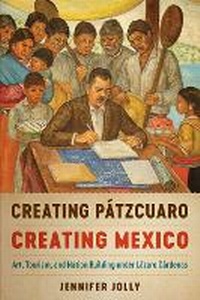
Creating Patzcuaro, Creating Mexico
Art, Tourism, and Nation Building Under Lazaro Cardenas
Published on 4. February 2018
Book
Paperback/Softback
352 pages
978-1-4773-1420-3 (ISBN)
Description
LASA Visual Culture Studies Section Book Prize, Latin American Studies Association (LASA)
Winner, Arthur P. Whitaker Prize, Middle Atlantic Council of Latin American Studies, 2019 In the 1930s, the artistic and cultural patronage of celebrated Mexican president LAzaro CArdenas transformed a small MichoacAn city, PAtzcuaro, into a popular center for national tourism. CArdenas commissioned public monuments and archeological excavations; supported new schools, libraries, and a public theater; developed tourism sites and infrastructure, including the Museo de Artes e Industrias Populares; and hired artists to paint murals celebrating regional history, traditions, and culture. The creation of PAtzcuaro was formative for Mexico; not only did it provide an early model for regional economic and cultural development, but it also helped establish some of Mexico's most enduring national myths, rituals, and institutions.
In Creating PAtzcuaro, Creating Mexico, Jennifer Jolly argues that PAtzcuaro became a microcosm of cultural power during the 1930s and that we find the foundations of modern Mexico in its creation. Her extensive historical and archival research reveals how CArdenas and the artists and intellectuals who worked with him used cultural patronage as a guise for radical modernization in the region. Jolly demonstrates that the PAtzcuaro project helped define a new modern body politic for Mexico, in which the population was asked to emulate CArdenas by touring the country and seeing and embracing its land, history, and people. Ultimately, by offering Mexicans a means to identify and engage with power and privilege, the creation of PAtzcuaro placed art and tourism at the center of Mexico's postrevolutionary nation building project.
Winner, Arthur P. Whitaker Prize, Middle Atlantic Council of Latin American Studies, 2019 In the 1930s, the artistic and cultural patronage of celebrated Mexican president LAzaro CArdenas transformed a small MichoacAn city, PAtzcuaro, into a popular center for national tourism. CArdenas commissioned public monuments and archeological excavations; supported new schools, libraries, and a public theater; developed tourism sites and infrastructure, including the Museo de Artes e Industrias Populares; and hired artists to paint murals celebrating regional history, traditions, and culture. The creation of PAtzcuaro was formative for Mexico; not only did it provide an early model for regional economic and cultural development, but it also helped establish some of Mexico's most enduring national myths, rituals, and institutions.
In Creating PAtzcuaro, Creating Mexico, Jennifer Jolly argues that PAtzcuaro became a microcosm of cultural power during the 1930s and that we find the foundations of modern Mexico in its creation. Her extensive historical and archival research reveals how CArdenas and the artists and intellectuals who worked with him used cultural patronage as a guise for radical modernization in the region. Jolly demonstrates that the PAtzcuaro project helped define a new modern body politic for Mexico, in which the population was asked to emulate CArdenas by touring the country and seeing and embracing its land, history, and people. Ultimately, by offering Mexicans a means to identify and engage with power and privilege, the creation of PAtzcuaro placed art and tourism at the center of Mexico's postrevolutionary nation building project.
Reviews / Votes
[Jolly's] thorough study on the Mexican town of PAtzcuaro reveals just how constructed geographic identities are through an attention to the players and politics involved in promotional projects...Jolly's study reminds us that when we visit a charming colonial town or a rustic Indigenous village market, we enter spaces that have been extensively edited, that are anything but natural or neutral...While Creating PAtzcuaro, Creating Mexico provides a compelling way of understanding modern Mexico, its approach is of value for implementation elsewhere in Latin America and beyond...While complex and nuanced in its articulation, this book reminds us of something quite simple: that images and spaces in the service of statecraft wield incredible power, but this power remains open to negotiation and contestation. (Latin American and Latinx Visual Culture) Creating Patzcuaro, Creating Mexico is a much welcomed addition to Mexican regional history...[Jolly] brings to light how the periphery informed nation-state building. (The Public Historian) Creating Patzcuaro, Creating Mexico makes important contributions to our understanding of 1930s Mexico, tourism development, art history, and the role of cultural policy in nation building. The book is essential for scholars interested in these fields and accessible for graduate and advanced undergraduate students. (Hispanic American Historical Review) A fascinating journey into art and tourism in PAtzcuaro...a welcome contribution to our understanding of regional art institutions and monuments, the interdisciplinary study of Mexican nation- and region-formation during the 1930s, and most importantly, the emergence of domestic tourism in postrevolutionary Mexico. (The Americas) Jolly's acute book is successful in giving us a comprehensive view of the mechanisms by which the image of Patzcuaro was created through a process of power engineering...Creating Patzcuaro, Creating Mexico demonstrates how history, art, and tourism can be combined and serve as a technology of governance. (caa.reviews) Through her consideration of visual culture, Jolly links the regional to the national (and the national to the regional), and thus effectively illuminates the ways in which the molding of PAtzcuaro's local identity contributed to Mexico's nation building overall. Jolly offers a significant study, but her colorful discussion of PAtzcuaro's art, murals, architecture, and streets ensure a lively read as well. (American Historical Review) As a compelling account of the creation of a particular historical and cultural narrative for PAtzcuaro in the context of building a national Mexican identity, Jolly's book constitutes both an excellent scholarly contribution and a fascinating and insightful story well worth reading. (Monthly Review) [A] magisterial study of cultural patronage and the construction of regional identity in PAtzcuaro...one of the most interesting new books on the history of modern Mexican art to appear in the past several years...It will long stand as the definitive account of this particular time and place...Jolly's book sets a high bar for future scholars who seek to excavate the histories of these and other sites, where regional differences remain resilient, notwithstanding the forces of industrialisation and globalisation. (Bulletin of Latin American Research) Jolly's study makes a useful contribution to research on and understanding of postrevolutionary nation-building and tourism in terms of the immense ideological power of public art, memorials, monuments and statues in Mexico. (Journal of Latin American Geography) [A] wonderful book...Richly illustrated...Jolly skillfully highlights the connections between the regional and the national...[and] skillfully interrogates elite ideas about Indians and race as PAtzcuaro's indigenous past and present were propped up as tourist attractions. (Latin American Research Review)More details
Language
English
Place of publication
Austin, TX
United States
Target group
Professional and scholarly
Illustrations
11 color and 92 b&w photos
Dimensions
Height: 229 mm
Width: 152 mm
Thickness: 25 mm
Weight
513 gr
ISBN-13
978-1-4773-1420-3 (9781477314203)
Copyright in bibliographic data and cover images is held by Nielsen Book Services Limited or by the publishers or by their respective licensors: all rights reserved.
Schweitzer Classification
Person
Jennifer Jolly is Charles A. Dana Professor of Art History at Ithaca College. Her essays on David Alfaro Siqueiros and Josep Renau have been published in edited volumes and the Oxford Art Journal.
Content
Acknowledgments
Introduction
Chapter 1. Seeing Lake PAtzcuaro, Transforming Mexico
Chapter 2. Creating PAtzcuaro TIpico: Architecture, Historical Preservation, and Race
Chapter 3. Creating the Traditional, Creating the Modern
Chapter 4. Creating Historical PAtzcuaro
Chapter 5. Creating CArdenas, Creating Mexico
Notes
Bibliography
Index
Introduction
Chapter 1. Seeing Lake PAtzcuaro, Transforming Mexico
Chapter 2. Creating PAtzcuaro TIpico: Architecture, Historical Preservation, and Race
Chapter 3. Creating the Traditional, Creating the Modern
Chapter 4. Creating Historical PAtzcuaro
Chapter 5. Creating CArdenas, Creating Mexico
Notes
Bibliography
Index