

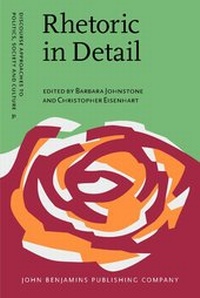
Rhetoric in Detail
Discourse analyses of rhetorical talk and text
Published on 29. October 2008
Book
Hardback
330 pages
978-90-272-0619-0 (ISBN)
Description
The eleven studies in this volume illustrate and advance the synthesis of discourse analysis with rhetorical studies. Rhetoric in Detail shows how a variety of techniques from discourse analysis can be useful in studying such concerns as agency, legitimation, controversy, and style, and how concepts from rhetoric including genre and figuration can enrich the work of discourse analysts. The authors' research sites range from government commissions, political speeches, newspaper reports and letters to interviews and conversations in beauty salons and online. Methodological overviews interspersed throughout survey critical discourse analysis, interactional sociolinguistics, grounded theory, computer-aided corpus analysis, narrative analysis, and participant observation and provide suggestions for further reading. Rhetoric in Detail is an invaluable source for rhetoricians looking for systematic, grounded ways of approaching new, more vernacular sites for rhetorical discourse and for discourse analysts interested in seeing what they can learn from the tradition and practice of rhetorical analysis.
More details
Series
Language
English
Place of publication
Amsterdam
Netherlands
Target group
Professional and scholarly
Dimensions
Height: 245 mm
Width: 164 mm
Weight
760 gr
ISBN-13
978-90-272-0619-0 (9789027206190)
Copyright in bibliographic data and cover images is held by Nielsen Book Services Limited or by the publishers or by their respective licensors: all rights reserved.
Schweitzer Classification
Other editions
Additional editions
Barbara Johnstone | Christopher Eisenhart
Rhetoric in Detail
Discourse analyses of rhetorical talk and text
E-Book
10/2008
1st Edition
John Benjamins Publishing Company
€130.99
Available for download
Persons
Content
1. Part I. Introduction; 2. 1. Discourse analysis in rhetorical studies (by Eisenhart, Christopher); 3. Part II. Style and legitimation; 4. Studying style and legitimation: Critical linguistics and Critical Discourse Analysis (by Zdenek, Sean); 5. 2. Talking the (political) talk: Cold War refugees and their political legitimation through style (by Ritivoi, Andreea Deciu); 6. 3. Reporting Waco: The constitutive work of bureaucratic style (by Eisenhart, Christopher); 7. 4. The rhetoric of temporality: The future as linguistic construct and rhetorical resource (by Dunmire, Patricia L.); 8. 5. The intertextual forging of epideictic discourse: Construals of victims in the South Africa Truth and Reconciliation Commission Amnesty Hearings (by Lawrence, Susan); 9. Part III. Identity and agency; 10. Studying identity and agency: CDA, interactional sociolinguistics, narrative analysis, grounded theory (by Johnstone, Barbara); 11. 6. Muted voices: Cochlear implants, news discourse, and the public fascination with curing deafness (by Zdenek, Sean); 12. 7. "American Humor" versus "Indian Humor": Indentity, ethos, and rhetorical situation (by Bhasin, Neeta); 13. 8. Ethos and narrative in online educational chat (by Cheng, Martha Sylvia); 14. 9. Disciplinary rhetorics, rhetorical agency, and the construction of voice (by Young, Amanda); 15. Part IV. Entextualizing controversy; 16. Studying entextualization and controversy: CDA, participant observation, computer-aided corpus analysis (by Johnstone, Barbara); 17. 10. How a media controversy can influence a scientific publication: The case of Robert L. Spitzer's "reparative therapy" study (by Stewart, Craig O.); 18. 11. Controversy as a media event category (by Cramer, Peter A.); 19. 12. Analyzing everyday talk about social issues (by Gilpin, Susan); 20. Index