

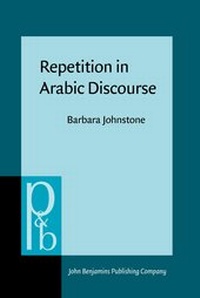
Repetition in Arabic Discourse
Paradigms, syntagms and the ecology of language
Published on 16. August 1991
Book
Hardback
130 pages
978-90-272-5028-5 (ISBN)
Description
In this examination of expository prose in contemporary Arabic, structural and semantic repetition is found to be responsible both for linguistic cohesion and for rhetorical force. Johnstone identifies and discusses repetitive features on every level of analysis. Writers in Arabic use lexical couplets consisting of conjoined synonyms, which create new semantic paradigms as they evoke old ones. Morphological roots and patterns are repeated at close range, and this creates phonological rhyme as well. Regular patterns of paraphrase punctuate texts, and patterns of parallelism mark the internal structure of their segments. Johnstone offers an explanation for how repetition of all these kinds can serve persuasive ends by creating rhetorical presence, and discusses how the Arabic language and the Arab-Islamic cultural tradition especially lend themselves to this rhetorical strategy. She suggests, however, that discourse repetition serves a crucial function in the ecology of any language, as the mechanism by which speakers evoke and create underlying paradigmatic structure in their syntagmatic talk and writing.
More details
Series
Language
English
Place of publication
Amsterdam
Netherlands
Target group
Professional and scholarly
Dimensions
Height: 245 mm
Width: 164 mm
Weight
320 gr
ISBN-13
978-90-272-5028-5 (9789027250285)
Copyright in bibliographic data and cover images is held by Nielsen Book Services Limited or by the publishers or by their respective licensors: all rights reserved.
Schweitzer Classification
Other editions
Additional editions
E-Book
08/1991
1st Edition
John Benjamins Publishing Company
€123.99
Available for download
Person
Content
1. Acknowledgments; 2. Note on Transliteration; 3. Introduction; 4. Paradigmatic Structure and Parallelistic Discourse; 5. Lexical Couplets and Semantic Paradigms; 6. Morphological Repetition; 7. Paraphrase and rhetorical Presentation; 8. Parallelism and Parataxis; 9. Reasons for Repetition: Sources of Constraints on Arabic Discourse; 10. References