

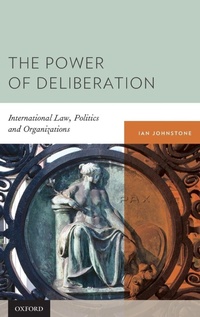
The Power of Deliberation
International Law, Politics and Organizations
Published on 28. April 2011
Book
Hardback
240 pages
978-0-19-539493-1 (ISBN)
Description
Arguing about matters of public policy is ubiquitous in democracies. The ability to resolve conflicts through peaceful contestation is a measure of any well-ordered society. Arguing is almost as ubiquitous in international affairs, yet it is not viewed as an important element of world order. In The Power of Deliberation: International Law, Politics and Organizations, Ian Johnstone challenges the assumption that arguing is mere lip service with no real impact on the behavior of states or the structure of the international system. Johnstone focuses on legal argumentation and asks why, if the rhetoric of law is inconsequential, governments and other international actors bother engaging in it.
Johnstone joins the efforts of international relations scholars and democracy theorists who consider why argumentation occurs beyond nation states. He focuses on deliberation in and around international organizations, drawing on various strands of legal, political and international relations theory to identify common features of legal argumentation and deliberative politics. Johnstone's central claim is that international organizations are places where "interpretive communities" coalesce, and the quality of the deliberations these communities provoke is a measure of the legitimacy of the organization.
Johnstone joins the efforts of international relations scholars and democracy theorists who consider why argumentation occurs beyond nation states. He focuses on deliberation in and around international organizations, drawing on various strands of legal, political and international relations theory to identify common features of legal argumentation and deliberative politics. Johnstone's central claim is that international organizations are places where "interpretive communities" coalesce, and the quality of the deliberations these communities provoke is a measure of the legitimacy of the organization.
Reviews / Votes
"If any organization holds insights on the power--and the limits--of deliberation, it is the United Nations. It offers both ample proof of the relevance of policy dialogue and legal discourse in international affairs and daily examples of results born out of consultation. This timely book profits greatly from the insights collected by Ian Johnstone during his years at the General Secretariat. Combined with his penetrating analysis of sophisticated legal andpolitical theory and carefully chosen case studies, they make The Power of Deliberation a truly fascinating account of why and how argumentation influences world politics."
--KOFI ANNAN
Secretary-General of the United Nations (1997-2006)
"In The Power of Deliberation, Ian Johnstone makes a distinctive and persuasive argument for why international law matters. In careful studies of humanitarian intervention, counter-terrorism, nuclear non-proliferation, peacekeeping and trade, he shows that international law matters because it serves as a uniquely powerful vocabulary for justificatory deliberation. States debate the law more than they follow the law. These international legal arguments shape how
states persuade each other and how they explain their actions at home, showing the extent to which the power of deliberation is the power of the better legal argument."
--MICHAEL DOYLE
Harold Brown Professor of International Affairs, Law and Political Science,
Columbia University
More details
Language
English
Place of publication
New York
United States
Target group
College/higher education
Dimensions
Height: 240 mm
Width: 161 mm
Thickness: 17 mm
Weight
526 gr
ISBN-13
978-0-19-539493-1 (9780195394931)
Copyright in bibliographic data and cover images is held by Nielsen Book Services Limited or by the publishers or by their respective licensors: all rights reserved.
Schweitzer Classification
Other editions
Additional editions
E-Book
04/2011
1st Edition
OUP eBook
€63.49
Available for download
Person
Ian Johnstone is a Professor of International Law at Fletcher School of Law and Diplomacy, Tufts University. He is also a Senior Fellow at the Center on International Cooperation, New York University. Prior to joining the Fletcher School in 2000, he held various positions in the United Nations Secretariat, including five years as political officer in the Office of the Secretary-General. He also served in the Office of the Under-Secretary-General for Peacekeeping Operations, and in the Office of the Legal Counsel. His recent publications include "The Use of Force" in The United Nations and Nuclear Orders (2009); "Normative evolution at the United Nations" in Cooperating for Peace and Security (2009); The United States and Contemporary Peace Operations: A Double-Edged Sword? (2008); "Legislation and Adjudication in the UN Security Council: Bringing down the Deliberative Deficit", American Journal of International Law (2008); "Law-making through the operational activities of
international organizations", George Washington International Law Review (2008); "The Secretary-General as norm entrepreneur," in Secretary or General? The Role of the UN Secretary-General in World Politics (2007); "The plea of necessity in international law: humanitarian intervention and counter-terrorism", Columbia Journal of Transnational Law (2005).
From 2005-2007 he was the Volume Editor and Lead Scholar of the first two volumes of the Center on International Cooperation's Annual Review of Global Peace Operations. Professor Johnstone is a regular consultant to the United Nations on political, peacekeeping and related issues. A citizen of Canada but long-time resident of the US, he holds an LL.M degree from Columbia University and JD and BA degrees from the University of Toronto.
international organizations", George Washington International Law Review (2008); "The Secretary-General as norm entrepreneur," in Secretary or General? The Role of the UN Secretary-General in World Politics (2007); "The plea of necessity in international law: humanitarian intervention and counter-terrorism", Columbia Journal of Transnational Law (2005).
From 2005-2007 he was the Volume Editor and Lead Scholar of the first two volumes of the Center on International Cooperation's Annual Review of Global Peace Operations. Professor Johnstone is a regular consultant to the United Nations on political, peacekeeping and related issues. A citizen of Canada but long-time resident of the US, he holds an LL.M degree from Columbia University and JD and BA degrees from the University of Toronto.
Content
Chapter 1: Introduction ; Chapter 2: Deliberation ; Chapter 3: Interpretive Communities ; Chapter 4: Responsibility to Protect ; Chapter 5: Counter-Terrorism ; Chapter 6: Non-Proliferation ; Chapter 7: Peace Operations ; Chapter 8: Operational Activities ; Chapter 9: Trade ; Chapter 10: Conclusion