

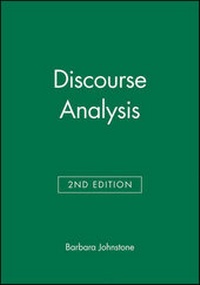
Discourse Analysis
Published on 27. June 2007
Book
Paperback/Softback
336 pages
978-1-4051-4427-8 (ISBN)
Description
Fully revised and updated throughout, the new edition of
Discourse Analysis is a user-friendly textbook for students taking their first course in linguistic approaches to discourse.
Second edition of a popular introductory textbook, combining breadth of coverage, practical examples, and student-friendly features
Includes new sections on metaphor, framing, stance and style, multimodal discourse, and Gricean pragmatics
Considers a variety of approaches to the subject, including critical discourse analysis, conversation analysis, interactional and variationist sociolinguistics, ethnography, corpus linguistics, and other qualitative and quantitative methods
Features detailed descriptions of the results of discourse analysts work
Retains and expands the useful student features, including discussion questions, exercises, and ideas for small research projects.
Discourse Analysis is a user-friendly textbook for students taking their first course in linguistic approaches to discourse.
Second edition of a popular introductory textbook, combining breadth of coverage, practical examples, and student-friendly features
Includes new sections on metaphor, framing, stance and style, multimodal discourse, and Gricean pragmatics
Considers a variety of approaches to the subject, including critical discourse analysis, conversation analysis, interactional and variationist sociolinguistics, ethnography, corpus linguistics, and other qualitative and quantitative methods
Features detailed descriptions of the results of discourse analysts work
Retains and expands the useful student features, including discussion questions, exercises, and ideas for small research projects.
Reviews / Votes
"A feature, and strength, of the book is its balanced approach. Johnstone does not support one approach at the expense of others, but carefully explains that texts can be analyzed in different ways, the reasons why some researchers choose one approach over another, and the results that different approaches bring." (Discourse Studies, January 2009) "The exercises incorporated into the book help students carry out mini-discourse analyses on their own ... .This book uses the learning-by-doing methodology, distinguishing it from other introductory books on the subject. And it clearly benefits from the author's rich synthesis of the field made possible by her long and distinguished career. This book will satisfy the curiosity of many TESL professionals, researchers and teachers alike. It also provides sufficient grounding for anyone who would like to pursue in greater depth the themes it introduces. As an entree to the field, Discourse Analysis is highly recommended." (TESL-EJ, June 2008)More details
Series
Edition
2nd Edition
Language
English
Place of publication
Chicester
United Kingdom
Publishing group
John Wiley and Sons Ltd
Target group
Professional and scholarly
Dimensions
Height: 243 mm
Width: 174 mm
Thickness: 18 mm
Weight
592 gr
ISBN-13
978-1-4051-4427-8 (9781405144278)
Copyright in bibliographic data and cover images is held by Nielsen Book Services Limited or by the publishers or by their respective licensors: all rights reserved.
Schweitzer Classification
Other editions
New editions
Barbara Johnstone
Discourse Analysis
Book
12/2017
3rd Edition
Wiley
Unfortunately, price unknown
Article exhausted; check for reprint
Previous edition

Barbara Johnstone
Discourse Analysis
Book
10/2001
Blackwell Publishers
€47.22
Article exhausted; check for reprint
Person
Barbara Johnstone is Professor of Rhetoric and Linguistics at Carnegie Mellon University and editor of the journal
Language in Society. She is the author of
Repetition in Arabic Discourse (1990),
Stories, Community, and Place: Narratives from Middle America (1990),
The Linguistic Individual (1996), and
Qualitative Methods in Sociolinguistics (2001), in addition to many articles and book chapters.
Language in Society. She is the author of
Repetition in Arabic Discourse (1990),
Stories, Community, and Place: Narratives from Middle America (1990),
The Linguistic Individual (1996), and
Qualitative Methods in Sociolinguistics (2001), in addition to many articles and book chapters.
Content
List of Figures.
Preface to Second Edition.
Preface to First Edition.
1. Introduction.
What is Discourse Analysis?.
Some Uses of Discourse Analysis.
Facets of Discourse Analysis.
Data for Discourse Analysis.
Transcription: Representing Speech in Writing.
Descriptive and Critical Goals.
Summary.
2. Discourse and World.
Linguistic Categories, Minds, and Worldviews.
Discourse, Culture, and Ideology.
Language Ideology.
Silence.
Summary.
3. Discourse Structure: Parts and Sequences.
Words and Lines.
Paragraphs and Episodes.
Discourse Schemata and the Structure of Narrative.
The Emergent Organization of Conversation.
Old and New Information and the Organization of Sentences.
Cohesion.
Structures and Rules.
4. Participants in Discourse: Relationships, Roles, Identities.
Power and Community.
Indexicality.
Stance and Style.
Social Roles and Participant Structure.
Audience, Politeness, and Accommodation.
Social Identity and Identification.
Personal Identity: Discourse and the Self.
The Linguistic Individual in Discourse.
Summary.
5. Prior Texts, Prior Discourses.
Intertextuality and Interdiscursivity.
Repetition in Conversation.
Register: Repeated Styles for Repeated Situations.
Genre: Recurrent Forms, Recurrent Actions.
Frames, Plots, and Coherence.
Summary.
6. Discourse and Medium.
Early Work on Orality and Literacy .
Literacy and Literacies.
Communication and Technology.
Planning and Discourse Structure.
Fixity, Fluidity, and Coherence.
Medium and Interpersonal Relations.
Analyzing Multimodal Discourse.
Summary.
7. Intention and Interpretation.
Speech Acts and Conversational Implicature.
Contextualization Cues and Discourse Marking.
Rhetorical Aims, Strategies, and Styles.
Verbal Art and Performance.
Summary.
8. Some General Themes.
A Heuristic Approach to Discourse Analysis.
Locations of Meaning.
Discourse as Strategy, Discourse as Adaptation.
Language and Languaging.
Particularity, Theory, and Method.
From Text Outward.
Glossary.
References.
Index
Preface to Second Edition.
Preface to First Edition.
1. Introduction.
What is Discourse Analysis?.
Some Uses of Discourse Analysis.
Facets of Discourse Analysis.
Data for Discourse Analysis.
Transcription: Representing Speech in Writing.
Descriptive and Critical Goals.
Summary.
2. Discourse and World.
Linguistic Categories, Minds, and Worldviews.
Discourse, Culture, and Ideology.
Language Ideology.
Silence.
Summary.
3. Discourse Structure: Parts and Sequences.
Words and Lines.
Paragraphs and Episodes.
Discourse Schemata and the Structure of Narrative.
The Emergent Organization of Conversation.
Old and New Information and the Organization of Sentences.
Cohesion.
Structures and Rules.
4. Participants in Discourse: Relationships, Roles, Identities.
Power and Community.
Indexicality.
Stance and Style.
Social Roles and Participant Structure.
Audience, Politeness, and Accommodation.
Social Identity and Identification.
Personal Identity: Discourse and the Self.
The Linguistic Individual in Discourse.
Summary.
5. Prior Texts, Prior Discourses.
Intertextuality and Interdiscursivity.
Repetition in Conversation.
Register: Repeated Styles for Repeated Situations.
Genre: Recurrent Forms, Recurrent Actions.
Frames, Plots, and Coherence.
Summary.
6. Discourse and Medium.
Early Work on Orality and Literacy .
Literacy and Literacies.
Communication and Technology.
Planning and Discourse Structure.
Fixity, Fluidity, and Coherence.
Medium and Interpersonal Relations.
Analyzing Multimodal Discourse.
Summary.
7. Intention and Interpretation.
Speech Acts and Conversational Implicature.
Contextualization Cues and Discourse Marking.
Rhetorical Aims, Strategies, and Styles.
Verbal Art and Performance.
Summary.
8. Some General Themes.
A Heuristic Approach to Discourse Analysis.
Locations of Meaning.
Discourse as Strategy, Discourse as Adaptation.
Language and Languaging.
Particularity, Theory, and Method.
From Text Outward.
Glossary.
References.
Index