

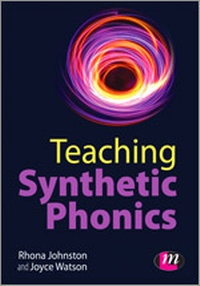
Teaching Synthetic Phonics
1st Edition
Published on 6. September 2007
Book
Paperback/Softback
136 pages
978-1-84445-121-0 (ISBN)
Description
Written for both in-service and trainee teachers, this title is a practical, up-to-date guide on how to teach children to read using synthetic phonics - the approach adopted in all schools in England from 2007. It describes several different approaches to systematic phonics teaching, together with the rapid progress in word recognition ability that can result. The book also includes case studies, advice on how to diagnose children's phonic skills, and how to locate and remediate their weaknesses. Further, it also provides guidance on how teaching assistants can support the work of the classroom teacher.
Reviews / Votes
"Liked the good mix of practical advice and theoretical underpinning. Very up to date book by experts in this field" (Lecturer, Stranmills University College)More details
Series
Language
English
Place of publication
Exeter
United Kingdom
Publishing group
Sage Publications Ltd
Target group
Professional and scholarly
Dimensions
Height: 246 mm
Width: 171 mm
ISBN-13
978-1-84445-121-0 (9781844451210)
Copyright in bibliographic data and cover images is held by Nielsen Book Services Limited or by the publishers or by their respective licensors: all rights reserved.
Schweitzer Classification
Other editions
New editions
Rhona Johnston | Joyce Watson
Teaching Synthetic Phonics
Book
12/2014
2nd Edition
Learning Matters Ltd
€74.90
Shipment within 15-20 days
Persons
Rhona Johnston trained as a primary school teacher and worked as a learning support teacher for a number of years. She was then a lecturer in psychology at the University of St Andrews, a Reader at the University of Birmingham, and since 2001 has been a Professor of Psychology at the University of Hull. With Joyce Watson she devised a synthetic phonics programme which they showed in their study in Clackmannanshire was very much more effective than other types of phonics teaching. Joyce Watson was an early years teacher for a number of years, and then a lecturer at the Northern College of Education, Dundee, for over 20 years. She is now a research fellow at the University of St Andrews. With Rhona Johnston she devised a synthetic phonics programme which they showed in their study in Clackmannanshire was very much more effective than other types of phonics teaching.
Content
What is phonics and which type is the most effective?
Phoneme awareness: what is it and what is its role in learning to read?
How does reading develop?
An introduction to Letters and Sounds and how to teach synthetic phonics
How do I start to teach synthetic phonics?
Teaching a synthetic phonics lesson in Phase 2 of Letters and Sounds
Teaching Phases 3 to 6 of Letters and Sounds
How to assess and diagnose reading problems - a case study
Teachers' views of the synthetic phonics programme
Glossary
Appendices:
Appendix 1: Phoneme Awareness Training Programme
Appendix 2: Score sheet to assess children's knowledge of the letters s a t p
Appendix 3: Score sheet to assess children's ability to sound and blend the letters s a t p
Appendix 4: Rules for where to split words into syllables
Appendix 5: Nonwords for testing sounding and blending in Phases 2 and 3
Phoneme awareness: what is it and what is its role in learning to read?
How does reading develop?
An introduction to Letters and Sounds and how to teach synthetic phonics
How do I start to teach synthetic phonics?
Teaching a synthetic phonics lesson in Phase 2 of Letters and Sounds
Teaching Phases 3 to 6 of Letters and Sounds
How to assess and diagnose reading problems - a case study
Teachers' views of the synthetic phonics programme
Glossary
Appendices:
Appendix 1: Phoneme Awareness Training Programme
Appendix 2: Score sheet to assess children's knowledge of the letters s a t p
Appendix 3: Score sheet to assess children's ability to sound and blend the letters s a t p
Appendix 4: Rules for where to split words into syllables
Appendix 5: Nonwords for testing sounding and blending in Phases 2 and 3