

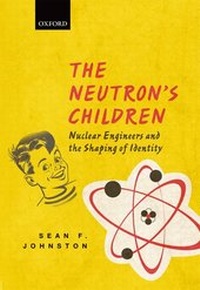
The Neutron's Children
Nuclear Engineers and the Shaping of Identity
Published on 26. April 2012
Book
Hardback
326 pages
978-0-19-969211-8 (ISBN)
Description
The first nuclear engineers emerged from the Manhattan Project in the USA, UK and Canada, but remained hidden behind security for a further decade. Cosseted and cloistered by their governments, they worked to explore applications of atomic energy at a handful of national labs. This unique bottom-up history traces how the identities of these unusually voiceless experts - forming a uniquely state-managed discipline - were shaped in the context of pre-war nuclear physics, wartime industrial management, post-war politics and utopian energy programmes. Even after their eventual emergence at universities and companies, nuclear workers carried the enduring legacy of their origins. Their shared experiences shaped not only their identities, but our collective memories of the late twentieth century. And as illustrated by the Fukushima accident seven decades after the Manhattan project began, this book explains why they are still seen conflictingly as selfless heroes or as mistrusted guardians of a malevolent genie.
Reviews / Votes
The Neutron's Children is a piece of high quality research and scholarship which should be read by all those involved in the teaching and practice of nuclear engineering. * M.M.R Williams, Annals of Nuclear Energy * In this fascinating and well-researched volume....the author capably weaves together a great variety of material * Benjamin Wilson, Metascience, February 2013 * The focus on working engineers rather than either scientists or managers distinguishes Johnson's account from the small library of books on the history of the atomic bomb and nuclear power. ... The Neutron's Children wil undoubtedly be the standard work on the professionalization of nuclear engineers for some time to come. * Audra J. Wolfe, Physics Today * The Neutron's Children is a welcome addition for specialists in the history of nuclear technology, as well as for anyone interested in postwar nuclear history. * Russell Olwell, Technology and Culture * This is a masterful, very recommendable study on the building of nuclear expertise - not only since the catastrophes of Chernobyl and Fukushima a topic of prime importance to scientists and technologists, professionals, politicians, and in fact to all of us. Historiographically Johnston combines social and cultural history with labour and political history, successfully weaving in insights from science and technology studies and from a practice-oriented history of science and technology. His book will become a classic for all of these fields. * Klaus Hentschel, Historical Institute of the University of Stuttgart * I enthusiastically recommend this fascinating study of nuclear engineering, which documents its development from its diverse origins in secret laboratories in the United States, Britain, and Canada during the Second World War, through its vital transformation in the international political arena during the first postwar decade, and culminates later in its maturation as a discipline through the commercialization of nuclear power, each stage of which entailed profound scientific, technical, institutional, educational, and sociopolitical consequences that affect our lives today. * Roger H. Stuewer, University of Minnesota * A fascinating account of how an entire industry developed from very sparse beginnings and, like all good histories, it offers lessons to be learned. * Geoff Vaughan, Physics World *More details
Language
English
Place of publication
Oxford
United Kingdom
Target group
College/higher education
Professional and scholarly
Scholars and educated laypersons concerned with the history of the nuclear era and social studies of science and technology. Advanced undergraduate and MA/PhD level courses in the history and sociology of technology, the history and sociology of science, and cultural history. Nuclear workers (physicists, chemists, nuclear engineers, technologists and technicians) interested in the history of their disciplines.
Illustrations
7 b&w line drawings, 20 b&w halftones
Dimensions
Height: 248 mm
Width: 173 mm
Thickness: 23 mm
Weight
802 gr
ISBN-13
978-0-19-969211-8 (9780199692118)
Copyright in bibliographic data and cover images is held by Nielsen Book Services Limited or by the publishers or by their respective licensors: all rights reserved.
Schweitzer Classification
Other editions
Additional editions
E-Book
04/2012
1st Edition
OUP Oxford
€88.39
Available for download
E-Book
04/2012
1st Edition
OUP eBook
€64.49
Available for download
Person
Sean F. Johnston is Professor of Science, Technology and Society at the University of Glasgow, a Fellow of the Higher Education Academy and a Chartered Physicist (Institute of Physics).
He has worked as a scientist, researcher and development manager at North American and British firms and at the University of Leeds, and as an historian at the Universities of York and Glasgow.
Johnston is a recipient of the Paul Bunge Prize of the Hans R. Jenemann Foundation, administered by the Gesellschaft Deutscher Chemiker, for the history of scientific instruments and of the George E. Davis Medal of the Institution of Chemical Engineers, for a history of chemical engineering co-written with Colin Divall, and has been International Scholar of the Society for the History of Technology.
He lives in southern Scotland, where he teaches and researches the historical, social and philosophical aspects of science and technology.
He has worked as a scientist, researcher and development manager at North American and British firms and at the University of Leeds, and as an historian at the Universities of York and Glasgow.
Johnston is a recipient of the Paul Bunge Prize of the Hans R. Jenemann Foundation, administered by the Gesellschaft Deutscher Chemiker, for the history of scientific instruments and of the George E. Davis Medal of the Institution of Chemical Engineers, for a history of chemical engineering co-written with Colin Divall, and has been International Scholar of the Society for the History of Technology.
He lives in southern Scotland, where he teaches and researches the historical, social and philosophical aspects of science and technology.
Content
PART A: GESTATION; PART B: INCUBATION; PART C: EMERGENCE; PART D: REPRESENTATIONS