

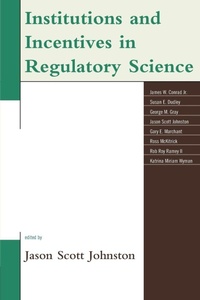
Institutions and Incentives in Regulatory Science
Published on 10. December 2013
Book
Paperback/Softback
232 pages
978-0-7391-9067-8 (ISBN)
Description
Institutions and Incentives in Regulatory Science explores fundamental problems with regulatory science in the environmental and natural resource law field. Each chapter covers a variety of natural resource and regulatory areas, ranging from climate change to endangered species protection and traditional health-based environmental regulation. Regulatory laws and institutions themselves strongly influence the direction of scientific research by creating a system of rewards and penalties for science. As a consequence, regulatory laws or institutions that are designed naively end up incentivizing scientists to generate and then publish only those results that further the substantive regulatory goals preferred by the scientists. By relying so heavily on science to dictate policy, regulatory laws and institutions encourage scientists to use their assessment of the state of the science to further their own preferred scientific and regulatory policy agendas. Additionally, many environmental and natural resource regulatory agencies have been instructed by legislatures to rely heavily upon science in their rulemaking. In areas of rapidly evolving science, regulatory agencies are inevitably looking for scientific consensus prematurely, before the scientific process has worked through competing hypotheses and evidence. The contributors in this volume address how institutions for regulatory science should be designed in light of the inevitable misfit between the political or legal demand for regulatory action and the actual state of evolving scientific knowledge.
Reviews / Votes
Institutions and Incentives in Regulatory Science is essential reading for people interested in how institutions affect regulatory agencies' abilities to make decisions based on objective interpretations of scientific evidence of risks to health, safety or the environment. -- Randall Lutter, Resources for the Future A powerful and disturbing account of the biases and uncertainties in regulatory science. Fortunately, the authors offer promising reforms to buttress the integrity of science in the midst of the politics of rulemaking. -- John D. Graham, Dean, School of Public and Environmental Affairs, Indiana University Provocative and timely, Institutions and Incentives in Regulatory Science raises crucial questions for anyone interested in science and public policy. In the abstract, everyone agrees that legitimate policy making depends on both credible science as well as on political and moral judgment. But in practice, as the cases in this book engagingly show, the challenge lies in discerning the appropriate roles for science and politics-and then keeping each in their respective places. Few challenges are more central to contemporary regulatory policy over matters as varied as climate change, biodiversity, and toxic pollution. -- Cary Coglianese, University of PennsylvaniaMore details
Language
English
Place of publication
United States
Publishing group
Bloomsbury Publishing Plc
Target group
Professional and scholarly
Dimensions
Height: 229 mm
Width: 152 mm
Thickness: 13 mm
Weight
343 gr
ISBN-13
978-0-7391-9067-8 (9780739190678)
Copyright in bibliographic data and cover images is held by Nielsen Book Services Limited or by the publishers or by their respective licensors: all rights reserved.
Schweitzer Classification
Other editions
Additional editions
Jason Scott Johnston
Institutions and Incentives in Regulatory Science
E-Book
04/2012
1st Edition
Lexington Books
€48.49
Available for download
Persons
Jason Scott Johnston is the Henry L. and Grace Doherty Charitable Foundation Professor of Law and the Nicholas E. Chimicles Research Professor in Business Law and Regulation, University of Virginia School of Law.
Content
Chapter 1: Introduction
by Jason Scott Johnston
PART I. Institutions for Climate Science Assessment
Chapter 2: The Cost of Cartelization: The IPCC Process and the Crisis of Credibility in Climate Science
by Jason Scott Johnson
Chapter 3: Adversarial versus consensus Processes for assessing scientific evidence: Should the IPCC operate more like a courtroom?
by Ross McKitrick
Part II. Taxonomy and Endangered Species Regulation
Chapter 4: On The Origin Of Specious Species
by Rob Roy Ramey II
Chapter 5: Politics and Science in Endangered Species
by Katrina Miriam Wyman
Part III. Reforming the Role of Science in Environmental, Health, and Safety Regulation
Chapter 6: Reconciling the Scientific & Regulatory Timetables
by James W. Conrad, Jr.
Chapter 7: Improving the Use of Science to Inform Environmental Regulation
by Susan E. Dudley & George M. Gray
Chapter 8: A Return to Expertise?: A Proposal for an Institute of Scientific Assessments
by Gary E. Marchant
by Jason Scott Johnston
PART I. Institutions for Climate Science Assessment
Chapter 2: The Cost of Cartelization: The IPCC Process and the Crisis of Credibility in Climate Science
by Jason Scott Johnson
Chapter 3: Adversarial versus consensus Processes for assessing scientific evidence: Should the IPCC operate more like a courtroom?
by Ross McKitrick
Part II. Taxonomy and Endangered Species Regulation
Chapter 4: On The Origin Of Specious Species
by Rob Roy Ramey II
Chapter 5: Politics and Science in Endangered Species
by Katrina Miriam Wyman
Part III. Reforming the Role of Science in Environmental, Health, and Safety Regulation
Chapter 6: Reconciling the Scientific & Regulatory Timetables
by James W. Conrad, Jr.
Chapter 7: Improving the Use of Science to Inform Environmental Regulation
by Susan E. Dudley & George M. Gray
Chapter 8: A Return to Expertise?: A Proposal for an Institute of Scientific Assessments
by Gary E. Marchant