

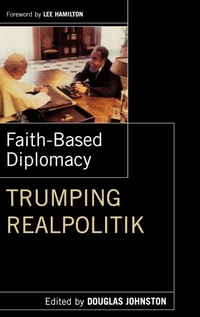
Faith-Based Diplomacy
Trumping Realpolitik
Published on 17. April 2003
Book
Hardback
296 pages
978-0-19-516089-5 (ISBN)
Description
For most of the twentieth century, the most critical concerns of national security have been balance of power politics and the global arms race. The attacks of September 11, 2001 and the motives behind them, however, demand a radical break with this tradition. If the United States is to prevail in its long-term contest with extremist Islam, it will need to re-examine old assumptions, expand the scope of its thinking to include religion and other "irrational" factors, and be willing to depart from past practice. A purely military response in reaction to such attacks will simply not suffice. What will be required is a long-term strategy of cultural engagement, backed by a deeper understanding of how others view the world and what is important to them.
In non-Western cultures, religion is a primary motivation for political actions. Historically dismissed by Western policymakers as a divisive influence, religion in fact has significant potential for overcoming the obstacles that lead to paralysis and stalemate. The incorporation of religion as part of the solution to such problems is as simple as it is profound. It is long overdue.
This book looks at five intractable conflicts and explores the possibility of drawing on religion as a force for peace. It builds upon the insights of Religion, the Missing Dimension of Statecraft (OUP,1994)--which examined the role that religious or spiritual factors can play in preventing or resolving conflict--while achieving social change based on justice and reconciliation. The world-class authors writing in this volume suggest how the peacemaking tenets of five major world religions can be strategically applied in ongoing conflicts in which those religions are involved. Finally, the commonalities and differences between these religions are examined with an eye toward further applications in peacemaking and conflict resolution.
In non-Western cultures, religion is a primary motivation for political actions. Historically dismissed by Western policymakers as a divisive influence, religion in fact has significant potential for overcoming the obstacles that lead to paralysis and stalemate. The incorporation of religion as part of the solution to such problems is as simple as it is profound. It is long overdue.
This book looks at five intractable conflicts and explores the possibility of drawing on religion as a force for peace. It builds upon the insights of Religion, the Missing Dimension of Statecraft (OUP,1994)--which examined the role that religious or spiritual factors can play in preventing or resolving conflict--while achieving social change based on justice and reconciliation. The world-class authors writing in this volume suggest how the peacemaking tenets of five major world religions can be strategically applied in ongoing conflicts in which those religions are involved. Finally, the commonalities and differences between these religions are examined with an eye toward further applications in peacemaking and conflict resolution.
Reviews / Votes
... impressive. * Asian Affairs * The writers provide illuminating outlines of five case studies. * The Expository Times *More details
Language
English
Place of publication
Oxford
United Kingdom
Target group
Professional and scholarly
Illustrations
3 maps
Dimensions
Height: 240 mm
Width: 161 mm
Thickness: 21 mm
Weight
614 gr
ISBN-13
978-0-19-516089-5 (9780195160895)
Copyright in bibliographic data and cover images is held by Nielsen Book Services Limited or by the publishers or by their respective licensors: all rights reserved.
Schweitzer Classification
Other editions
Additional editions
Book
06/2008
Oxford University Press Inc
€45.10
Shipment within 15-20 days
Person
Douglas Johnston is President and Founder of the International Center for Religion and Diplomacy. Prior to that, he was Executive Vice President and Chief Operating Officer of the Washington-based Center for Strategic and International Studies (CSIS). He has served at senior levels in government, the military, and the private sector, including Harvard University, where he founded and directed the University's Executive Program in National and International Security and taught international affairs. He is the editor and principal author of Religion, the Missing Dimension of Statecraft (OUP, 1994) and Foreign Policy into the 21st Century: The U.S. Leadership Challenge (1996).