

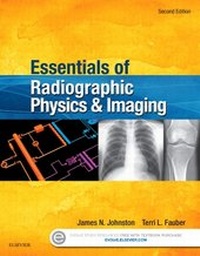
Essentials of Radiographic Physics and Imaging
2nd Edition
Published on 4. November 2015
Book
Hardback
288 pages
978-0-323-33966-7 (ISBN)
Description
Written by radiographers for radiographers, Essentials of Radiographic Physics and Imaging, 2nd Edition follows the ASRT recommended curriculum and focuses on what the radiographer needs to understand to safely and competently perform radiographic examinations. This comprehensive radiologic physics and imaging text links the two subjects together so that you understand how they relate to each other - and to clinical practice. Prepare for success on the ARRT exam and the job with just the right amount of information on radiation production and characteristics, imaging equipment, film screen image acquisition and processing, digital image acquisition and display, image analysis, and the basic principles of computed tomography.
345 photos and line drawings encourage you to visualize important concepts.
Strong pedagogy, including chapter objectives, key terms, outlines, bulleted chapter summaries, and specialty boxes, help you organize information and focus on what is most important in each chapter.
Make the Physics Connection and Make the Imaging Connection boxes link physics and imaging concepts so you fully appreciate the importance of both subjects.
Educator resources on Evolve, including lesson plans, an image collection, PowerPoint presentations, and a test bank, provide additional resources for instructors to teach the topics presented in the text.
Theory to Practice boxes succinctly explain the application of concepts and describe how to use the information in clinical practice.
Critical Concept boxes further explain and emphasize key points in the chapters.
Math Application boxes use examples to show how mathematical concepts and formulas are applied in the clinical setting.
An emphasis on the practical information highlights just what you need to know to ace the ARRT exam and become a competent practitioner.
Numerous critique exercises teach you how to evaluate the quality of radiographic images and determine which factors produce poor images.
A glossary of key terms serves as a handy reference.
NEW! Updated content reflects the newest curriculum standards outlined by the ARRT and ASRT, providing you with the information you need to pass the boards.
NEW! Critical Thinking Questions at the end of every chapter offer opportunity for review and greater challenge.
NEW! Chapter Review Questions at the end of every chapter allow you to evaluate how well you have mastered the material in each chapter.
NEW! Increased coverage of radiation protection principles helps you understand the ethical obligations to minimize radiation dosages, shielding, time and distance, how to limit the field of exposure and what that does to minimize dose, and technical factors and how they represent the quantity and quality of radiation.
NEW! Conversion examples and sample math problems give you the practice needed to understand complex concepts.
NEW! More images highlighting key concepts help you visualize the material.
NEW! Expansion of digital image coverage and ample discussion on differentiating between digital and film ensures you are prepared to succeed on your exams.
NEW! All-new section on manual vs. AEC use in Chapter 13 keeps you in the know.
NEW and UPDATED! Expanded digital fluoroscopy section, including up-to-date information on LCD and Plasma displays, familiarizes you with the equipment you will encounter.
NEW! Online chapter quizzes on Evolve feature 5-10 questions each and reinforce key concepts.
NEW! PowerPoint presentations with new lecture notes on Evolve and in-depth information in the notes section of each slide make presenting quick and easy for instructors.
345 photos and line drawings encourage you to visualize important concepts.
Strong pedagogy, including chapter objectives, key terms, outlines, bulleted chapter summaries, and specialty boxes, help you organize information and focus on what is most important in each chapter.
Make the Physics Connection and Make the Imaging Connection boxes link physics and imaging concepts so you fully appreciate the importance of both subjects.
Educator resources on Evolve, including lesson plans, an image collection, PowerPoint presentations, and a test bank, provide additional resources for instructors to teach the topics presented in the text.
Theory to Practice boxes succinctly explain the application of concepts and describe how to use the information in clinical practice.
Critical Concept boxes further explain and emphasize key points in the chapters.
Math Application boxes use examples to show how mathematical concepts and formulas are applied in the clinical setting.
An emphasis on the practical information highlights just what you need to know to ace the ARRT exam and become a competent practitioner.
Numerous critique exercises teach you how to evaluate the quality of radiographic images and determine which factors produce poor images.
A glossary of key terms serves as a handy reference.
NEW! Updated content reflects the newest curriculum standards outlined by the ARRT and ASRT, providing you with the information you need to pass the boards.
NEW! Critical Thinking Questions at the end of every chapter offer opportunity for review and greater challenge.
NEW! Chapter Review Questions at the end of every chapter allow you to evaluate how well you have mastered the material in each chapter.
NEW! Increased coverage of radiation protection principles helps you understand the ethical obligations to minimize radiation dosages, shielding, time and distance, how to limit the field of exposure and what that does to minimize dose, and technical factors and how they represent the quantity and quality of radiation.
NEW! Conversion examples and sample math problems give you the practice needed to understand complex concepts.
NEW! More images highlighting key concepts help you visualize the material.
NEW! Expansion of digital image coverage and ample discussion on differentiating between digital and film ensures you are prepared to succeed on your exams.
NEW! All-new section on manual vs. AEC use in Chapter 13 keeps you in the know.
NEW and UPDATED! Expanded digital fluoroscopy section, including up-to-date information on LCD and Plasma displays, familiarizes you with the equipment you will encounter.
NEW! Online chapter quizzes on Evolve feature 5-10 questions each and reinforce key concepts.
NEW! PowerPoint presentations with new lecture notes on Evolve and in-depth information in the notes section of each slide make presenting quick and easy for instructors.
More details
Edition
2nd Revised edition
Language
English
Place of publication
St Louis
United States
Publishing group
Elsevier - Health Sciences Division
Target group
College/higher education
Edition type
Revised edition
Illustrations
Approx. 800 illustrations (562 in full color)
Dimensions
Height: 281 mm
Width: 222 mm
ISBN-13
978-0-323-33966-7 (9780323339667)
Copyright in bibliographic data and cover images is held by Nielsen Book Services Limited or by the publishers or by their respective licensors: all rights reserved.
Schweitzer Classification
Other editions
New editions
James Johnston | Terri L. Fauber
Essentials of Radiographic Physics and Imaging
Book
08/2019
3rd Edition
Mosby
€127.50
Article exhausted; check for reprint
Additional editions
R. T. (R)(Cv) Johnston Ph. D. | Rt(R)(M) Fauber EdD
Essentials of Radiographic Physics and Imaging - E-Book
Essentials of Radiographic Physics and Imaging - E-Book
E-Book
10/2015
2nd Edition
Mosby
€91.99
Available for download
Previous edition
James Johnston | Terri L. Fauber
Essentials of Radiographic Physics and Imaging
Book
04/2011
Mosby
€82.93
Article exhausted; check for reprint
Content
1. Introduction to the Imaging Sciences
Section I: Principles of Radiation Physics
2. Structure of the Atom
3. Electromagnetic and Particulate Radiation
4. The X-ray Circuit
5. The X-Ray Tube
6. X-Ray Production
7. X-Ray Interactions with Matter
Section II: Image Production and Evaluation
8. Image Production
9. Image Quality and Characteristics
10. Radiographic Exposure Technique
11. Scatter Control
12. Image Receptors
Section III: Specialized Radiographic Equipment
13. Exposure Technique Selection
14. Image Intensified Fluoroscopy
15. Additional Equipment
16. Computed Tomography
Appendix A: Answers to Review Questions
Glossary
Section I: Principles of Radiation Physics
2. Structure of the Atom
3. Electromagnetic and Particulate Radiation
4. The X-ray Circuit
5. The X-Ray Tube
6. X-Ray Production
7. X-Ray Interactions with Matter
Section II: Image Production and Evaluation
8. Image Production
9. Image Quality and Characteristics
10. Radiographic Exposure Technique
11. Scatter Control
12. Image Receptors
Section III: Specialized Radiographic Equipment
13. Exposure Technique Selection
14. Image Intensified Fluoroscopy
15. Additional Equipment
16. Computed Tomography
Appendix A: Answers to Review Questions
Glossary