

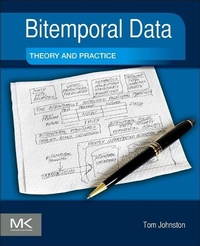
Bitemporal Data
Theory and Practice
Published on 21. August 2014
Book
Paperback/Softback
400 pages
978-0-12-408067-6 (ISBN)
Description
Bitemporal data has always been important. But it was not until 2011 that the ISO released a SQL standard that supported it. Currently, among major DBMS vendors, Oracle, IBM and Teradata now provide at least some bitemporal functionality in their flagship products. But to use these products effectively, someone in your IT organization needs to know more than how to code bitemporal SQL statements. Perhaps, in your organization, that person is you.
To correctly interpret business requests for temporal data, to correctly specify requirements to your IT development staff, and to correctly design bitemporal databases and applications, someone in your enterprise needs a deep understanding of both the theory and the practice of managing bitemporal data. Someone also needs to understand what the future may bring in the way of additional temporal functionality, so their enterprise can plan for it. Perhaps, in your organization, that person is you.
This is the book that will show the do-it-yourself IT professional how to design and build bitemporal databases and how to write bitemporal transactions and queries, and will show those who will direct the use of vendor-provided bitemporal DBMSs exactly what is going on "under the covers" of that software.
To correctly interpret business requests for temporal data, to correctly specify requirements to your IT development staff, and to correctly design bitemporal databases and applications, someone in your enterprise needs a deep understanding of both the theory and the practice of managing bitemporal data. Someone also needs to understand what the future may bring in the way of additional temporal functionality, so their enterprise can plan for it. Perhaps, in your organization, that person is you.
This is the book that will show the do-it-yourself IT professional how to design and build bitemporal databases and how to write bitemporal transactions and queries, and will show those who will direct the use of vendor-provided bitemporal DBMSs exactly what is going on "under the covers" of that software.
Reviews / Votes
"...the book describes in a nice and engaging manner an important business problem, the (often serious) shortcomings of existing IT solutions, and ways to solve the problem properly." --Computing ReviewsMore details
Language
English
Place of publication
San Francisco
United States
Publishing group
Elsevier Science & Technology
Target group
Professional and scholarly
Enterprise Data Architects
Product notice
Paperback (trade)
Unsewn / adhesive bound
Illustrations
Approx. 170 illustrations
Dimensions
Height: 233 mm
Width: 184 mm
Thickness: 22 mm
Weight
814 gr
ISBN-13
978-0-12-408067-6 (9780124080676)
Copyright in bibliographic data and cover images is held by Nielsen Book Services Limited or by the publishers or by their respective licensors: all rights reserved.
Schweitzer Classification
Other editions
Additional editions
E-Book
08/2014
Morgan Kaufmann
€45.95
Available for download
Person
Dr. Tom Johnston is the Chief Scientist at Asserted Versioning, LLC, which has developed a middleware product which supports the standard theory of bitemporal data, and which also implements the Asserted Versioning extensions to that standard theory. He is the co-author of Managing Time in Relational Databases (Morgan-Kaufmann, 2010). He lives in Atlanta, Georgia.
Content
1. Basic Concepts.
Part I. Theory2. Time and Temporal Terminology3. The Relational Paradigm: Mathematics4. The Relational Paradigm: Logic5. The Relational Paradigm: Ontology6. The Relational Paradigm: Semantics7. The Allen Relationships8. Temporal Integrity Concepts9. Temporal Entity Integrity10. Temporal Referential Integrity
Part II. Practice11. Temporal Transactions12. Basic Temporal Queries13. Advanced Temporal Queries14. Future Assertion Time15. Temporal Requirements16. Bitemporal Data and the Inmon Data Warehouse17. Semantic Integration via Messaging18. Bitemporal Data and the Kimball Data Warehouse19. The Future of Relational Databases
Part I. Theory2. Time and Temporal Terminology3. The Relational Paradigm: Mathematics4. The Relational Paradigm: Logic5. The Relational Paradigm: Ontology6. The Relational Paradigm: Semantics7. The Allen Relationships8. Temporal Integrity Concepts9. Temporal Entity Integrity10. Temporal Referential Integrity
Part II. Practice11. Temporal Transactions12. Basic Temporal Queries13. Advanced Temporal Queries14. Future Assertion Time15. Temporal Requirements16. Bitemporal Data and the Inmon Data Warehouse17. Semantic Integration via Messaging18. Bitemporal Data and the Kimball Data Warehouse19. The Future of Relational Databases