

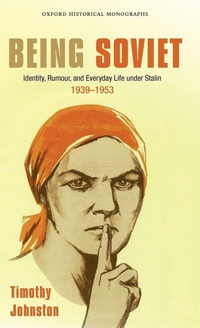
Being Soviet
Identity, Rumour, and Everyday Life under Stalin 1939-1953
Published on 18. August 2011
Book
Hardback
294 pages
978-0-19-960403-6 (ISBN)
Description
Being Soviet adopts a refreshing and innovative approach to the years between the Nazi-Soviet Pact and Stalin's death in the USSR.
Timothy Johnston draws on newspapers, films, plays, and popular music in order to examine the changing nature of Soviet identity in this era. He pays particular attention to the evolution of Britain and America from wartime allies to Cold War enemies.
Being Soviet then explores how ordinary citizens related to this official version of Soviet identity. It examines that question via the rumours, jazz music, hairstyles, jokes, anti-war campaigns, and sexual relationships of the time. Johnston argues that these 'everyday' activities defined Soviet identity for the man on the street in the USSR.
At the heart of the book is a sustained critique of the current emphasis on 'supporters' or 'resistors' of the regime. Johnston suggests that the shadow of Foucault looms too large in the history of Stalinism. The relationship between Soviet citizens and Soviet power was defined by the subtle tactics of everyday living. For many, life was not defined by 'belief' or 'unbelief' but rather the constant struggle to stay fed, informed, and entertained. This more nuanced approach offers a rich and textured image of what it meant to be Soviet in Stalin's least years.
Timothy Johnston draws on newspapers, films, plays, and popular music in order to examine the changing nature of Soviet identity in this era. He pays particular attention to the evolution of Britain and America from wartime allies to Cold War enemies.
Being Soviet then explores how ordinary citizens related to this official version of Soviet identity. It examines that question via the rumours, jazz music, hairstyles, jokes, anti-war campaigns, and sexual relationships of the time. Johnston argues that these 'everyday' activities defined Soviet identity for the man on the street in the USSR.
At the heart of the book is a sustained critique of the current emphasis on 'supporters' or 'resistors' of the regime. Johnston suggests that the shadow of Foucault looms too large in the history of Stalinism. The relationship between Soviet citizens and Soviet power was defined by the subtle tactics of everyday living. For many, life was not defined by 'belief' or 'unbelief' but rather the constant struggle to stay fed, informed, and entertained. This more nuanced approach offers a rich and textured image of what it meant to be Soviet in Stalin's least years.
Reviews / Votes
adds significantly to our understanding of World War II and the Cold War by showing some of the ways that ordinary Soviet citizens imagined the world around them during the Stalin years. * Eric Duskin, American Historical Review * Without any doubt, there is much to learn from this well researched and excellently organized book. * Robert Kindler, Journal of Social History * this is an ambitious and impressive monograph. * Ian D. Thatcher, European History Quarterly * Being Soviet is a significant contribution to studies of popular opinion and collective mentalites in modern dictatorships. * Alexey Tikhomirov, Slavonic and East European Review *More details
Series
Language
English
Place of publication
Oxford
United Kingdom
Target group
College/higher education
Professional and scholarly
Graduate and undergraduate students of the USSR and Soviet history; academics with a professional interest in Soviet studies
Illustrations
5 black and white images
Dimensions
Height: 222 mm
Width: 145 mm
Thickness: 21 mm
Weight
549 gr
ISBN-13
978-0-19-960403-6 (9780199604036)
Copyright in bibliographic data and cover images is held by Nielsen Book Services Limited or by the publishers or by their respective licensors: all rights reserved.
Schweitzer Classification
Other editions
Additional editions
E-Book
08/2011
OUP eBook
€66.49
Available for download
Person
Timothy Johnston is a former Junior Research Fellow in Modern European History of St. Peter's College, Oxford. This work is his first book and follows a number of well-received articles in Russian and English. He has left academia in order to pursue a career as a barrister but retains an active research interest in the Soviet Union under Stalin.
Content
PART 1: BEING SOVIET IN THE PRE-WAR ERA; PART 2: BEING SOVIET DURING THE GREAT PATRIOTIC WAR; PART 3: BEING SOVIET IN THE POST-WAR YEARS