

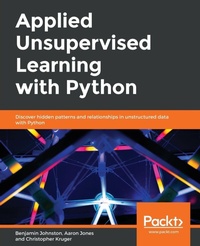
Applied Unsupervised Learning with Python
Discover hidden patterns and relationships in unstructured data with Python
Published on 28. May 2019
Book
Paperback/Softback
482 pages
978-1-78995-229-2 (ISBN)
Description
Design clever algorithms that can uncover interesting structures and hidden relationships in unstructured and unlabeled data
Key Features
Learn how to select the most suitable Python library to solve your problem
Compare k-Nearest Neighbor (k-NN) and non-parametric methods and decide when to use them
Explore the applications of neural networks using real-world datasets
Book DescriptionUnsupervised learning is a useful and practical solution in situations where labeled data is not available.
Applied Unsupervised Learning with Python guides you in learning the best practices for using unsupervised learning techniques in tandem with Python libraries and extracting meaningful information from unstructured data. The book begins by explaining how basic clustering works to find similar data points in a set. Once you are well-versed with the k-means algorithm and how it operates, you'll learn what dimensionality reduction is and where to apply it. As you progress, you'll learn various neural network techniques and how they can improve your model. While studying the applications of unsupervised learning, you will also understand how to mine topics that are trending on Twitter and Facebook and build a news recommendation engine for users. Finally, you will be able to put your knowledge to work through interesting activities such as performing a Market Basket Analysis and identifying relationships between different products.
By the end of this book, you will have the skills you need to confidently build your own models using Python.What you will learn
Understand the basics and importance of clustering
Build k-means, hierarchical, and DBSCAN clustering algorithms from scratch with built-in packages
Explore dimensionality reduction and its applications
Use scikit-learn (sklearn) to implement and analyze principal component analysis (PCA) on the Iris dataset
Employ Keras to build autoencoder models for the CIFAR-10 dataset
Apply the Apriori algorithm with machine learning extensions (Mlxtend) to study transaction data
Who this book is forThis course is designed for developers, data scientists, and machine learning enthusiasts who are interested in unsupervised learning. Some familiarity with Python programming along with basic knowledge of mathematical concepts including exponents, square roots, means, and medians will be beneficial.
Key Features
Learn how to select the most suitable Python library to solve your problem
Compare k-Nearest Neighbor (k-NN) and non-parametric methods and decide when to use them
Explore the applications of neural networks using real-world datasets
Book DescriptionUnsupervised learning is a useful and practical solution in situations where labeled data is not available.
Applied Unsupervised Learning with Python guides you in learning the best practices for using unsupervised learning techniques in tandem with Python libraries and extracting meaningful information from unstructured data. The book begins by explaining how basic clustering works to find similar data points in a set. Once you are well-versed with the k-means algorithm and how it operates, you'll learn what dimensionality reduction is and where to apply it. As you progress, you'll learn various neural network techniques and how they can improve your model. While studying the applications of unsupervised learning, you will also understand how to mine topics that are trending on Twitter and Facebook and build a news recommendation engine for users. Finally, you will be able to put your knowledge to work through interesting activities such as performing a Market Basket Analysis and identifying relationships between different products.
By the end of this book, you will have the skills you need to confidently build your own models using Python.What you will learn
Understand the basics and importance of clustering
Build k-means, hierarchical, and DBSCAN clustering algorithms from scratch with built-in packages
Explore dimensionality reduction and its applications
Use scikit-learn (sklearn) to implement and analyze principal component analysis (PCA) on the Iris dataset
Employ Keras to build autoencoder models for the CIFAR-10 dataset
Apply the Apriori algorithm with machine learning extensions (Mlxtend) to study transaction data
Who this book is forThis course is designed for developers, data scientists, and machine learning enthusiasts who are interested in unsupervised learning. Some familiarity with Python programming along with basic knowledge of mathematical concepts including exponents, square roots, means, and medians will be beneficial.
More details
Language
English
Place of publication
Birmingham
United Kingdom
Target group
Professional and scholarly
US School Grade: College Graduate Student
Dimensions
Height: 235 mm
Width: 191 mm
Thickness: 26 mm
Weight
892 gr
ISBN-13
978-1-78995-229-2 (9781789952292)
Copyright in bibliographic data and cover images is held by Nielsen Book Services Limited or by the publishers or by their respective licensors: all rights reserved.
Schweitzer Classification
Other editions
Additional editions
Benjamin Johnston | Aaron Jones Jones | Christopher Kruger
Applied Unsupervised Learning with Python
Discover hidden patterns and relationships in unstructured data with Python
E-Book
05/2019
Packt Publishing
€34.99
Available for download
Persons
Benjamin Johnston is a senior data scientist for one of the world's leading data-driven MedTech companies and is involved in the development of innovative digital solutions throughout the entire product development pathway, from problem definition to solution research and development, through to final deployment. He is currently completing his Ph.D. in ML, specializing in image processing and deep convolutional neural networks. He has more than 10 years of experience in medical device design and development, working in a variety of technical roles, and holds a first-class honors bachelor's degree in both engineering and medical science from the University of Sydney, Australia. Aaron Jones is a full-time senior data scientist and consultant. He has built models and data products while working in retail, media, and environmental science. Aaron is based in Seattle, Washington and has a particular interest in clustering algorithms, natural language processing, and Bayesian statistics. Christopher Kruger is a practicing data scientist and AI researcher. He has managed applied machine learning projects across multiple industries while mentoring junior team members on best practices. His primary focus is on pushing both business practicality as well as academic rigor in every project. Chris is currently developing research in the computer vision space.
Content
Table of Contents
Introduction to Clustering
Hierarchical Clustering
Neighborhood Approaches and DBSCAN
An Introduction to Dimensionality Reduction and PCA
Autoencoders
t-Distributed Stochastic Neighbor Embedding (t-SNE)
Topic Modeling
Market Basket Analysis
Hotspot Analysis
Introduction to Clustering
Hierarchical Clustering
Neighborhood Approaches and DBSCAN
An Introduction to Dimensionality Reduction and PCA
Autoencoders
t-Distributed Stochastic Neighbor Embedding (t-SNE)
Topic Modeling
Market Basket Analysis
Hotspot Analysis