

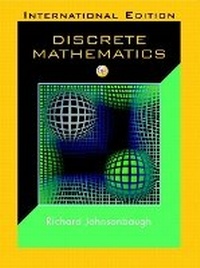
Discrete Mathematics
International Edition
6th Edition
Published on 9. September 2004
Book
Paperback/Softback
688 pages
978-0-13-127767-0 (ISBN)
Description
For a one- or two-term introductory course in discrete mathematics.
This best-selling book provides an accessible introduction to discrete mathematics, using an algorithmic approach that focuses on problem-solving techniques. The new edition weaves techniques of proofs into the text as a running theme. Each chapter has a special section dedicated to showing students how to attack and solve problems.
This best-selling book provides an accessible introduction to discrete mathematics, using an algorithmic approach that focuses on problem-solving techniques. The new edition weaves techniques of proofs into the text as a running theme. Each chapter has a special section dedicated to showing students how to attack and solve problems.
More details
Edition
6th edition
Language
English
Place of publication
United States
Publishing group
Pearson Education (US)
Target group
Professional and scholarly
Dimensions
Height: 276 mm
Width: 211 mm
Thickness: 22 mm
Weight
1314 gr
ISBN-13
978-0-13-127767-0 (9780131277670)
Copyright in bibliographic data and cover images is held by Nielsen Book Services Limited or by the publishers or by their respective licensors: all rights reserved.
Schweitzer Classification
Other editions
New editions
Book
02/2008
7th Edition
Pearson
€129.98
Article exhausted; check for reprint
Content
(NOTE: All Chapters end with Notes, Chapter Review, Chapter Self-Test, and Computer Exercises.)
Preface.
1. Logic and Proofs.
Propositions. Conditional Propositions and Logical Equivalence. Quantifiers. Proofs. Resolution Proofs. Mathematical Induction. Strong Form of Induction and well ordering Property.
2. The Language of Mathematics
Sets. Functions. Sequences and Strings. Relations.
3. Relations.
Relations. Equivalence Relations. Matrices of Relations. Relational Databases.
4. Algorithms.
Introduction. Correctness of Algorithms. Analysis of Algorithms. Recursive Algorithms.
5. Introduction to Number Theory.
Divisors. Representation of Integers and Integer Algorithims. The Euclidean Algorithm. The RSA Public-Key Cryptosystem.
6. Counting Methods and the Pigeonhole Principle.
Basic Principles. Permutations and Combinations. Algorithms for Generating Permutations and Combinations. Introduction to Discrete Probability. Discrete Probability Theory. Generalized Permutations and Combinations. Binomial Coefficients and Combinatorial Identities. The Pigeonhole Principle.
7. Recurrence Relations.
Introduction. Solving Recurrence Relations. Applications to the Analysis of Algorithms.
8. Graph Theory.
Introduction. Paths and Cycles. Hamiltonian Cycles and the Traveling Salesperson Problem. A Shortest-Path Algorithm. Representations of Graphs. Isomorphisms of Graphs. Planar Graphs. Instant Insanity.
9. Trees.
Introduction. Terminology and Characterizations of Trees. Spanning Trees. Minimal Spanning Trees. Binary Trees. Tree Traversals. Decision Trees and the Minimum Time for Sorting. Isomorphisms of Trees. Game Trees.
10. Network Models.
Introduction. A Maximal Flow Algorithm. The Max Flow, Min Cut Theorem. Matching.
11. Boolean Algebras and Combinatorial Circuits.
Combinatorial Circuits. Properties of Combinatorial Circuits. Boolean Algebras. Boolean Functions and Synthesis of Circuits. Applications
12. Automata, Grammars, and Languages.
Sequential Circuits and Finite-State Machines. Finite-State Automata. Languages and Grammars. Nondeterministic Finite-State Automata. Relationships Between Languages and Automata.
13. Computational Geometry.
The Closest-Pair Problem. An Algorithm to Compute the Convex Hull.
Appendices.
Matrices. Algebra Review.
References.
Hints and Solutions to Selected Exercises.
Index.
Preface.
1. Logic and Proofs.
Propositions. Conditional Propositions and Logical Equivalence. Quantifiers. Proofs. Resolution Proofs. Mathematical Induction. Strong Form of Induction and well ordering Property.
2. The Language of Mathematics
Sets. Functions. Sequences and Strings. Relations.
3. Relations.
Relations. Equivalence Relations. Matrices of Relations. Relational Databases.
4. Algorithms.
Introduction. Correctness of Algorithms. Analysis of Algorithms. Recursive Algorithms.
5. Introduction to Number Theory.
Divisors. Representation of Integers and Integer Algorithims. The Euclidean Algorithm. The RSA Public-Key Cryptosystem.
6. Counting Methods and the Pigeonhole Principle.
Basic Principles. Permutations and Combinations. Algorithms for Generating Permutations and Combinations. Introduction to Discrete Probability. Discrete Probability Theory. Generalized Permutations and Combinations. Binomial Coefficients and Combinatorial Identities. The Pigeonhole Principle.
7. Recurrence Relations.
Introduction. Solving Recurrence Relations. Applications to the Analysis of Algorithms.
8. Graph Theory.
Introduction. Paths and Cycles. Hamiltonian Cycles and the Traveling Salesperson Problem. A Shortest-Path Algorithm. Representations of Graphs. Isomorphisms of Graphs. Planar Graphs. Instant Insanity.
9. Trees.
Introduction. Terminology and Characterizations of Trees. Spanning Trees. Minimal Spanning Trees. Binary Trees. Tree Traversals. Decision Trees and the Minimum Time for Sorting. Isomorphisms of Trees. Game Trees.
10. Network Models.
Introduction. A Maximal Flow Algorithm. The Max Flow, Min Cut Theorem. Matching.
11. Boolean Algebras and Combinatorial Circuits.
Combinatorial Circuits. Properties of Combinatorial Circuits. Boolean Algebras. Boolean Functions and Synthesis of Circuits. Applications
12. Automata, Grammars, and Languages.
Sequential Circuits and Finite-State Machines. Finite-State Automata. Languages and Grammars. Nondeterministic Finite-State Automata. Relationships Between Languages and Automata.
13. Computational Geometry.
The Closest-Pair Problem. An Algorithm to Compute the Convex Hull.
Appendices.
Matrices. Algebra Review.
References.
Hints and Solutions to Selected Exercises.
Index.