

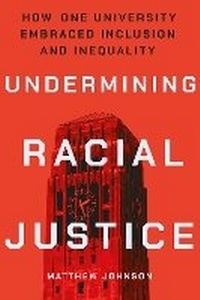
Undermining Racial Justice
How One University Embraced Inclusion and Inequality
Published on 15. April 2020
Book
Hardback
336 pages
978-1-5017-4858-5 (ISBN)
Description
Over the last sixty years, administrators on college campuses nationwide have responded to black campus activists by making racial inclusion and inequality compatible.
This bold argument is at the center of Matthew Johnson's powerful and controversial book. Focusing on the University of Michigan, often a key talking point in national debates about racial justice thanks to the contentious Gratz v. Bollinger 2003 Supreme Court case, Johnson argues that UM leaders incorporated black student dissent selectively into the institution's policies, practices, and values. This strategy was used to prevent activism from disrupting the institutional priorities that campus leaders deemed more important than racial justice. Despite knowing that racial disparities would likely continue, Johnson demonstrates that these administrators improbably saw themselves as champions of racial equity.
What Johnson contends in Undermining Racial Justice is not that good intentions resulted in unforeseen negative consequences, but that the people who created and maintained racial inequities at premier institutions of higher education across the United States firmly believed they had good intentions in spite of all the evidence to the contrary. The case of the University of Michigan fits into a broader pattern at elite colleges and universities and is a cautionary tale for all in higher education. As Matthew Johnson illustrates, inclusion has always been a secondary priority, and, as a result, the policies of the late 1970s and 1980s ushered in a new and enduring era of racial retrenchment on campuses nationwide.
This bold argument is at the center of Matthew Johnson's powerful and controversial book. Focusing on the University of Michigan, often a key talking point in national debates about racial justice thanks to the contentious Gratz v. Bollinger 2003 Supreme Court case, Johnson argues that UM leaders incorporated black student dissent selectively into the institution's policies, practices, and values. This strategy was used to prevent activism from disrupting the institutional priorities that campus leaders deemed more important than racial justice. Despite knowing that racial disparities would likely continue, Johnson demonstrates that these administrators improbably saw themselves as champions of racial equity.
What Johnson contends in Undermining Racial Justice is not that good intentions resulted in unforeseen negative consequences, but that the people who created and maintained racial inequities at premier institutions of higher education across the United States firmly believed they had good intentions in spite of all the evidence to the contrary. The case of the University of Michigan fits into a broader pattern at elite colleges and universities and is a cautionary tale for all in higher education. As Matthew Johnson illustrates, inclusion has always been a secondary priority, and, as a result, the policies of the late 1970s and 1980s ushered in a new and enduring era of racial retrenchment on campuses nationwide.
Reviews / Votes
If I were asked to identify a single book published in 2020 that profoundly changed the way I look at higher education, it would be Matthew Johnson's Undermining Racial Justice.(Inside Higher Ed) In his groundbreaking book, Undermining Racial Justice, Matthew Johnson does an excellent job examining how, over the last sixty years, 'campus leaders embraced racial inclusion only so far as it could coexist with [their] long-standing values and priorities.' As Johnson writes, we must understand the policies and the people who created them if we are to ever understand that 'inequality is a choice' and that we can 'demand choices that lead to equality.' We must remain vigilant, and Undermining Racial Justice will help us fight back.
(History of Education Quarterly) Matthew Johnson's Undermining Racial Justice: How One University Embraced Inclusion and Inequality provides a critical account of how the University of Michigan, long heralded as an exemplar of campus diversity policy, made racial inclusion compatible with inequality, largely through co-optation of the demands of student activists over decades. Though Johnson examines the implementation of race-access policy at the Michigan over a fifty-year period, his insights are fruitful for a contemporary landscape rife with threats to affirmative action, critique of diversity rhetoric, and proposed reform. Johnson's text greatly contributes to scholarship on affirmative action in higher education, the bureaucracy of diversity, and more broadly policy making and social movement demobilization.
(The Journal of African American History)
More details
Series
Language
English
Place of publication
Ithaca
United States
Target group
College/higher education
Product notice
Paper over boards
Dimensions
Height: 229 mm
Width: 152 mm
Thickness: 28 mm
Weight
907 gr
ISBN-13
978-1-5017-4858-5 (9781501748585)
Copyright in bibliographic data and cover images is held by Nielsen Book Services Limited or by the publishers or by their respective licensors: all rights reserved.
Schweitzer Classification
Other editions
Additional editions
E-Book
04/2020
Cornell University Press
€23.49
Available for download
Person
Matthew Johnson is Associate Professor of History at Washington & Jefferson College. Follow him on X @matthist83.
Content
Introduction: Preserving Inequality
1. Bones and Sinews
2. The Origins of Affirmative Action
3. The Rise of the Black Campus Movement
4. Controlling Inclusion
5. Affirmative Action for Whom?
6. Sustaining Racial Retrenchment
7. The Michigan Mandate
8. Gratz v. Bollinger
Epilogue: The University as Victim
1. Bones and Sinews
2. The Origins of Affirmative Action
3. The Rise of the Black Campus Movement
4. Controlling Inclusion
5. Affirmative Action for Whom?
6. Sustaining Racial Retrenchment
7. The Michigan Mandate
8. Gratz v. Bollinger
Epilogue: The University as Victim