

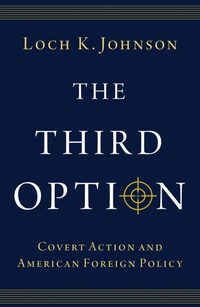
The Third Option
Covert Action and American Foreign Policy
Published on 20. June 2024
Book
Paperback/Softback
408 pages
978-0-19-777925-5 (ISBN)
Description
Loch Johnson explores the subject of covert action, often referred to as a "Third Option" between America's use of diplomacy and warfare-a shadowy approach to international affairs based on the controversial use of secret propaganda, political activities, economic sabotage, and paramilitary operations (whether clandestine warfare or assassinations).
The three major instruments that guide United States foreign policy are the Treaty Power, the War Power, and the Spy Power. Within the category of Spy Power is the "Third Option": the use of covert action. Ever since the creation of the Central Intelligence Agency in 1947, the US has often turned to the third option in the conduct of its international relations. This controversial approach includes covert propaganda campaigns, subversive political activities, economic sabotage, and paramilitary operations ranging from clandestine warfare to the assassination of foreign leaders. From the beginning of the Cold War to the present day, America's intelligence and national security agencies have employed all of these "third option" tools in order to advance America's global interests.
In The Third Option, the eminent national security scholar Loch Johnson provides a history of American covert warfare from 1947 to the present. In particular, he focuses on the morality and consequences of America's heavily veiled attempts to shape global affairs through its covert actions. Over the course of the book, a fundamental question comes into focus: Of what value has the Third Option been to the US as a complement to the nation's more open battlefield and diplomatic initiatives? Just as importantly, Johnson exposes the conflict between this controversial approach to achieving America's international objectives and the ideals that the US has always propounded: democracy, human rights, and liberalism. The Third Option closes with a sharp assessment of the policy, measuring its failures versus its successes. A richly detailed synthesis of America's covert action program ever since it became the world's preeminent power, this book serves as an ideal introduction for anyone interested in US foreign and national security policy.
The three major instruments that guide United States foreign policy are the Treaty Power, the War Power, and the Spy Power. Within the category of Spy Power is the "Third Option": the use of covert action. Ever since the creation of the Central Intelligence Agency in 1947, the US has often turned to the third option in the conduct of its international relations. This controversial approach includes covert propaganda campaigns, subversive political activities, economic sabotage, and paramilitary operations ranging from clandestine warfare to the assassination of foreign leaders. From the beginning of the Cold War to the present day, America's intelligence and national security agencies have employed all of these "third option" tools in order to advance America's global interests.
In The Third Option, the eminent national security scholar Loch Johnson provides a history of American covert warfare from 1947 to the present. In particular, he focuses on the morality and consequences of America's heavily veiled attempts to shape global affairs through its covert actions. Over the course of the book, a fundamental question comes into focus: Of what value has the Third Option been to the US as a complement to the nation's more open battlefield and diplomatic initiatives? Just as importantly, Johnson exposes the conflict between this controversial approach to achieving America's international objectives and the ideals that the US has always propounded: democracy, human rights, and liberalism. The Third Option closes with a sharp assessment of the policy, measuring its failures versus its successes. A richly detailed synthesis of America's covert action program ever since it became the world's preeminent power, this book serves as an ideal introduction for anyone interested in US foreign and national security policy.
Reviews / Votes
He offers a framework for evaluating the ethics of covert action, which he applies to exemplary cases from the last 75 years. Readers might apply this framework differently in some cases, but it is a good model. Johnson's book will have lasting utility for evaluating the US's ongoing use of covert action. * T. C. Ellington, Wesleyan College, CHOICE * ...the book offers a characteristically thoughtful contribution to the growing literature. * Rory Cormac, University of Nottingham, UK, International Affairs * A wonderfully rich book by the dean of American students of intelligence. Johnson combines inside experience from various positions in the Congress with a lifetime of scholarship on intelligence. He pays particular attention to the role of Congress and the ethical dimension of covert action. The book provides invaluable background as covert action enters yet another phase in the cyber world. * Greg Treverton, former Chair, National Intelligence Council * No informed scholar has written about American intelligence from more angles and with more informed knowledge than Johnson. His new analysis of covert action maintains his record for thoroughness, insight, and fairness on all aspects of intelligence, and provides fascinating reading in the bargain. * Richard K. Betts, Professor of War and Peace Studies, Columbia University * In this richly detailed book, Johnson provides a framework for evaluating covert action in ethical terms. It is a landmark study-essential reading for all those studying or working in the fields of intelligence and foreign policy. * Mark Phythian, Professor of Politics, University of Leicester * There is no better chronicler of the American intelligence community than Johnson. In his latest book, a tour de force study of covert action, he once again dazzles readers with the breadth and depth of his knowledge of national security affairs. In this important and illuminating look at propaganda, paramilitary operations, and lethal measures, he shows how the nation's leaders have all too often been seduced by the power of covert action and paid the price, damaging what intelligence activity is meant to defend-freedom. * Christopher R. Moran, , Professor of US National Security, University of Warwick * Covert action-propaganda, coups, assassinations-are a comparatively recent 'third option' for US presidents acting in your name. Johnson gives a disquieting but readable history and a persuasive argument for why you should want the option limited or taken off the table. * James H. Johnston, author of Murder, Inc. * A sweeping, judicious, and lively account of covert action. Johnson, the reigning dean of American intelligence scholars, draws on his encyclopedic knowledge of the history of the CIA and forthrightly recounts decades of payoffs, propaganda, poisoning plots, coups, and drone killings. His clear-eyed assessment of what worked and what backfired should be read by every policymaker and spymaster. * Scott Shane, former New York Times national security reporter * Loch Johnson has an astonishing grasp of the history of U.S. covert action since the beginning of the Cold War in the Truman era all the way through the beginnings of the Biden era. Drawing on that knowledge, he judges the Third Option by way of constitutional, ethical, and pragmatic criteria, and does so brilliantly. Any student, journalist, or citizen wishing to understand the pro's and con's of covert action as a tool of foreign policy should read this book. * David M. Barrett, Villanova University * Johnson remains objective and balanced with respect to both the achievements and the failures of U.S. covert action. He points to some of the challenges for effective intelligence oversight and also highlights the dysfunction in government that impacts the use of intelligence and covert action, especially as it concerned the Trump administration. The book strangely ends on a very optimistic note by proposing a fourth option: "...the virtue of leading by example" (275). * Armin Krishnan, East Carolina University, Congress & the Presidency * The Third Option, captures Johnson's vast experience and knowledge of the intricacies of covert action. Combined with his typically eloquent and accessible style of writing, The Third Option gives students, novice scholars and enthusiasts a well-rounded account of US covert action and its place in the broader context of US foreign policy. * Magda Long, King's College London, International Spectator * . . . . the most thorough, thoughtful, provocative, and extensively documented contribution to the literature of covert action as an element of the intelligence profession. * Hayden Peake, CIA, Studies in Intelligence *More details
Language
English
Place of publication
New York
United States
Target group
Professional and scholarly
Product notice
Paperback (trade)
Unsewn / adhesive bound
Illustrations
12
Dimensions
Height: 224 mm
Width: 146 mm
Thickness: 29 mm
Weight
516 gr
ISBN-13
978-0-19-777925-5 (9780197779255)
Copyright in bibliographic data and cover images is held by Nielsen Book Services Limited or by the publishers or by their respective licensors: all rights reserved.
Schweitzer Classification
Other editions
Additional editions
E-Book
11/2021
OUP eBook
€15.49
Available for download
E-Book
11/2021
OUP eBook
€15.49
Available for download
Person
Loch K. Johnson is Regents Professor Emeritus of International Affairs at the University of Georgia. His recent books include Spy Watching (Oxford University Press 2018) and National Security Intelligence (Polity 2017). He served as assistant to Chairman Frank Church, Senate Committee on Intelligence; as the first staff director for oversight, House Committee on Intelligence; and as assistant to Chairman Les Aspin, Presidential Commission on Intelligence. Professor Johnson led the founding of the School of Public and International Affairs (SPIA) at the University of Georgia. He was the inaugural "Professor of the Year" for the Southeast Conference consortium of universities, and he is a recipient of the Presidential Medal at the University of Georgia.
Content
Figures and Tables
Preface
Introduction: The Hidden World of Clandestine Interventions
PART I: TRADECRAFT
1. The Forms of Covert Action
2. A Ladder of Clandestine Escalation
PART II: PRACTICE, 1947-1975
3. A Shadowy Foreign Policy, 1947-1960
4. Murder Most Foul, 1960-1975
PART III: PRACTICE, 1975-2020
5. A New Approach to Covert Action, 1975-2000
6. The Third Option in an Age of Terror, 2000-2020
PART IV: LAW AND ACCOUTABILITY
7. Legal Foundations
8. Decision Paths and Accountability
PART V: ETHICS AND ASSESSMENTS
9. Drawing Bright Lines: Ethics and Covert Action
10. The Third Option Reconsidered
Acknowledgments
Appendix A: Intelligence Leadership in the United States, 1946-2020
Appendix B: Intelligence Oversight Act of 1980
Notes
Abbreviations and Codenames
References and Further Reading
Index
Preface
Introduction: The Hidden World of Clandestine Interventions
PART I: TRADECRAFT
1. The Forms of Covert Action
2. A Ladder of Clandestine Escalation
PART II: PRACTICE, 1947-1975
3. A Shadowy Foreign Policy, 1947-1960
4. Murder Most Foul, 1960-1975
PART III: PRACTICE, 1975-2020
5. A New Approach to Covert Action, 1975-2000
6. The Third Option in an Age of Terror, 2000-2020
PART IV: LAW AND ACCOUTABILITY
7. Legal Foundations
8. Decision Paths and Accountability
PART V: ETHICS AND ASSESSMENTS
9. Drawing Bright Lines: Ethics and Covert Action
10. The Third Option Reconsidered
Acknowledgments
Appendix A: Intelligence Leadership in the United States, 1946-2020
Appendix B: Intelligence Oversight Act of 1980
Notes
Abbreviations and Codenames
References and Further Reading
Index