

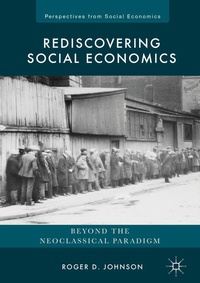
Rediscovering Social Economics
Beyond the Neoclassical Paradigm
Published on 2. March 2017
Book
Hardback
XV, 191 pages
978-3-319-51264-8 (ISBN)
Description
This book argues that economists need to reengage with societal issues, such as justice and fairness in distribution, that inevitably arise when discussing the basic economic problem of unlimited human wants and finite resources. Approaching the problem through a history of economic thought, Johnson reexamines Adam Smith's contributions to show how they reach beyond neoclassical models that are too simplistic to reflect the growing interdependencies of market economies. He breaks down supposedly value-free neoclassical postulates to expose normative assumptions about economics and justice, demonstrating, for example, that the concept of market equilibrium is problematic because need-based behavior can produce involuntary unemployment even when a competitive labor market achieves equilibrium.
More details
Series
Edition
1st ed. 2017
Language
English
Place of publication
Cham
Switzerland
Publishing group
Springer International Publishing
Target group
Professional and scholarly
Illustrations
25 farbige Abbildungen, 7 s/w Abbildungen
XV, 191 p. 32 illus., 25 illus. in color.
Dimensions
Height: 216 mm
Width: 153 mm
Thickness: 16 mm
Weight
388 gr
ISBN-13
978-3-319-51264-8 (9783319512648)
DOI
10.1007/978-3-319-51265-5
Schweitzer Classification
Other editions
Additional editions

Book
07/2018
Palgrave Macmillan
€117.69
Shipment within 10-15 days

E-Book
02/2017
Palgrave Macmillan
€106.99
Available for download
Person
Roger D. Johnson is a retired Professor of Economics from Messiah College, USA. He earned the Helen Potter Award from the Association for Social Economics for best article appearing in the
Review of Social Economics
in 1990.
Content
1. The Foundations of Economics.- 2. The Political and Moral Dimension of Economics.- 3. The Moral and Social Problem of Scarcity.- 4. Social Welfare, Markets and Efficiency.- 5. Understanding Human Choice.- 6. Challenges to Homo Economicus.- 8. The Supply of Labor.- 10. Labor Market Equilibrium?.- 11. The Mondragón Alternative.- 12. Financial Markets and the Growth of Plutonomies.- 13. The Evolving Dialogue.