

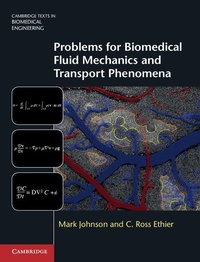
Problems for Biomedical Fluid Mechanics and Transport Phenomena
Published on 9. December 2013
Book
Hardback
181 pages
978-1-107-03769-4 (ISBN)
Description
How does one deal with a moving control volume? What is the best way to make a complex biological transport problem tractable? Which principles need to be applied to solve a given problem? How do you know if your answer makes sense? This unique resource provides over two hundred well-tested biomedical engineering problems that can be used as classroom and homework assignments, quiz material and exam questions. Questions are drawn from a range of topics, covering fluid mechanics, mass transfer and heat transfer applications. Driven by the philosophy that mastery of biotransport is learned by practice, these problems aid students in developing the key skills of determining which principles to apply and how to apply them. Each chapter starts with basic problems and progresses to more difficult questions. Lists of material properties, governing equations and charts provided in the appendices make this a fully self-contained work. Solutions are provided online for instructors.
More details
Series
Language
English
Place of publication
Cambridge
United Kingdom
Target group
Professional and scholarly
Illustrations
Worked examples or Exercises; 3 Tables, black and white; 2 Halftones, unspecified; 134 Line drawings, unspecified
Dimensions
Height: 260 mm
Width: 208 mm
Thickness: 15 mm
Weight
626 gr
ISBN-13
978-1-107-03769-4 (9781107037694)
Copyright in bibliographic data and cover images is held by Nielsen Book Services Limited or by the publishers or by their respective licensors: all rights reserved.
Schweitzer Classification
Other editions
Additional editions
E-Book
12/2013
Cambridge University Press
€88.99
Available for download
Mark Johnson | C. Ross Ethier
Problems for Biomedical Fluid Mechanics and Transport Phenomena
E-Book
11/2013
1st Edition
Cambridge University Press
€105.99
Available for download
Persons
Mark Johnson is Professor of Biomedical Engineering, Mechanical Engineering and Ophthalmology at Northwestern University. He has made substantial contributions to the study of the pathogenesis of glaucoma and of age-related macular degeneration of the retina. His academic interests include biofluid and biotransport issues, especially those related to ocular biomechanics. C. Ross Ethier is the Lawrence L. Gellerstedt, Jr Chair in Bioengineering and a Georgia Research Alliance Eminent Scholar in Biomechanics and Mechanobiology at Georgia Tech and Emory University. His academic interests include cell and tissue biomechanics and mechanobiology. He is co-author of Introductory Biomechanics: From Cells to Organisms as part of the Cambridge Texts in Biomedical Engineering.
Content
Preface; 1. Problem solving; 2. Conservation of mass and the Reynolds Transport Theorem; 3. Steady and unsteady Bernoulli and momentum conservation; 4. Viscous flow; 5. Momentum boundary layers; 6. Piping systems, friction factors and drag coefficients; 7. Problems involving surface tension; 8. Non-Newtonian blood flow; 9. Dimensional analysis; 10. Statistical mechanics; 11. Steady diffusion and conduction; 12. Unsteady diffusion and conduction; 13. Convection of mass and heat; 14. Concentration and thermal boundary layers; 15. Mass and heat transfer coefficients; 16. Osmotic pressure; Appendix A. Material properties; Appendix B. Transport equations; Appendix C. Charts; References; Acknowledgements.