

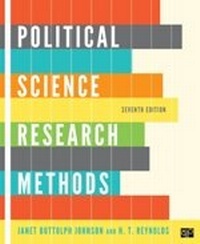
Political Science Research Methods
7th Edition
Published on 17. January 2012
Book
Paperback/Softback
680 pages
978-1-60871-689-0 (ISBN)
Description
Political Science Research Methods set the standard for being relevant, comprehensive, and ever-mindful of its student audience. With the seventh edition, the authors further refine their popular text to be more welcoming and more intuitive than ever-an ideal gateway to understanding not just the "how" but also the "why" behind research in the discipline.
Updates to this new edition include:
- new case studies of political science research in chapter 1-from causes of income inequality, to repression of human rights, to judicial decision making-that serve as touchpoints throughout the book;
- updated discussion in chapter 2 about the empirical approach to political science;
- a heavily revamped chapter 3 with clearer guidance on how to develop research questions along with steps for doing a literature review more appropriately placed earlier in the text;
- new extended case study on polling and the health care debate in chapter 7 on sampling;
- greater explanation of how to do content analysis in chapter 9 on document analysis;
- separate chapters for descriptive and inferential statistics step out instruction and increase accessibility; and
- a brand new annotated research article in chapter 16.
Bolded key terms, a glossary and explanatory charts, figures, and tables help aid students learning. "Helpful-hint" boxes give students nuts-and-bolts reminders they can refer to when conducting their own research.
Updates to this new edition include:
- new case studies of political science research in chapter 1-from causes of income inequality, to repression of human rights, to judicial decision making-that serve as touchpoints throughout the book;
- updated discussion in chapter 2 about the empirical approach to political science;
- a heavily revamped chapter 3 with clearer guidance on how to develop research questions along with steps for doing a literature review more appropriately placed earlier in the text;
- new extended case study on polling and the health care debate in chapter 7 on sampling;
- greater explanation of how to do content analysis in chapter 9 on document analysis;
- separate chapters for descriptive and inferential statistics step out instruction and increase accessibility; and
- a brand new annotated research article in chapter 16.
Bolded key terms, a glossary and explanatory charts, figures, and tables help aid students learning. "Helpful-hint" boxes give students nuts-and-bolts reminders they can refer to when conducting their own research.
Reviews / Votes
The authors do a great job in including many research topics in the text--it is the book's major strength. Also it is very well-organized, which helps students see the logical progression among topics. As the Instructor, I enjoy how the book's level of specificity. -- Brandy Faulkner * Current Edition Review--Faulkner * "Political Science Research Methods' primary strengths are the intuitive and example-based discussions of the necessity of and the execution of research methods. Simply put, it is an easier book through which to understand the research process in political science, see examples of that research process in journals, and to begin to comprehend how the research process would be integrated in the student's own research program." -- David Sacko * Current Edition Review--Sacko * "What I really like about the book is its simplicity and straightforward language. Methods is usually a tough subject matter for students to wrap their heads around. This text I find cogent, clear, and 'doable' for students.""I truly believe this is one of the best texts for methods out there-for the range of students we have at my school in terms of ability and aptitude... Compared to other texts I have examined (and I have examined many), this one is the best, in my opinion, for my students." -- Gina Woodall * Current Edition Review--Woodall * "The book is very clearly written and comprehensive and does a fine job in covering most of the essential criteria of a certain type of empirical political science research." -- Nick Jorgensen * Current Edition Review--Jorgensen *
More details
Edition
7th Revised edition
Language
English
Place of publication
Washington
United States
Publishing group
SAGE Publications Inc
Target group
College/higher education
Edition type
Revised edition
Dimensions
Height: 232 mm
Width: 191 mm
Weight
930 gr
ISBN-13
978-1-60871-689-0 (9781608716890)
Copyright in bibliographic data and cover images is held by Nielsen Book Services Limited or by the publishers or by their respective licensors: all rights reserved.
Schweitzer Classification
Other editions
New editions
Janet B. Johnson | H. T. Reynolds | Jason D. Mycoff
Political Science Research Methods
Book
11/2015
8th Edition
CQ Press
€130.73
Article exhausted; check for reprint
Previous edition
Janet B. Johnson | H. T. Reynolds | Jason D. Mycoff
Political Science Research Methods
Book
12/2007
6th Edition
CQ Press
€69.51
Article exhausted; check for reprint
Persons
Janet Buttolph Johnson is associate professor of political science and international relations at the University of Delaware, where she specializes in public policy, state and local politics, and environmental policy and politics.
H. T. Reynolds is professor emeritus of political science at the University of Delaware. He is author of Governing America, with David Volger; The Analysis of Nominal Data, Second Edition; and several articles on methodology.
H. T. Reynolds is professor emeritus of political science at the University of Delaware. He is author of Governing America, with David Volger; The Analysis of Nominal Data, Second Edition; and several articles on methodology.
Content
Introduction
The Empirical Approach to Political Science
Beginning the Research Process: Identifying a Topic, Developing Questions, and Reviewing the Literature
The Building Blocks of Social Scientific Research: Hypotheses, Concepts, and Variables
The Building Blocks of Social Scientific Research: Measurement
Research Design: Making Causal Inferences
Sampling
Making Empirical Observations: Direct and Indirect Observation
Document Analysis: Using the Written Record
Survey Research and Interviewing
Making Sense of Data: First Steps
Statistical Inference
Investigating Relationships between Two Variables
Multivariate Analysis
The Research Report: An Annotated Example
The Empirical Approach to Political Science
Beginning the Research Process: Identifying a Topic, Developing Questions, and Reviewing the Literature
The Building Blocks of Social Scientific Research: Hypotheses, Concepts, and Variables
The Building Blocks of Social Scientific Research: Measurement
Research Design: Making Causal Inferences
Sampling
Making Empirical Observations: Direct and Indirect Observation
Document Analysis: Using the Written Record
Survey Research and Interviewing
Making Sense of Data: First Steps
Statistical Inference
Investigating Relationships between Two Variables
Multivariate Analysis
The Research Report: An Annotated Example