

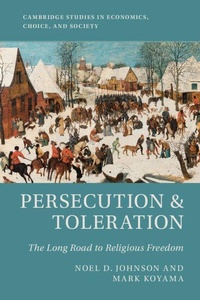
Persecution and Toleration
The Long Road to Religious Freedom
Published on 14. February 2019
Book
Paperback/Softback
368 pages
978-1-108-44116-2 (ISBN)
Description
Religious freedom has become an emblematic value in the West. Embedded in constitutions and championed by politicians and thinkers across the political spectrum, it is to many an absolute value, something beyond question. Yet how it emerged, and why, remains widely misunderstood. Tracing the history of religious persecution from the Fall of Rome to the present-day, Noel D. Johnson and Mark Koyama provide a novel explanation of the birth of religious liberty. This book treats the subject in an integrative way by combining economic reasoning with historical evidence from medieval and early modern Europe. The authors elucidate the economic and political incentives that shaped the actions of political leaders during periods of state building and economic growth.
Reviews / Votes
'A profound new argument about the relationship between political power and religion in the making of the modern world. If you want to know where the liberty you currently enjoy, for now, came from, this is the book to read.' James Robinson, Richard L. Pearson Professor of Global Conflict, University of Chicago 'Johnson and Koyama investigate the fascinating intersection of the state and religion in late medieval and early modern Europe. Rather than enduring patterns of religious toleration or persecution, of liberty or tyranny, they tell a rich history of change and variation in rules, institutions, and societies. This is an important and persuasive book.' John Joseph Wallis, Mancur Olson Professor of Economics, University of Maryland, College Park 'Lucidly written, incisively argued, this book shows how religious toleration emerged not only from ideas, but also from institutions which motivated people - especially the powerful - to accept and act on those ideas. A brilliant account of early modern Europe's transition from identity-based privileges to open markets and impartial governance.' Sheilagh Ogilvie, University of Cambridge 'This analysis of the historical process underlying the modern state formation is a fantastic scholarly accomplishment. The implications for the present, in terms of the risks associated to the loss of the core liberal values of modern western states, will not be lost to the careful reader.' Alberto Bisin, New York UniversityMore details
Series
Language
English
Place of publication
Cambridge
United Kingdom
Target group
Professional and scholarly
Product notice
Paperback (trade)
Illustrations
Worked examples or Exercises
Dimensions
Height: 229 mm
Width: 152 mm
Thickness: 22 mm
Weight
600 gr
ISBN-13
978-1-108-44116-2 (9781108441162)
Copyright in bibliographic data and cover images is held by Nielsen Book Services Limited or by the publishers or by their respective licensors: all rights reserved.
Schweitzer Classification
Other editions
Additional editions
E-Book
03/2019
Cambridge University Press
€26.49
Available for download
Book
02/2019
Cambridge University Press
€79.80
Shipment within 15-20 days
Persons
Noel D. Johnson is an Associate Professor of Economics at George Mason University, Virginia and a Senior Research Fellow at the Mercatus Center.
Content
1. Toleration, persecution, and state capacity; Part I. Conditional Toleration: 2 Religion and the state in the premodern world; 3. Why do states persecute?; 4. Jewish communities, conditional toleration, and rent-seeking; 5. Climatic shocks and persecutions; 6. The shock of the Black Death; Part II. The Origins of Religious Freedom: 7. State building and the reformation; 8. The inquisition and the establishment of religious homogeneity in Spain; 9. From confessionalization to toleration and then to religious liberty; 10. From persecution to emancipation; Part III. Implications of Greater Religious Liberty: 11. The persecution of witchcraft; 12. Religious minorities and economic growth; 13. The emergence of modern states, religious freedom, and modern economic growth; 14. Applying our argument to the rest of the world; 15. Modern states, liberalism, and religious freedom; 16. Conclusions.