

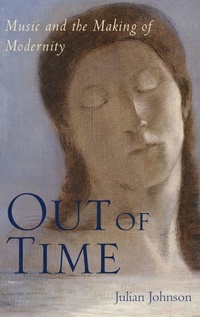
Out of Time
Music and the Making of Modernity
Published on 16. April 2015
Book
Hardback
400 pages
978-0-19-023327-3 (ISBN)
Description
What does music have to say about modernity? How can this apparently unworldly art tell us anything about modern life?
In Out of Time, author Julian Johnson begins from the idea that it can, arguing that music renders an account of modernity from the inside, a history not of events but of sensibility, an archaeology of experience. If music is better understood from this broad perspective, our idea of modernity itself is also enriched by the specific insights of music. The result is a rehearing of modernity and a rethinking of music - an account that challenges ideas of linear progress and reconsiders the common concerns of music, old and new.
If all music since 1600 is modern music, the similarities between Monteverdi and Schoenberg, Bach and Stravinsky, or Beethoven and Boulez, become far more significant than their obvious differences. Johnson elaborates this idea in relation to three related areas of experience - temporality, history and memory; space, place and technology; language, the body, and sound. Criss-crossing four centuries of Western culture, he moves between close readings of diverse musical examples (from the madrigal to electronic music) and drawing on the history of science and technology, literature, art, philosophy, and geography. Against the grain of chronology and the usual divisions of music history, Johnson proposes profound connections between musical works from quite different times and places. The multiple lines of the resulting map, similar to those of the London Underground, produce a bewildering network of plural connections, joining Stockhausen to Galileo, music printing to sound recording, the industrial revolution to motivic development, steam trains to waltzes.
A significant and groundbreaking work, Out of Time is essential reading for anyone interested in the history of music and modernity.
In Out of Time, author Julian Johnson begins from the idea that it can, arguing that music renders an account of modernity from the inside, a history not of events but of sensibility, an archaeology of experience. If music is better understood from this broad perspective, our idea of modernity itself is also enriched by the specific insights of music. The result is a rehearing of modernity and a rethinking of music - an account that challenges ideas of linear progress and reconsiders the common concerns of music, old and new.
If all music since 1600 is modern music, the similarities between Monteverdi and Schoenberg, Bach and Stravinsky, or Beethoven and Boulez, become far more significant than their obvious differences. Johnson elaborates this idea in relation to three related areas of experience - temporality, history and memory; space, place and technology; language, the body, and sound. Criss-crossing four centuries of Western culture, he moves between close readings of diverse musical examples (from the madrigal to electronic music) and drawing on the history of science and technology, literature, art, philosophy, and geography. Against the grain of chronology and the usual divisions of music history, Johnson proposes profound connections between musical works from quite different times and places. The multiple lines of the resulting map, similar to those of the London Underground, produce a bewildering network of plural connections, joining Stockhausen to Galileo, music printing to sound recording, the industrial revolution to motivic development, steam trains to waltzes.
A significant and groundbreaking work, Out of Time is essential reading for anyone interested in the history of music and modernity.
Reviews / Votes
Including many musical examples and a wealth of references to literature on modernity and music, this refreshing exploration of "modern music" goes backward and forward, and surrounds music in the present. * B. L. Eden, CHOICE *More details
Language
English
Place of publication
New York
United States
Target group
College/higher education
Professional and scholarly
Illustrations
15 halftones and 67 music examples
Dimensions
Height: 240 mm
Width: 161 mm
Thickness: 28 mm
Weight
830 gr
ISBN-13
978-0-19-023327-3 (9780190233273)
Copyright in bibliographic data and cover images is held by Nielsen Book Services Limited or by the publishers or by their respective licensors: all rights reserved.
Schweitzer Classification
Other editions
Additional editions
E-Book
02/2015
1st Edition
OUP eBook
€32.99
Available for download
E-Book
02/2015
1st Edition
OUP eBook
€25.49
Available for download
Person
Julian Johnson is Regius Professor of Music at Royal Holloway, University of London, having previously been a Reader in Music at the University of Oxford. He has published widely on music from the 18th century to contemporary music, with a particular focus on Modernism, musical aesthetics, and questions of music's cultural meaning and value. He was for many years an active composer, a background that continues to shape his perspectives as a musicologist.
Content
Introduction ; Mapping musical modernity ; 1. Being Late ; Looking back ; Brokenness ; Remembering ; 2. Being Early ; Pushing forwards ; The temporality of desire ; Sounding utopia ; 3. The Precarious Present ; Simultaneity ; Boredom ; Historicism as modernism ; 4. Being Everywhere ; The space of music ; Labyrinths ; Technologies of the musical body ; 5. Being Elsewhere ; Music as transport ; The metaphysics of restlessness ; Re-enchantment ; 6. Placing the Self ; Being nowhere ; Hypersubjectivity ; Staging the self ; 7. Like a Language ; Disclosure ; Discourse ; Music as self-critique ; 8. Le corps sonore ; The return of the repressed ; Bodies of sound ; The grammar of dreams ; Bibliography