

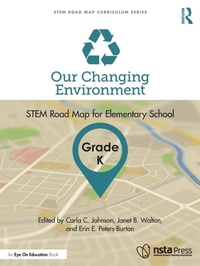
Our Changing Environment, Grade K
STEM Road Map for Elementary School
1st Edition
Published on 31. May 2022
Book
Paperback/Softback
164 pages
978-1-032-19979-5 (ISBN)
Description
What if you could challenge your kindergartners to come up with a way to reduce human impact on the environment? With this volume in the STEM Road Map Curriculum Series, you can!
Our Changing Environment outlines a journey that will steer your students toward authentic problem solving while grounding them in integrated STEM disciplines. Like the other volumes in the series, this book is designed to meet the growing need to infuse real-world learning into K-12 classrooms.
This interdisciplinary, three-lesson module uses project- and problem-based learning to help students investigate the environment around them, with a focus on ways that humans can impact the environment. Working in teams, students will investigate various types of human impact on the environment (including pollution, littering, and habitat destruction), will participate in a classroom recycling program, and will explore the engineering design process as they devise ways to repurpose waste materials. To support this goal, students will do the following:
Identify human impacts on the environment.
Identify technological advances and tools that scientists use to learn about the changing environment, and use technology to gather data.
Explain, discuss, and express concepts about the environment through development and design of a publication to report their scientific findings about the environment around the school.
Chart and understand local weather patterns, and make connections between weather conditions and their observations of the environment.
Identify and demonstrate recycling practices, including sorting materials and tracking amounts of materials recycled, and participate in a class recycling program.
The STEM Road Map Curriculum Series is anchored in the Next Generation Science Standards, the Common Core State Standards, and the Framework for 21st Century Learning. In-depth and flexible, Our Changing Environment can be used as a whole unit or in part to meet the needs of districts, schools, and teachers who are charting a course toward an integrated STEM approach.
Our Changing Environment outlines a journey that will steer your students toward authentic problem solving while grounding them in integrated STEM disciplines. Like the other volumes in the series, this book is designed to meet the growing need to infuse real-world learning into K-12 classrooms.
This interdisciplinary, three-lesson module uses project- and problem-based learning to help students investigate the environment around them, with a focus on ways that humans can impact the environment. Working in teams, students will investigate various types of human impact on the environment (including pollution, littering, and habitat destruction), will participate in a classroom recycling program, and will explore the engineering design process as they devise ways to repurpose waste materials. To support this goal, students will do the following:
Identify human impacts on the environment.
Identify technological advances and tools that scientists use to learn about the changing environment, and use technology to gather data.
Explain, discuss, and express concepts about the environment through development and design of a publication to report their scientific findings about the environment around the school.
Chart and understand local weather patterns, and make connections between weather conditions and their observations of the environment.
Identify and demonstrate recycling practices, including sorting materials and tracking amounts of materials recycled, and participate in a class recycling program.
The STEM Road Map Curriculum Series is anchored in the Next Generation Science Standards, the Common Core State Standards, and the Framework for 21st Century Learning. In-depth and flexible, Our Changing Environment can be used as a whole unit or in part to meet the needs of districts, schools, and teachers who are charting a course toward an integrated STEM approach.
More details
Series
Language
English
Place of publication
London
United Kingdom
Publishing group
Taylor & Francis Ltd
Target group
College/higher education
Professional and scholarly
Postgraduate, Professional, and Undergraduate Advanced
Illustrations
32 s/w Abbildungen, 9 s/w Photographien bzw. Rasterbilder, 23 s/w Zeichnungen, 53 s/w Tabellen
53 Tables, black and white; 23 Line drawings, black and white; 9 Halftones, black and white; 32 Illustrations, black and white
Dimensions
Height: 280 mm
Width: 210 mm
Thickness: 10 mm
Weight
452 gr
ISBN-13
978-1-032-19979-5 (9781032199795)
Copyright in bibliographic data and cover images is held by Nielsen Book Services Limited or by the publishers or by their respective licensors: all rights reserved.
Schweitzer Classification
Other editions
Additional editions
Carla C. Johnson | Janet B. Walton | Erin E. Peters-Burton
Our Changing Environment, Grade K
STEM Road Map for Elementary School
Book
05/2022
1st Edition
Routledge
€215.77
Shipment within 10-20 days
Carla C. Johnson | Janet B. Walton | Erin E. Peters-Burton
Our Changing Environment, Grade K
STEM Road Map for Elementary School
E-Book
05/2022
1st Edition
Routledge
€36.99
Available for download
Carla C. Johnson | Janet B. Walton | Erin E. Peters-Burton
Our Changing Environment, Grade K
STEM Road Map for Elementary School
E-Book
05/2022
1st Edition
Routledge
€36.99
Available for download
Persons
Carla C. Johnson is Professor of Science Education in the College of Education and Office of Research and Innovation, and a Faculty Research Fellow at North Carolina State University in North Carolina, USA
Janet B. Walton is Senior Research Scholar at North Carolina State University in North Carolina, USA
Erin E. Peters-Burton is the Donna R. and David E. Sterling Endowed Professor in Science Education at George Mason University in Virginia, USA
Janet B. Walton is Senior Research Scholar at North Carolina State University in North Carolina, USA
Erin E. Peters-Burton is the Donna R. and David E. Sterling Endowed Professor in Science Education at George Mason University in Virginia, USA
Content
Part 1: The STEM Road Map: Background, Theory, and Practice
1 Overview of the STEM Road Map Curriculum Series
2 Strategies Used in the STEM Road Map Curriculum Series
Part 2: Our Changing Environment STEM Road Map Module
3 Our Changing Environment Module Overview
4 Our Changing Environment Lesson Plans
5 Transforming Learning with Our Changing Environment and the STEM Road Map Curriculum Series
1 Overview of the STEM Road Map Curriculum Series
2 Strategies Used in the STEM Road Map Curriculum Series
Part 2: Our Changing Environment STEM Road Map Module
3 Our Changing Environment Module Overview
4 Our Changing Environment Lesson Plans
5 Transforming Learning with Our Changing Environment and the STEM Road Map Curriculum Series