

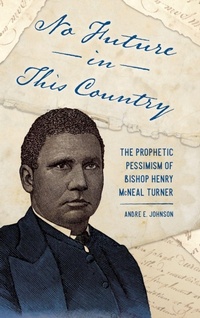
No Future in This Country
The Prophetic Pessimism of Bishop Henry McNeal Turner
Published on 30. October 2020
Book
Hardback
208 pages
978-1-4968-3070-8 (ISBN)
Description
No Future in This Country: The Prophetic Pessimism of Bishop Henry McNeal Turner is a history of the career of Bishop Henry McNeal Turner (1834-1915), specifically focusing on his work from 1896 to 1915. Drawing on the copious amount of material from Turner's speeches, editorial, and open and private letters, Andre E. Johnson tells a story of how Turner provided rhetorical leadership during a period in which America defaulted on many of the rights and privileges gained for African Americans during Reconstruction. Unlike many of his contemporaries during this period, Turner did not opt to proclaim an optimistic view of race relations. Instead, Johnson argues that Turner adopted a prophetic persona of a pessimistic prophet who not only spoke truth to power but, in so doing, also challenged and pushed African Americans to believe in themselves.
At this time in his life, Turner had no confidence in American institutions or that the American people would live up to the promises outlined in their sacred documents. While he argued that emigration was the only way for African Americans to retain their "personhood" status, he also would come to believe that African Americans would never emigrate to Africa. He argued that many African Americans were so oppressed and so stripped of agency because they were surrounded by continued negative assessments of their personhood that belief in emigration was not possible. Turner's position limited his rhetorical options, but by adopting a pessimistic prophetic voice that bore witness to the atrocities African Americans faced, Turner found space for his oratory, which reflected itself within the lament tradition of prophecy.
At this time in his life, Turner had no confidence in American institutions or that the American people would live up to the promises outlined in their sacred documents. While he argued that emigration was the only way for African Americans to retain their "personhood" status, he also would come to believe that African Americans would never emigrate to Africa. He argued that many African Americans were so oppressed and so stripped of agency because they were surrounded by continued negative assessments of their personhood that belief in emigration was not possible. Turner's position limited his rhetorical options, but by adopting a pessimistic prophetic voice that bore witness to the atrocities African Americans faced, Turner found space for his oratory, which reflected itself within the lament tradition of prophecy.
More details
Series
Language
English
Place of publication
Jackson
United States
Target group
Professional and scholarly
Dimensions
Height: 235 mm
Width: 157 mm
Thickness: 17 mm
Weight
505 gr
ISBN-13
978-1-4968-3070-8 (9781496830708)
Copyright in bibliographic data and cover images is held by Nielsen Book Services Limited or by the publishers or by their respective licensors: all rights reserved.
Schweitzer Classification
Other editions
Additional editions
E-Book
10/2020
NYU Press
€29.49
Available for download
Person
Andre E. Johnson is associate professor of rhetoric and media studies at the University of Memphis. He is director of the Henry McNeal Turner Project, a digital humanities project curating the writings of Bishop Henry McNeal Turner.