

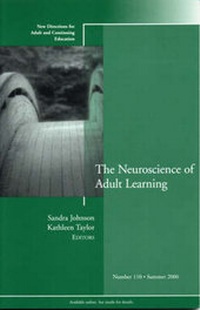
The Neuroscience of Adult Learning
New Directions for Adult and Continuing Education, Number 110
Published on 7. November 2006
Book
Paperback/Softback
96 pages
978-0-7879-8704-6 (ISBN)
Description
This timely volume examines links between the emerging neurobiological research on adult learning and the adult educators' practice. Now that it is possible to trace the pathways of the brain involved in various learning tasks, we can also explore which learning environments are likely to be most effective. Topics explored in The Neuroscience of Adult Learning include:
basic brain architecture and "executive" functions of the brain
how learning can "repair" the effects of psychological trauma on the brain
effects of stress and emotions on learning
the centrality of experience to learning and construction of knowledge
the mentor-learner relationship
intersections between best practices in adult learning and current neurobiological discoveries
Volume contributors include neurobiologists, educators, and clinical psychologists who have illuminated connections between how the brain functions and how to enhance learning.
Although the immediate goal of this volume is to expand the discourse on adult teaching and learning practices, the overarching goal is to encourage adult learners toward more complex ways of knowing.
This is the 110th volume of New Directions for Adult and Continuing Education, a quarterly publication published by Jossey-Bass.
basic brain architecture and "executive" functions of the brain
how learning can "repair" the effects of psychological trauma on the brain
effects of stress and emotions on learning
the centrality of experience to learning and construction of knowledge
the mentor-learner relationship
intersections between best practices in adult learning and current neurobiological discoveries
Volume contributors include neurobiologists, educators, and clinical psychologists who have illuminated connections between how the brain functions and how to enhance learning.
Although the immediate goal of this volume is to expand the discourse on adult teaching and learning practices, the overarching goal is to encourage adult learners toward more complex ways of knowing.
This is the 110th volume of New Directions for Adult and Continuing Education, a quarterly publication published by Jossey-Bass.
More details
Series
Language
English
Place of publication
New York
United States
Publishing group
John Wiley & Sons Inc
Target group
Professional and scholarly
Dimensions
Height: 231 mm
Width: 148 mm
Thickness: 6 mm
Weight
141 gr
ISBN-13
978-0-7879-8704-6 (9780787987046)
Copyright in bibliographic data and cover images is held by Nielsen Book Services Limited or by the publishers or by their respective licensors: all rights reserved.
Schweitzer Classification
Other editions
Additional editions
Sandra Johnson | Kathleen Taylor
The Neuroscience of Adult Learning
New Directions for Adult and Continuing Education, Number 110
E-Book
10/2011
Jossey-Bass
€22.99
Available for download
Sandra Johnson | Kathleen Taylor
The Neuroscience of Adult Learning
New Directions for Adult and Continuing Education, Number 110
E-Book
10/2011
Jossey-Bass
€22.99
Available for download
Persons
Sandra Johnson and Kathleen Taylor are the authors of The Neuroscience of Adult Learning: New Directions for Adult and Continuing Education, Number 110, published by Wiley.
Content
1 Key aspects of how the brain learns. 2 Neuroscience and adult learning.
3 Fear and learning : trauma-related factors in the adult education process.
4 Brain self-repair in psychotherapy: implications for education.
5 The role of meaning and emotions in learning.
6 Experience, consciousness, and learning: implications for instruction.
7 Meaningful learning and the executive functions of the brain.
8 The neuroscience of the mentor-learner relationship.
9 Brain function and adult learning: implications for practice.
3 Fear and learning : trauma-related factors in the adult education process.
4 Brain self-repair in psychotherapy: implications for education.
5 The role of meaning and emotions in learning.
6 Experience, consciousness, and learning: implications for instruction.
7 Meaningful learning and the executive functions of the brain.
8 The neuroscience of the mentor-learner relationship.
9 Brain function and adult learning: implications for practice.