

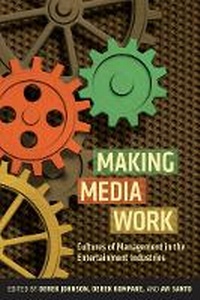
Making Media Work
Cultures of Management in the Entertainment Industries
Published on 1. August 2014
Book
Hardback
336 pages
978-0-8147-6469-5 (ISBN)
Description
The management and labor culture of the entertainment industry.
In popular culture, management in the media industry is
frequently understood as the work of network executives, studio developers, and
market researchers-"the suits"-who oppose the more productive forces of
creative talent and subject that labor to the inefficiencies and risk aversion
of bureaucratic hierarchies. However, such portrayals belie the reality
of how media management operates as a culture of shifting discourses,
dispositions, and tactics that create meaning, generate value, and shape media
work throughout each moment of production and consumption.
Making Media Work aims to provide a deeper and more nuanced understanding of
management within the entertainment industries. Drawing from work in critical
sociology and cultural studies, the collection theorizes management as a
pervasive, yet flexible set of principlesdrawn upon by a wide range of
practitioners-artists, talent scouts, performers, directors, show runners, and
more-in their ongoing efforts to articulate relationships and bridge
potentially discordant forces within the media industries. The contributors
interrogate managerial labor and identity, shine a light on how management
understands its roles within cultural and creative contexts, and reconfigure
the complex relationship between labor and managerial authority as productive
rather than solely prohibitive. Engaging with primary evidence gathered through
interviews, archives, and trade materials, the essays offer tremendous insight
into how management is understood and performed within media industry contexts.
The volume as a whole traces the changing roles of management both historically
and in the contemporary moment within US and international contexts, and across
a range of media forms, from film and television to video games and social
media.
In popular culture, management in the media industry is
frequently understood as the work of network executives, studio developers, and
market researchers-"the suits"-who oppose the more productive forces of
creative talent and subject that labor to the inefficiencies and risk aversion
of bureaucratic hierarchies. However, such portrayals belie the reality
of how media management operates as a culture of shifting discourses,
dispositions, and tactics that create meaning, generate value, and shape media
work throughout each moment of production and consumption.
Making Media Work aims to provide a deeper and more nuanced understanding of
management within the entertainment industries. Drawing from work in critical
sociology and cultural studies, the collection theorizes management as a
pervasive, yet flexible set of principlesdrawn upon by a wide range of
practitioners-artists, talent scouts, performers, directors, show runners, and
more-in their ongoing efforts to articulate relationships and bridge
potentially discordant forces within the media industries. The contributors
interrogate managerial labor and identity, shine a light on how management
understands its roles within cultural and creative contexts, and reconfigure
the complex relationship between labor and managerial authority as productive
rather than solely prohibitive. Engaging with primary evidence gathered through
interviews, archives, and trade materials, the essays offer tremendous insight
into how management is understood and performed within media industry contexts.
The volume as a whole traces the changing roles of management both historically
and in the contemporary moment within US and international contexts, and across
a range of media forms, from film and television to video games and social
media.
Reviews / Votes
"Making Media Work marks a distinctive intervention in the study of management in the media industries. Drawing from a variety of perspectives and incorporating rare insights from industry insiders, this book promises to be highly influential for media scholars, providing a useful framework and extended focus on the work of intermediaries. A terrific book." - Alisa Perren,author of Indie, Inc.: Miramax and the Transformation of Hollywood in the 1990s "This collection by academics and researcherschallenges the traditional and often stereotypical imagery of the entertainment and media industrys management ethos across a range of media forms, from film and television to video games and social media. With an interdisciplinary emphasis on configuration theory and organizational sociology, the books13 chapters provide an intimate insight and perspective on the industrys administrative leadership and its operations management.Summing Up: Recommended." (Choice) "The volume speaks to a growing number of media researchers and students interested in the transformation of media labor and workplace politics in the making of media contents." (Cultural Sociology)More details
Series
Language
English
Place of publication
New York
United States
Target group
College/higher education
Professional and scholarly
Illustrations
4 black and white illustrations
Dimensions
Height: 229 mm
Width: 153 mm
ISBN-13
978-0-8147-6469-5 (9780814764695)
Copyright in bibliographic data and cover images is held by Nielsen Book Services Limited or by the publishers or by their respective licensors: all rights reserved.
Schweitzer Classification
Other editions
Additional editions
Derek Johnson | Derek Kompare | Avi Santo
Making Media Work
Cultures of Management in the Entertainment Industries
E-Book
08/2014
1st Edition
New York University Press
€142.99
Available for download
Persons
Derek Johnson is Assistant Professor of Media and Cultural Studies in the Department of Communication Arts at the University of Wisconsin-Madison. He is the author of Media Franchising: Creative License and Collaboration in the Culture Industries and the co-editor of A Companion to Media Authorship.
Derek Kompare is Associate Professor of Film and Media Arts in the Meadows School of the Arts at Southern Methodist University. He is the author of Rerun Nation: How Repeats Invented American Television and CSI.
Avi Santo is Associate Professor and Director of the Institute for the Humanities at Old Dominion University.
Derek Kompare is Associate Professor of Film and Media Arts in the Meadows School of the Arts at Southern Methodist University. He is the author of Rerun Nation: How Repeats Invented American Television and CSI.
Avi Santo is Associate Professor and Director of the Institute for the Humanities at Old Dominion University.
Content
Introduction: Discourses, Dispositions, Tactics: Reconceiving Management in Critical Media Industry StudiesDerek Johnson, Derek Kompare, and Avi SantoI. 1. Building Theories of Creative Industry Managers: Challenges, Perspectives, and Future DirectionsAmanda D. Lotz 2. Towards a Structuration Theory of Media Intermediaries Timothy Havens 3. Linear Legacies: Managing the Multiplatform Production ProcessJames Bennett and Niki Strange 4. Enterprising Selves: Reality Television and Human Capital Laurie OuelletteII. 5. Record Men: Talent Scouts in the U.S. Recording Industry, 1920-1935Kyle Barnett 6. Recasting the Casting Director: Managed Change, Gendered LaborErin Hill 7. Brazilian Film Management Culture and Partnering with os majors: A Midlevel ApproachCourtney Brannon Donoghue 8. Constructing Social Media's Indie Auteurs: Management of the Celebrity Self in the Case of Felicia DayElizabeth EllcessorIII. 9. "Selling Station Personality": Managing Impending Change in Postwar Radio, 1948-1953Alexander Russo 10. Tweeting on the BBC: Audience and Brand Management via Third Party WebsitesElizabeth Evans 11. Market Research in the Media Industries: On the Strategic Relationship between Client and SupplierJustin Wyatt 12. Listening and Empathizing: Advocating for New Management Logics in Marketing and Corporate CommunicationSam FordBibliographyContributorsIndex