

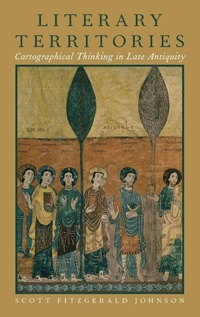
Literary Territories
Cartographical Thinking in Late Antiquity
Published on 4. January 2016
Book
Hardback
216 pages
978-0-19-022123-2 (ISBN)
Description
Literary Territories introduces readers to a wide range of literature from 200-900 CE in which geography is a defining principle of literary art. From accounts of Holy Land pilgrimage, to Roman mapmaking, to the systematization of Ptolemy's scientific works, Literary Territories argues that forms of literature that were conceived and produced in very different environments and for different purposes in Late Antiquity nevertheless shared an aesthetic
sensibility which treated the classical "inhabited world," the oikoumene, as a literary metaphor for the collection and organization of knowledge. This type of "cartographical thinking" stresses the world of knowledge that is encapsulated in the literary archive. The archival aesthetic coincided with an explosion of
late antique travel and Christian pilgrimage which in itself suggests important unifying themes between visual and textual conceptions of space. Indeed, by the end of Late Antiquity the geographical mode appears in nearly every type of writing in multiple Christian languages (Greek, Latin, Syriac, Armenian, and others). The diffusion of cartographical thinking throughout the real-world oikoumene, now the Christian Roman Empire, was a fundamental intellectual trajectory of Late
Antiquity.
sensibility which treated the classical "inhabited world," the oikoumene, as a literary metaphor for the collection and organization of knowledge. This type of "cartographical thinking" stresses the world of knowledge that is encapsulated in the literary archive. The archival aesthetic coincided with an explosion of
late antique travel and Christian pilgrimage which in itself suggests important unifying themes between visual and textual conceptions of space. Indeed, by the end of Late Antiquity the geographical mode appears in nearly every type of writing in multiple Christian languages (Greek, Latin, Syriac, Armenian, and others). The diffusion of cartographical thinking throughout the real-world oikoumene, now the Christian Roman Empire, was a fundamental intellectual trajectory of Late
Antiquity.
Reviews / Votes
In this ambitious book the excitement felt by Scott Johnson for his themes is palpable and infectious. * Richard J. A. Talbert, Sehepunkte *More details
Other editions
Additional editions
E-Book
01/2016
1st Edition
OUP eBook
€53.49
Available for download
E-Book
12/2015
1st Edition
OUP eBook
€53.49
Available for download
Person
Scott Fitzgerald Johnson is a Dumbarton Oaks Teaching Fellow in Byzantine Greek at Georgetown University.
Content
Abbreviations ; Introduction ; Chapter 1 Pilgrimage and Archive ; Chapter 2 An Aesthetic of Accumulation ; Chapter 3 Locus Amoenus / Loca Sancta ; Chapter 4 Apostolic Geography ; Chapter 5 The Westwardness of Things ; Conclusion ; Appendix Astrological, Astronomical, Cosmographical, Geographical, and Topographical Texts in Greek, Latin, and Syriac from 0 to 700 CE ; Works Cited