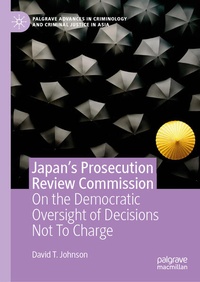
Japan's Prosecution Review Commission
Description
More broadly, this book explores a problem that is common in many criminal justice systems: how to hold prosecutors accountable for their non-charge decisions. It discusses the potential these panels have for improving the quality of criminal justice in Japan and other countries, and it will appeal to scholars and students studying prosecution and democracy, criminal justice, criminology, lay participation, justice reform, and Japanese studies.
Reviews / Votes
"What is - and what should be - the role of citizens' preferences in making prosecution decisions? This fascinating and well documented book takes Japan as its case study. The country's high conviction rate reflects a cautious and conservative charging policy that leaves many victims of crime feeling abandoned by the prosecutors who are supposed to be their allies and advocates. By contrast, its Prosecution Review Commission - the subject of this book - enables citizens to exert some external accountability on prosecutors for their non-charge decisions. The book explores the strengths and weaknesses of Japan's system while stimulating readers to ask whether other systems of justice have more or less need of such a body. The findings are interesting and important and make a significant contribution to studies of Japanese criminal justice and comparative criminal justice more generally.- David Nelken , Dickson Poon Law School, King's College London, UK
"This book provides unprecedented insight into the complex dynamics of democracy in a fascinating country where crime rates are low and conviction rates high. The focus is Japan's Prosecution Review Commission, which is the principal mediator between different visions of democracy and the main actor in that country's criminal justice system - the prosecutor. David Johnson takes us skilfully beyond simple explanations in this clear, balanced, and empirically grounded analysis of an understudied institution which asks citizens selected by lottery to check the non-charge decisions of professional prosecutors. The result is highly recommended for readers interested in understanding the complexities of Japanese criminal justice and the relationship between prosecution and democracy."
- Dimitri Vanoverbeke , Professor of Law and Society, University of Tokyo, Japan
"This is the first systematic and comprehensive book on Japan's Prosecution Review Commission (PRC) written in English in the world. The PRC was established in the postwar occupation, to enhance democracy in Japanese criminal justice. It is composed of eleven lay people selected randomly from voter registration lists, and its main mission is the review of prosecutors' non-charge decisions. This book explains the PRC's history and impacts and identifies lessons for Japan and other countries that are based on original research that is rich in facts and analysis. It brilliantly combines scholarly reflections on the PRC with practical suggestions for making prosecution more democratic. It is a major achievement."
- Satoru Shinomiya , Professor of Law, Kokugakuin University, Japan
More details
Other editions
Additional editions