

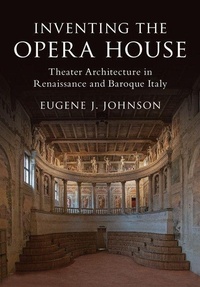
Inventing the Opera House
Theater Architecture in Renaissance and Baroque Italy
Published on 17. May 2018
Book
Hardback
346 pages
978-1-108-42174-4 (ISBN)
Description
In this book, Eugene J. Johnson traces the invention of the opera house, a building type of world wide importance. Italy laid the foundation theater buildings in the West, in architectural spaces invented for the commedia dell'arte in the sixteenth century, and theaters built to present the new art form of opera in the seventeenth. Rulers lavished enormous funds on these structures. Often they were among the most expensive artistic undertakings of a given prince. They were part of an upsurge of theatrical invention in the performing arts. At the same time, the productions that took place within the opera house could threaten the social order, to the point where rulers would raze them. Johnson reconstructs the history of the opera house by bringing together evidence from a variety of disciplines, including music, art, theatre, and politics. Writing in an engaging manner, he sets the history of the opera house within its broader early modern social context.
Reviews / Votes
'... sprinkled with photographs and illustrations of Italian theatres as well as architectural plans and digital reconstruction of stage interiors. The content is technical throughout, but there's just enough colour to hold the general reader's interest.' BBC Music Magazine 'Beautifully presented ... an important addition to the bibliography on the topic ...' Brian Robins, Opera 'This is clearly the definitive study of Renaissance and early Baroque theaters and should be on the reading lists not only of scholars and students in the fields of theater and architecture but also those of musicologists and historians concerned with the role of culture in early modern Italy.' Jonathan Glixon, Renaissance Quarterly 'The book is clearly written and profusely illustrated (nearly two hundred images in black-and-white and color). This is clearly the definitive study of Renaissance and early Baroque theaters and should be on the reading lists not only of scholars and students in the fields of theater and architecture but also those of musicologists and historians concerned with the role of culture in early modern Italy.' Jonathan Glixon, Renaissance QuarterlyMore details
Language
English
Place of publication
Cambridge
United Kingdom
Target group
Professional and scholarly
Illustrations
Worked examples or Exercises; 63 Plates, color; 126 Halftones, black and white; 6 Line drawings, black and white
Dimensions
Height: 257 mm
Width: 179 mm
Thickness: 24 mm
Weight
766 gr
ISBN-13
978-1-108-42174-4 (9781108421744)
Copyright in bibliographic data and cover images is held by Nielsen Book Services Limited or by the publishers or by their respective licensors: all rights reserved.
Schweitzer Classification
Other editions
Additional editions
E-Book
05/2018
Cambridge University Press
€39.49
Available for download
E-Book
04/2018
Cambridge University Press
€47.49
Available for download
Person
Eugene J. Johnson is Amos Lawrence Professor of Art History at Williams College, Massachusetts.
Content
1. Ferrara and Mantua, 1486-1519; 2. Rome 1480s-1520; 3. Early theaters in Venice and the Veneto; 4. Sixteenth-century Florence, with excursions to Venice, Lyon and Siena; 5. Early permanent theaters and the commedia dell'arte; 6. Theaters in the ancient manner and Andrea Palladio; 7. Drama-Tourney theaters; 8. Ferrara, Parma, and theaters of Giovanni Battista Aleotti; 9. Seventeenth-century theaters in Venice: the invention of the opera house; 10. Seventeenth-century theaters for comedy and opera; 11. Teatro di Tordinona in Rome, Queen Christina of Sweden, and Carlo Fontana.