

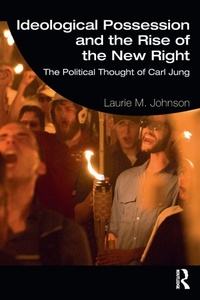
Ideological Possession and the Rise of the New Right
The Political Thought of Carl Jung
1st Edition
Published on 26. June 2019
Book
Paperback/Softback
190 pages
978-1-138-08212-0 (ISBN)
Description
Political theorist Laurie M. Johnson deals with Jung's analysis of the effects of modern scientific rationalism on the development of communism, fascism and Nazism in the 20th century and applies this analysis to the rise of the New Right in the 21st century.
Jung's thought provides much needed insight into contemporary ideologies such as neoliberalism, Identitarianism and the Alt-Right. Johnson explains Jungian analytical psychology as it relates to these topics, with a chapter devoted to Jung's views of Friedrich Nietzsche, who exemplifies the modern problem with his proclamation that God is dead, and an in-depth discussion of Jung's views on truth and the psychological function of religion as a safeguard against deadly mass movements. She then turns to Jung's treatment of anti-Semitism and the Nazi movement, and his views on race and racism.
Johnson applies these historical insights to the current manifestations of mass psychological disruption in the clash between neoliberals and the right-wing populist and Identitarian movements on the rise in North America and Europe. She concludes by discussing the search for an authentic and meaningful life in a West that rejects extremism and is open to authentic spiritual experiences as a counterbalance to mass mindedness.
Ideological Possession and the Rise of the New Right will appeal to both undergraduate and graduate students of psychology and intellectual history. The book will also be of interest to those wishing to understand the new nationalist, nativist and Identarian movements.
Jung's thought provides much needed insight into contemporary ideologies such as neoliberalism, Identitarianism and the Alt-Right. Johnson explains Jungian analytical psychology as it relates to these topics, with a chapter devoted to Jung's views of Friedrich Nietzsche, who exemplifies the modern problem with his proclamation that God is dead, and an in-depth discussion of Jung's views on truth and the psychological function of religion as a safeguard against deadly mass movements. She then turns to Jung's treatment of anti-Semitism and the Nazi movement, and his views on race and racism.
Johnson applies these historical insights to the current manifestations of mass psychological disruption in the clash between neoliberals and the right-wing populist and Identitarian movements on the rise in North America and Europe. She concludes by discussing the search for an authentic and meaningful life in a West that rejects extremism and is open to authentic spiritual experiences as a counterbalance to mass mindedness.
Ideological Possession and the Rise of the New Right will appeal to both undergraduate and graduate students of psychology and intellectual history. The book will also be of interest to those wishing to understand the new nationalist, nativist and Identarian movements.
Reviews / Votes
"Johnson's book is an original and timely attempt to use resources from Karl Jung's psychological theories-especially his understanding of the collective unconscious-to make sense of the contemporary resurgence of far-right nationalism. In addition to its contributions to understanding current political reality, one major philosophical achievement of the book is to make Jung a potential participant in contemporary debates in critical theory concerning the concept of "social pathology." I highly recommend it." - Frederick Neuhouser, Barnard College, Columbia University."Laurie Johnson provides a lucid introduction to Carl Jung's political thought and a powerful Jungian diagnosis for the political illnesses of our time. Drawing upon Charles Taylor's concepts of disenchantment and disembedding, Johnson elucidates Jung's account of modern man's predicament as a spiritual sickness: a pervasive psychological disharmony with the collective unconscious brought about by ideational, social, and economic displacement. Johnson's demonstration that the imbalanced psyche of modern man is a fertile ground for ideological possession is a must-read for anyone seeking to understand the identitarianism of the alt-right. The Jungian curative she offers-a recovery of a religious faith that is both sufficiently rich in rite and symbolism to generate genuine transcendent experience and supple enough to accommodate the doubts of the disenchanted-is timely and thoughtful." - Kody Cooper, UC Foundation Assistant Professor, University of Tennessee Chattanooga
More details
Language
English
Place of publication
London
United Kingdom
Publishing group
Taylor & Francis Ltd
Target group
College/higher education
Product notice
Paperback (trade)
Unsewn / adhesive bound
Dimensions
Height: 226 mm
Width: 152 mm
Thickness: 15 mm
Weight
295 gr
ISBN-13
978-1-138-08212-0 (9781138082120)
Copyright in bibliographic data and cover images is held by Nielsen Book Services Limited or by the publishers or by their respective licensors: all rights reserved.
Schweitzer Classification
Other editions
Additional editions
Laurie M. Johnson
Ideological Possession and the Rise of the New Right
The Political Thought of Carl Jung
Book
05/2019
1st Edition
Routledge
€207.40
Shipment within 10-20 days
Laurie M. Johnson
Ideological Possession and the Rise of the New Right
The Political Thought of Carl Jung
E-Book
05/2019
1st Edition
Routledge
€55.49
Available for download
Laurie M. Johnson
Ideological Possession and the Rise of the New Right
The Political Thought of Carl Jung
E-Book
05/2019
1st Edition
Routledge
€55.49
Available for download
Person
Laurie M. Johnson is Professor of Political Science at Kansas State University. She teaches a variety of courses, including Introduction to Political Thought, ancient and modern political thought, as well as a graduate seminar in political thought. Dr. Johnson has published seven other books, most concentrating on the development of modern liberal ideas and the limits of liberalism, the latest Honor in America? Tocqueville on the American Enlightenment. Other books include: Thucydides, Hobbes, and the Interpretation of Realism; Hobbes's Leviathan; Thomas Hobbes: Turning Point for Honor and Locke and Rousseau: Two Enlightenment Responses to Honor. She has published in numerous scholarly journals such as IO-International Organization, Journal of Political Science Education and Interpretation: A Journal of Political Philosophy.
Content
1. Jung's Political Thought: An Introduction 2. Lessons from Nietzsche 3. Jung's Psycho-Theological History 4. Jung and the Nazi Movement 5. Jung and Race 6. Signs of Mass Psychosis 7. The Rise of the New Right 8. Conclusion