

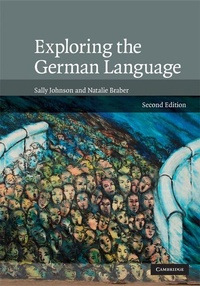
Exploring the German Language
2nd Edition
Published on 14. August 2008
Book
Hardback
312 pages
978-0-521-87208-9 (ISBN)
Description
If we want to understand how German speakers think about themselves and the world in which they live, then a useful place to begin is by looking at the language they use. This fully revised and updated edition provides a systematic approach to the study of the German language and an introduction to the social aspects of the language, including its dialects, its history and the uses of the language today. No previous knowledge of linguistics is assumed, and each chapter is accompanied by a series of practical exercises. This edition includes a brand new section on gender, purism and German unification, fresh examples for analysis and an updated chapter on the geography of Germany today. The book will help students not only to find new ways of exploring the German language, but also of thinking and talking about German-speaking cultures.
More details
Edition
2nd Revised edition
Language
English
Place of publication
Cambridge
United Kingdom
Target group
College/higher education
Edition type
Revised edition
Illustrations
36 Tables, unspecified; 7 Maps; 8 Line drawings, unspecified
Dimensions
Height: 250 mm
Width: 175 mm
Thickness: 21 mm
Weight
720 gr
ISBN-13
978-0-521-87208-9 (9780521872089)
Copyright in bibliographic data and cover images is held by Nielsen Book Services Limited or by the publishers or by their respective licensors: all rights reserved.
Schweitzer Classification
Other editions
Additional editions
Sally Johnson | Natalie Braber
Exploring the German Language
E-Book
09/2008
2nd Edition
Cambridge University Press
€39.99
Available for download
Sally Johnson | Natalie Braber
Exploring the German Language
Book
08/2008
2nd Edition
Cambridge University Press
€67.20
Shipment within 15-20 days
Persons
Sally Johnson is Professor of Linguistics in the School of Modern Languages and Cultures at the University of Leeds, and is a Fellow of the Alexander von Humboldt Foundation. Her recent publications include Gender, Group Identity and Variation in the Berlin Urban Vernacular (1995), Spelling Trouble: Language, Ideology and the Reform of German Orthography (2005) and a special issue of German Life and Letters on the German spelling reform, co-edited with Oliver Stenschke (2005). Natalie Braber is a lecturer in the Department of Linguistics at Nottingham Trent University. She has published on a range of linguistic topics, including speech disorders, language and intercultural communication, and emotional language in post-unification Germany.
Content
1. Introduction; Part I. The History and Geography of German: 2. The German language past and present; 3. The German-speaking areas; Part II. The Structures of German: 4. The sounds of German; 5. Putting the sounds together; 6. The structure of German words; 7. The structure of German sentences; 8. The meaning of German words; Part III. The German Language in Use: 9. Meaning in context; 10. Variation in German.