

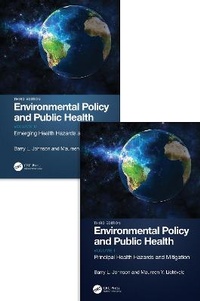
Environmental Policy and Public Health
Two Volume Set
3rd Edition
Published on 28. February 2022
Book
760 pages
978-1-032-08028-4 (ISBN)
Description
Written by environmental health experts with long teaching and professional careers in policy and public health, the third edition of "Environmental Policy and Public Health" comprises two volumes, addressing key physical hazards in the environment that impact public health. The first volume on "Principal Health Hazards and Mitigation" is complemented by Volume 2, "Emerging Health Hazards and Mitigation."
Thoroughly updated, the first volume describes how the quality of air, water, and food are threatened by the presence of toxic substances and explains why climate change is a global health priority already impacting human health and the environment. Each chapter explains step by step how new environmental health issues are translated into public health policies and concludes with practice questions to facilitate interactive learning for upper-level undergraduate and graduate students taking courses in public health and environmental sciences.
The second volume discusses emerging health hazards and mitigation including environment- related infectious diseases, COVID 19 pandemic, social justice, and drugs and public health. New in this volume are a chapter on firearms violence as a public health hazard, a chapter on transportation and how built environments can affect human health and social well-being, and concludes with a chapter on noise and light pollution. The volume concludes with case studies and practice questions to facilitate interactive learning for upper-level undergraduate and graduate students taking courses in public health and environmental sciences.
Thoroughly updated, the first volume describes how the quality of air, water, and food are threatened by the presence of toxic substances and explains why climate change is a global health priority already impacting human health and the environment. Each chapter explains step by step how new environmental health issues are translated into public health policies and concludes with practice questions to facilitate interactive learning for upper-level undergraduate and graduate students taking courses in public health and environmental sciences.
The second volume discusses emerging health hazards and mitigation including environment- related infectious diseases, COVID 19 pandemic, social justice, and drugs and public health. New in this volume are a chapter on firearms violence as a public health hazard, a chapter on transportation and how built environments can affect human health and social well-being, and concludes with a chapter on noise and light pollution. The volume concludes with case studies and practice questions to facilitate interactive learning for upper-level undergraduate and graduate students taking courses in public health and environmental sciences.
More details
Edition
3rd edition
Language
English
Place of publication
London
United Kingdom
Publishing group
Taylor & Francis Ltd
Target group
College/higher education
Postgraduate, Undergraduate Advanced, and Undergraduate Core
Illustrations
51 s/w Abbildungen, 45 s/w Photographien bzw. Rasterbilder, 6 s/w Zeichnungen, 32 s/w Tabellen
32 Tables, black and white; 6 Line drawings, black and white; 45 Halftones, black and white; 51 Illustrations, black and white
Dimensions
Height: 234 mm
Width: 156 mm
Weight
1570 gr
ISBN-13
978-1-032-08028-4 (9781032080284)
Copyright in bibliographic data and cover images is held by Nielsen Book Services Limited or by the publishers or by their respective licensors: all rights reserved.
Schweitzer Classification
Other editions
Additional editions
Book
05/2024
3rd Edition
CRC Press
€93.15
Shipment within 10-20 days
Persons
Barry L. Johnson is Adjunct Professor at the Rollins School of Public Health, Emory University. Dr. Johnson conducted environmental research at the USPHS, USEPA, and CDC. An elected Fellow, Collegium Ramazani, he retired from the USPHS with the rank of Rear Admiral.
Maureen Lichtveld is Dean, Professor, Environmental and Occupational Health and Jonas Salk Chair in Population Health, University of Pittsburgh, Graduate School of Public Health. She is a member of the National Academy of Medicine with decades environmental public health experience.
Maureen Lichtveld is Dean, Professor, Environmental and Occupational Health and Jonas Salk Chair in Population Health, University of Pittsburgh, Graduate School of Public Health. She is a member of the National Academy of Medicine with decades environmental public health experience.
Content
Volume 1: 1. Climate Change. 2. Air Quality. 3. Water Quality and Security. 4. Food Safety and Security. 5. Tobacco Products, Vaping Devices, Marijuana Smoking. 6. Toxic Substances in the Environment. Lessons Learned and Authors' Reflections. Workbook.
Volume 2: 1. Environment-Related Infectious Diseases. 2. Solid and Hazardous Waste. 3. Drugs and Alcohol. 4. Firearms Violence. 5. Noise and Light Pollution. 6. The Built Environment. 7. Transportation. Lessons Learned and Authors' Reflections. Workbook.
Volume 2: 1. Environment-Related Infectious Diseases. 2. Solid and Hazardous Waste. 3. Drugs and Alcohol. 4. Firearms Violence. 5. Noise and Light Pollution. 6. The Built Environment. 7. Transportation. Lessons Learned and Authors' Reflections. Workbook.