

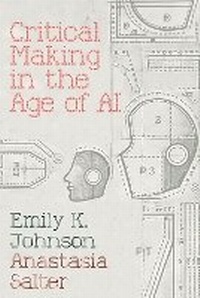
Critical Making in the Age of AI
Published on 15. April 2025
Book
Hardback
268 pages
978-1-943208-97-5 (ISBN)
Description
Critical Making in the Age of AI invites students, teachers, learners, and digital humanists to explore making as scholarship. Inspired by the craft traditions of textile arts, this book combines a survey of forms of alternative scholarly communication-such as comics, GIFs, maps, games, and generative AI-and a pattern book, where patterns serve as starting points that makers can reimagine and remix. Firmly grounded in the humanities and utilizing free tools and platforms (including Twine, Voyant, and Tracery) wherever possible, this engaging and accessible guide to digital methods introduces and puts into practice concepts that are essential to preparing students to navigate a changing landscape of media and information without investing in proprietary software, dedicated lab space, or expensive creative tools.
The book's eight patterns are especially appropriate for those just beginning to explore digital scholarly methods, and one goal of Critical Making in the Age of AI is to provide structure for work that is both meaningful and achievable with limited resources and time. By centering critical making through a design-justice and feminist lens, the coauthors model how inclusive and expansive approaches to making in research and teaching are vital to shaping the humanities of the future.
The book's eight patterns are especially appropriate for those just beginning to explore digital scholarly methods, and one goal of Critical Making in the Age of AI is to provide structure for work that is both meaningful and achievable with limited resources and time. By centering critical making through a design-justice and feminist lens, the coauthors model how inclusive and expansive approaches to making in research and teaching are vital to shaping the humanities of the future.
More details
Series
Language
English
Place of publication
United States
Publishing group
Michigan Publishing Services
Target group
Professional and scholarly
College/higher education
Product notice
sewn/stitched
Cloth over boards
Illustrations
37 color images
Dimensions
Height: 230 mm
Width: 162 mm
Thickness: 23 mm
Weight
585 gr
ISBN-13
978-1-943208-97-5 (9781943208975)
Copyright in bibliographic data and cover images is held by Nielsen Book Services Limited or by the publishers or by their respective licensors: all rights reserved.
Schweitzer Classification
Persons
Emily K. Johnson is assistant professor in the Department of English (Technical Communication and Digital Humanities), graduate faculty in the Technical Communication MA program, and core faculty in the Texts and Technology program at the University of Central Florida. She is co-author of Playful Pedagogy in the Pandemic: Pivoting to Games-Based Learning (with Anastasia Salter, Routledge, 2022).
Anastasia Salter is professor of English and director of Graduate Programs and the PhD in Texts and Technology at the University of Central Florida. Salter is the author of numerous books including Twining: Critical and Creative Approaches to Hypertext Narratives (with Stuart Moulthrop, Amherst College Press, 2021), Adventure Games: Playing the Outsider (with Aaron Reed and John Murray, Bloomsbury, 2020), Toxic Geek Masculinity in Media (with Bridget Blodgett, Palgrave Macmillan, 2017), and What is Your Quest? From Adventure Games to Interactive Books (University of Iowa Press, 2014).
Anastasia Salter is professor of English and director of Graduate Programs and the PhD in Texts and Technology at the University of Central Florida. Salter is the author of numerous books including Twining: Critical and Creative Approaches to Hypertext Narratives (with Stuart Moulthrop, Amherst College Press, 2021), Adventure Games: Playing the Outsider (with Aaron Reed and John Murray, Bloomsbury, 2020), Toxic Geek Masculinity in Media (with Bridget Blodgett, Palgrave Macmillan, 2017), and What is Your Quest? From Adventure Games to Interactive Books (University of Iowa Press, 2014).