

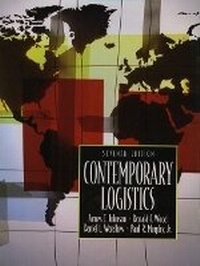
Contemporary Logistics
7th Edition
Published on 21. January 1999
Book
Hardback
608 pages
978-0-13-798548-7 (ISBN)
Description
For undergraduate/graduate-level courses in Logistics, Logistics Channels, Physical Distribution, Materials Management, and Supply Chain Management.
Using real-world case studies throughout, this exploration of contemporary logistics describes the entire supply channel system - from inbound movement of freight through materials management to physical distribution to customers. State-of-the-art in perspective, it highlights topics that affect logistics channels management - including customer service, packaging, inventory management, traffic management and creating "value-added" linkages in the supply chain.
Using real-world case studies throughout, this exploration of contemporary logistics describes the entire supply channel system - from inbound movement of freight through materials management to physical distribution to customers. State-of-the-art in perspective, it highlights topics that affect logistics channels management - including customer service, packaging, inventory management, traffic management and creating "value-added" linkages in the supply chain.
More details
Edition
7th edition
Language
English
Place of publication
United States
Publishing group
Pearson Education (US)
Target group
Professional and scholarly
Dimensions
Height: 235 mm
Width: 243 mm
Thickness: 33 mm
Weight
1058 gr
ISBN-13
978-0-13-798548-7 (9780137985487)
Copyright in bibliographic data and cover images is held by Nielsen Book Services Limited or by the publishers or by their respective licensors: all rights reserved.
Schweitzer Classification
Other editions
New editions
Book
08/2003
8th Edition
Pearson
€66.95
Article exhausted; check for reprint
Previous edition

James C. Johnson
Contemporary Logistics
Book
11/1995
6th Edition
Prentice-Hall
€32.18
Article exhausted; check for reprint
Content
I. OVERVIEW OF LOGISTICS.
1. Logistics Systems: Their Development and Growth.
2. The Supply-Chain Concept.
3. Logistics Interfaces with Suppliers and Within the Firm.
II. ELEMENTS OF LOGISTICS SYSTEMS.
4. Order Management and Customer Service.
5. Protective Packaging and Materials Handling.
6. The Domestic Transportation System.
7. The Traffic Management Function.
8. Distribution Center, Warehouse, and Plant Location.
9. Inventory Management.
10. Distribution Centers and Warehousing.
11. International Logistics.
III. ANALYZING, DESIGNING, AND IMPLEMENTING A LOGISTICS SYSTEM.
12. Reengineering Logistics Systems.
13. Logistics Systems Controls.
14. Supply-Chain Integration and Management.
15. Logistics: Future Directions.
Glossary.
Subject Index.
Name Index.
1. Logistics Systems: Their Development and Growth.
2. The Supply-Chain Concept.
3. Logistics Interfaces with Suppliers and Within the Firm.
II. ELEMENTS OF LOGISTICS SYSTEMS.
4. Order Management and Customer Service.
5. Protective Packaging and Materials Handling.
6. The Domestic Transportation System.
7. The Traffic Management Function.
8. Distribution Center, Warehouse, and Plant Location.
9. Inventory Management.
10. Distribution Centers and Warehousing.
11. International Logistics.
III. ANALYZING, DESIGNING, AND IMPLEMENTING A LOGISTICS SYSTEM.
12. Reengineering Logistics Systems.
13. Logistics Systems Controls.
14. Supply-Chain Integration and Management.
15. Logistics: Future Directions.
Glossary.
Subject Index.
Name Index.