

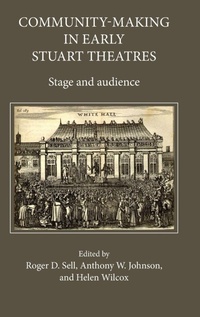
Community-Making in Early Stuart Theatres
Stage and audience
1st Edition
Published on 21. October 2016
Book
Hardback
450 pages
978-1-4094-2701-8 (ISBN)
Description
Twenty-two leading experts on early modern drama collaborate in this volume
to explore three closely interconnected research questions. To what extent did
playwrights represent dramatis personae in their entertainments as forming, or
failing to form, communal groupings? How far were theatrical productions likely
to weld, or separate, different communal groupings within their target audiences?
And how might such bondings or oppositions among spectators have tallied with
the community-making or -breaking on stage? Chapters in Part One respond to
one or more of these questions by reassessing general period trends in censorship,
theatre attendance, forms of patronage, playwrights' professional and linguistic
networks, their use of music, and their handling of ethical controversies.
In Part Two, responses arise from detailed re-examinations of particular plays
by Shakespeare, Chapman, Jonson, Beaumont and Fletcher, Cary, Webster, Middleton,
Massinger, Ford, and Shirley. Both Parts cover a full range of early-Stuart
theatre settings, from the public and popular to the more private circumstances
of hall playhouses, court masques, women's drama, country-house theatricals,
and school plays. And one overall finding is that, although playwrights frequently
staged or alluded to communal conflict, they seldom exacerbated such divisiveness
within their audience. Rather, they tended toward more tactful modes of
address (sometimes even acknowledging their own ideological uncertainties) so
that, at least for the duration of a play, their audiences could be a community
within which internal rifts were openly brought into dialogue.
to explore three closely interconnected research questions. To what extent did
playwrights represent dramatis personae in their entertainments as forming, or
failing to form, communal groupings? How far were theatrical productions likely
to weld, or separate, different communal groupings within their target audiences?
And how might such bondings or oppositions among spectators have tallied with
the community-making or -breaking on stage? Chapters in Part One respond to
one or more of these questions by reassessing general period trends in censorship,
theatre attendance, forms of patronage, playwrights' professional and linguistic
networks, their use of music, and their handling of ethical controversies.
In Part Two, responses arise from detailed re-examinations of particular plays
by Shakespeare, Chapman, Jonson, Beaumont and Fletcher, Cary, Webster, Middleton,
Massinger, Ford, and Shirley. Both Parts cover a full range of early-Stuart
theatre settings, from the public and popular to the more private circumstances
of hall playhouses, court masques, women's drama, country-house theatricals,
and school plays. And one overall finding is that, although playwrights frequently
staged or alluded to communal conflict, they seldom exacerbated such divisiveness
within their audience. Rather, they tended toward more tactful modes of
address (sometimes even acknowledging their own ideological uncertainties) so
that, at least for the duration of a play, their audiences could be a community
within which internal rifts were openly brought into dialogue.
More details
Language
English
Place of publication
London
United Kingdom
Publishing group
Taylor & Francis Ltd
Target group
College/higher education
Illustrations
16 s/w Zeichnungen, 7 s/w Photographien bzw. Rasterbilder, 23 s/w Abbildungen
16 Line drawings, black and white; 7 Halftones, black and white; 23 Illustrations, black and white
Dimensions
Height: 240 mm
Width: 161 mm
Thickness: 29 mm
Weight
837 gr
ISBN-13
978-1-4094-2701-8 (9781409427018)
Copyright in bibliographic data and cover images is held by Nielsen Book Services Limited or by the publishers or by their respective licensors: all rights reserved.
Schweitzer Classification
Other editions
Additional editions
Anthony W. Johnson | Roger D. Sell | Helen Wilcox
Community-Making in Early Stuart Theatres
Stage and audience
Book
01/2019
1st Edition
Routledge
€73.80
Shipment within 15-20 days
Anthony W. Johnson | Roger D. Sell | Helen Wilcox
Community-Making in Early Stuart Theatres
Stage and audience
E-Book
10/2016
Routledge
€65.99
Available for download
Anthony W. Johnson | Roger D. Sell | Helen Wilcox
Community-Making in Early Stuart Theatres
Stage and audience
E-Book
10/2016
Routledge
€65.99
Available for download
Persons
Roger D. Sell is Emeritus H.W. Donner Research Professor of Literary Communication
at Abo Akademi University, Finland.
Anthony W. Johnson is J.O.E. Donner Professor of English Language and Literature
at Abo Akademi University, Finland.
Helen Wilcox is Professor of English at Bangor University, Wales.
at Abo Akademi University, Finland.
Anthony W. Johnson is J.O.E. Donner Professor of English Language and Literature
at Abo Akademi University, Finland.
Helen Wilcox is Professor of English at Bangor University, Wales.
Content
Table of Contents to come