

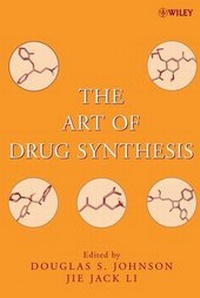
The Art of Drug Synthesis
Published on 20. July 2007
Book
Hardback
296 pages
978-0-471-75215-8 (ISBN)
Description
DISCOVER THE INS ANDOUTS OF DRUG SYNTHESIS, FROM IDENTIFYING A LEAD MOLECULE TO COMMERCIAL PRODUCTION.
Learn how chemistry, biology, pharmacokinetics, and a host of other disciplines all play a role in the successful discovery of new drugs and therapeutics. This text features contributions from seventeen leading medicinal and process chemists who show you how it is done. Some of the contributors were instrumental in the discovery of the drugs they review, offering you a unique and invaluable perspective on the complete drug discovery process.
The first two chapters of this text introduce the stringent requirements for a potential therapeutic molecule, approaches in finding molecular structures that 'hit" a biological target, and the many steps needed to go from initial small-scale laboratory synthesis to commercial and the many steps needed to go from initial small-scale laboratory synthesis to commercial production. The remaining fifteen chapters are divided into three major therapeutic areas:
* Cancer and infectious Diseases
* Cardiovascular and Metabolic Diseases
* Central Nervous System Diseases
These three section collectively cover twenty-one categories of drugs and more than sixty individual drugs, highlighting both medicinal and process synthetic routes. The authors present detailed accounts of the synthesis of such high-profile drugs as Actos(r), Levaquin(r), Avelox(r), Diflucan(r), Tamiflu(r), Zetia(r), Lyrica(r), and Strattera(r). You gain new insight into how a first generational agent is refined and improved by the application of medicinal chemistry for the discovery of second and third generation medicines.
This text is an excellent companion to the bestselling Contemporary Drug Synthesis, covering all new drugs. In addition to serving as a reference for medicinal chemists and pharmacologists, this book is highly recommended as a graduate-level text for medicinal pharmacologists, this book is highly recommended as a graduate-level text for medicinal and pharmaceutical chemistry courses. With its many examples and insights into successful and pharmaceutical chemistry courses. With its many examples and insights into successful syntheses, it enables students to make the bridge from theory to practice.
Reviews / Votes
"This is a most topical and useful short primer on estab1ished drugs and their synthesis." (American Journal of Therapeutics, June 2009) "The book is very felicitous and closes a gap in the literature by covering the subject of drug development in this particular way." (Angewandte Chemie, June 23, 2008)"This book is a very entertaining read." (ChemMedChem, 2008, 3)
"The editors and contriubting authros have certainly provided a most useful book for the medicinal and organic chemistry community." (Journal of Medicinal Chemistry, March 2008)
"Where I see the book being very useful is as a starting point for student seminars or discussion groups... Also, it is highly illuminating just to dip into for a browse and to marvel at some of the excellent chemistry that goes on in the pharmaceutical industry." (Chemistry World, January 2008)
More details
Product info
gebunden
Edition
1. Auflage
Language
English
Place of publication
United States
Publishing group
John Wiley & Sons Inc
Target group
Professional and scholarly
Product notice
sewn/stitched
Paper over boards
Dimensions
Height: 260 mm
Width: 183 mm
Thickness: 20 mm
Weight
754 gr
ISBN-13
978-0-471-75215-8 (9780471752158)
Schweitzer Classification
Other editions
Additional editions
Douglas S. Johnson | Jie Jack Li
The Art of Drug Synthesis
E-Book
02/2013
Wiley
€126.99
Available for download
Douglas S. Johnson | Jie Jack Li
The Art of Drug Synthesis
E-Book
06/2008
Wiley
€126.99
Available for download
Persons
Douglas S. Johnson, PHD, is a Research Chemist at Pfizer Global Research and Development.
Jie Jack Li, PHD, is a Research Chemist at Pfizer Global Research and Development.
Content
Foreword.
Preface.
Contributors.
1 THE ROLE OF MEDICINAL CHEMISTRY IN DRUG DISCOVERY (John A. Lowe, III).
References.
2 PROCESS RESEARCH: HOW MUCH? HOW SOON? (Neal G. Anderson).
References.
I CANCER AND INFECTIOUS DISEASES.
3 AROMATASE INHIBITORS FOR BREAST CANCER: EXEMESTANE (AROMASIN), ANASTROZOLE (ARIMIDEX), AND LETROZOLE (FEMARA) (Jie Jack Li).
References.
4 QUINOLONE ANTIBIOTICS: LEVOFLOXACIN (LEVAQUIN), MOXIFLOXACIN (AVELOX), GEMIFLOXACIN (FACTIVE), AND GARENOXACIN (T-3811) (Chris Limberakis).
References.
5 TRIAZOLE ANTIFUNGALS: ITRACONAZOLE (SPORANOX), FLUCONAZOLE (DIFLUCAN), VORICONAZOLE (VFEND), AND FOSFLUCONAZOLE (PRODIF) (Andrew S. Bell).
References.
6 NON-NUCLEOSIDE HIV REVERSE TRANSCRIPTASE INHIBITORS (Arthur Harms).
References.
7 NEURAMINIDASE INHIBITORS FOR INFLUENZA: OSELTAMIVIR PHOSPHATE (TAMIFLU) AND ZANAMIVIR (RELENZA) (Douglas S. Johnson and Jie Jack Li).
References.
II CARDIOVASCULAR AND METABOLIC DISEASES.
8 PEROXISOME PROLIFERATOR-ACTIVATED RECEPTOR (PPAR) AGONISTS FOR TYPE 2 DIABETES (Jin Li).
References.
9 ANGIOTENSIN AT1 ANTAGONISTS FOR HYPERTENSION (Larry Yet).
References.
10 LEADING ACE INHIBITORS FOR HYPERTENSION (Victor J. Cee and Edward J. Olhava).
References.
11 DIHYDROPYRIDINE CALCIUM CHANNEL BLOCKERS FOR HYPERTENSION (Daniel P. Christen).
References.
12 SECOND-GENERATION HMG-CoA REDUCTASE INHIBITORS (Jeffrey A. Pfefferkorn).
References.
13 CHOLESTEROL ABSORPTION INHIBITORS: EZETIMIBE (ZETIA) (Stuart B. Rosenblum).
References.
III CENTRAL NERVOUS SYSTEM DISEASES.
14 DUAL SELECTIVE SEROTONIN AND NOREPINEPHRINE REUPTAKE INHIBITORS (SSNRIs) FOR DEPRESSION (Marta Piñeiro-Núñez)
References.
15 GABAA RECEPTOR AGONISTS FOR INSOMNIA: ZOLPIDEM (AMBIEN), ZALEPLON (SONATA), ESZOPICLONE (ESTORRA, LUNESTA), AND INDIPLON (Peter R. Guzzo).
References.
16 a2d LIGANDS: NEURONTIN (GABAPENTIN) AND LYRICA (PREGABALIN) (Po-Wai Yuen).
References.
17 APPROVED TREATMENTS FOR ATTENTION DEFICIT HYPERACTIVITY DISORDER: AMPHETAMINE (ADDERALL), METHYLPHENIDATE (RITALIN), AND ATOMOXETINE (STRATERRA) (David L. Gray).
References.
Index.