

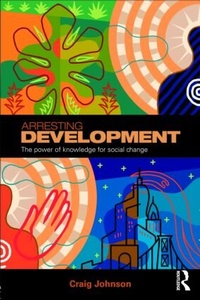
Arresting Development
The power of knowledge for social change
1st Edition
Published on 24. November 2008
Book
Paperback/Softback
208 pages
978-0-415-38153-6 (ISBN)
Description
Scholars have become increasingly concerned about the impact of neo-liberalism on the field of development. Governments around the world have for some time been exposed to the forces of globalization and macro-economic reform, reflecting the power and influence of the world's principal international economic institutions and a broader commitment to the principles of neo-classical economics and free trade. Concerns have also been raised that neo-classical theory now dominates the ways in which scholars frame and ask their questions in the field of development.
This book is about the ways in which ideologies shape the construction of knowledge for development. A central theme concerns the impact of neo-liberalism on contemporary development theory and research. The book's main objectives are twofold. One is to understand the ways in which neo-liberalism has framed and defined the 'meta-theoretical' aims and assumptions of what is deemed relevant, important and appropriate to the study of development. A second is to explore the theoretical and ideological terms on which an alternative to neo-classical theory may be theorized, idealized and pursued. By tracing the impact of Marxism, postmodernism and liberalism on the study of development, Arresting Development contends that development has become increasingly fragmented in terms of the theories and methodologies it uses to understand and explain complex and contextually-specific processes of economic development and social change. Outside of neo-classical economics (and related fields of rational choice), the notion that social science can or should aim to develop general and predictive theories about development has become mired in a philosophical and political orientation that questions the ability of scholars to make universal or comparative statements about the nature of history, cultural diversity and progress.
To advance the debate, a case is made that development needs to re-capture what the American sociologist Peter Evans once called the 'comparative institutional method.' At the heart of this approach is an inductive methodology that searches for commonalities and connections to broader historical trends and problems while at the same time incorporating divergent and potentially competing views about the nature of history, culture and development. This book will be of interest to scholars and students of Development, Social and Political Studies and it will also be beneficial to professionals interested in the challenge of constructing "knowledge for development."
This book is about the ways in which ideologies shape the construction of knowledge for development. A central theme concerns the impact of neo-liberalism on contemporary development theory and research. The book's main objectives are twofold. One is to understand the ways in which neo-liberalism has framed and defined the 'meta-theoretical' aims and assumptions of what is deemed relevant, important and appropriate to the study of development. A second is to explore the theoretical and ideological terms on which an alternative to neo-classical theory may be theorized, idealized and pursued. By tracing the impact of Marxism, postmodernism and liberalism on the study of development, Arresting Development contends that development has become increasingly fragmented in terms of the theories and methodologies it uses to understand and explain complex and contextually-specific processes of economic development and social change. Outside of neo-classical economics (and related fields of rational choice), the notion that social science can or should aim to develop general and predictive theories about development has become mired in a philosophical and political orientation that questions the ability of scholars to make universal or comparative statements about the nature of history, cultural diversity and progress.
To advance the debate, a case is made that development needs to re-capture what the American sociologist Peter Evans once called the 'comparative institutional method.' At the heart of this approach is an inductive methodology that searches for commonalities and connections to broader historical trends and problems while at the same time incorporating divergent and potentially competing views about the nature of history, culture and development. This book will be of interest to scholars and students of Development, Social and Political Studies and it will also be beneficial to professionals interested in the challenge of constructing "knowledge for development."
More details
Language
English
Place of publication
London
United Kingdom
Publishing group
Taylor & Francis Ltd
Target group
College/higher education
Illustrations
2 s/w Abbildungen, 2 s/w Zeichnungen, 3 s/w Tabellen
3 Tables, black and white; 2 Line drawings, black and white; 2 Illustrations, black and white
Dimensions
Height: 234 mm
Width: 156 mm
Weight
380 gr
ISBN-13
978-0-415-38153-6 (9780415381536)
Copyright in bibliographic data and cover images is held by Nielsen Book Services Limited or by the publishers or by their respective licensors: all rights reserved.
Schweitzer Classification
Other editions
Additional editions
E-Book
11/2008
1st Edition
Routledge
€55.59
Available for download
E-Book
11/2008
Routledge
€31.49
Available for download
E-Book
11/2008
Routledge
€31.49
Available for download

Book
11/2008
1st Edition
Routledge
€237.70
Shipment within 15-20 days
Person
Craig Johnson is Associate Professor of Political Science at the University of Guelph in Canada. He has published widely in the field of governance, decentralization and sustainable development, focusing mainly on Asia. His most recent publication (co-edited) is Policy Windows and Livelihood Futures: Prospects for Poverty Reduction in Rural India (Oxford University Press, 2006).
Content
1. Deconstructing 'Knowledge for Development' 2. The 'Poverty of History' in Neo-classical Discourse: Positivism, New Institutionalism and 'the Tragedy of the Commons' 3. Exporting the Model: Marxism, Postmodernism and Development 4. Development as Discourse: Contesting the Politics of 'Post-Development' 5. Development as Freedom of Choice: From Measurement to Empowerment to Rational Choice 6. Advancing Knowledge for Social Change