

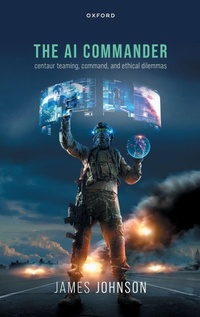
The AI Commander
Centaur Teaming, Command, and Ethical Dilemmas
Published on 11. January 2024
Book
Hardback
230 pages
978-0-19-889218-2 (ISBN)
Description
What does AI mean for the role of humans in war? The AI Commander addresses the largely neglected question of how the fusion of machines into the war machine will affect the human condition of warfare. James Johnson emphasizes the "mind" - both human and machine - and the mechanisms of thought (intelligence, consciousness, emotion, memory, experience, etc.) to consider the effects of AI and autonomy on the human condition of war. Johnson investigates the vexing and misunderstood - and at times contradictory - ethical, moral, and normative implications, whether incremental, transformative, or revolutionary, of synthesizing man and machine in future algorithmic warfare - or AI-enabled centaur warfighting. At the heart of these vexing questions are whether we are inevitably moving toward a situation in which AI-enabled autonomous weapons will make strategic decisions in place of humans and thus become the owners of those decisions. Can AI-powered systems replace human commanders? And, more importantly, should they? The AI Commander argues that AI cannot be merely passive and neutral force multipliers of human cognition. Instead, they will likely become - either by conscious choice or inadvertently - strategic actors in war. AI will transform the role and nature of human warfare, but not necessarily in the ways most observers expect.
Reviews / Votes
James Johnson has produced an excellent study of how rapid technological change is transforming the role of human commanders in warfare. Amongst all the hype surrounding Artificial Intelligence, this book makes a sophisticated, thoughtful, and balanced contribution to our understanding of the ethical, moral, and operational nature of the future battlespace. This book will be a must-read for all those interested in how we can understand - and survive - a strategic world Increasingly defined by the complex relationship between humans and machines. * Andrew Futter, Professor of International Politics, University of Leicester * In this intellectually invigorating work, James Johnson provides some very interesting insights into AI-enabled warfighting. With its primary focus on psychological facets of human-AI teaming, the book addresses several rarely explored themes, such as the ethical and moral implications of AI-anthropomorphism, the closely related inverse phenomenon of dehumanizing warfare, and the complex impact of AI-powered decision-making on nuclear deterrence and brinkmanship. Creatively framed scenarios provide interesting operational backdrops for an intense and illuminating analysis. A must read for policy makers, military strategists, and researchers in the field of responsible military AI. * Lieutenant General R. S. Panwar (Ret.), Colonel Commandant of the Corps of Signals, Indian Army * James Johnson's The AI Commander is an essential addition to the discourse on AI and national security. Johnson advances a timely and compelling analysis of the opportunities and risks of AI for national security. He offers masterful insights on human-machine integration and the ethical-political dilemmas of AI-enabled warfare. Johnson provides a vitally important exploration of AI's potential role in nuclear deterrence and risk analysis, with an insightful examination of how AI might be used to develop counterfactual 'red team' thought experiments that can help leaders with decision-making processes in both nuclear and conventional warfare. A must-read! * Lieutenant General John (Jack) N.T. Shanahan (USAF, Ret.), inaugural Director of Project Maven and the U.S. Department of Defense Joint AI Center * The AI Commander provides a much-needed human-centric take on the moral and ethical dilemmas of AI-enabled war. In this in-depth analysis, James Johnson moves beyond simplistic takes to explore the nuances of human-machine 'centaur' teaming in warfare. He argues that AI agents will become strategic actors in war, but they are no replacement for human judgment in command. * Paul Scharre, author of Four Battlegrounds and Army of None *More details
Language
English
Place of publication
Oxford
United Kingdom
Target group
Professional and scholarly
Dimensions
Height: 240 mm
Width: 161 mm
Thickness: 17 mm
Weight
514 gr
ISBN-13
978-0-19-889218-2 (9780198892182)
Copyright in bibliographic data and cover images is held by Nielsen Book Services Limited or by the publishers or by their respective licensors: all rights reserved.
Schweitzer Classification
Other editions
Additional editions
E-Book
08/2024
OUP eBook
€76.99
Available for download
E-Book
08/2024
OUP eBook
€76.99
Available for download
Person
James Johnson is a Lecturer in Strategic Studies in the Department of Politics and International Relations, University of Aberdeen. He is also an Honorary Fellow at the University of Leicester, a Non-Resident Associate on the ERC-funded "Towards a Third Nuclear Age" Project, and a Mid-Career Cadre with the Center for Strategic and International Studies (CSIS) Project on Nuclear Issues. Previously, he was an Assistant Professor at Dublin City University, a Non-Resident Fellow with the Modern War Institute at West Point, and a Postdoctoral Research Fellow at the James Martin Center for Nonproliferation Studies in Monterey.
Content
Introduction: AI-enabled "centaur warfighting"
1: The AI commander problem
2: Anthropomorphizing AI in centaur teaming
3: Tactical generals and strategic corporals
4: Brinkmanship in algorithmic warfare
5: Thinking forward with counterfactuals
Conclusion: No magic bullets
Appendices
Selected bibliography
Index
1: The AI commander problem
2: Anthropomorphizing AI in centaur teaming
3: Tactical generals and strategic corporals
4: Brinkmanship in algorithmic warfare
5: Thinking forward with counterfactuals
Conclusion: No magic bullets
Appendices
Selected bibliography
Index