

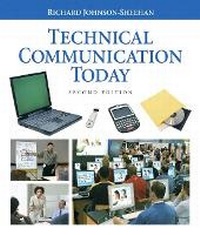
Technical Communication Today
2nd Edition
Published on 1. August 2007
Book
Paperback/Softback
784 pages
978-0-321-45758-5 (ISBN)
Description
Technical Communication Todayremains the only text to fully centralize the computer in the technical workplace, presenting how it is used throughout today's communication process.
The text is based on a solid core of rhetorical principles. Clear instruction not only describes technical documents, but it guides the user through the activity of producing them. Technical Communication Today foregrounds computers as a thinking tool-helping communicators to draft and design documents, prepare material for print and Web publication, and make oral presentations. It more accurately reflects the modern day computer-centered technical workplace.
Technical Communication Today epitomizes the shift in technical communication from literal-linear created to visual-spatial created documents. This evolution, which has been provoked by the ubiquity of the computer as a communication tool, is changing fundamental writing and reading processes. The text has been designed using the idea of "chunking," where readable portions of text are combined with graphics. Not only does this concept facilitate learning, but it models the way today's technical documents should be designed. Its presentation of teaching readers how to write integrates a new awareness of how documents are read-by "raiding" for the information needed. The author wrote the text with the presumption that users are researching, organizing, drafting, designing, and revising directly on their computer screens. By mirroring these processes in its content and structure, Technical Communication Today offers a higher level of accessibility for readers.
The text is based on a solid core of rhetorical principles. Clear instruction not only describes technical documents, but it guides the user through the activity of producing them. Technical Communication Today foregrounds computers as a thinking tool-helping communicators to draft and design documents, prepare material for print and Web publication, and make oral presentations. It more accurately reflects the modern day computer-centered technical workplace.
Technical Communication Today epitomizes the shift in technical communication from literal-linear created to visual-spatial created documents. This evolution, which has been provoked by the ubiquity of the computer as a communication tool, is changing fundamental writing and reading processes. The text has been designed using the idea of "chunking," where readable portions of text are combined with graphics. Not only does this concept facilitate learning, but it models the way today's technical documents should be designed. Its presentation of teaching readers how to write integrates a new awareness of how documents are read-by "raiding" for the information needed. The author wrote the text with the presumption that users are researching, organizing, drafting, designing, and revising directly on their computer screens. By mirroring these processes in its content and structure, Technical Communication Today offers a higher level of accessibility for readers.
More details
Edition
2nd edition
Language
English
Place of publication
United States
Publishing group
Pearson Education (US)
Target group
Professional and scholarly
Dimensions
Height: 232 mm
Width: 200 mm
Weight
1209 gr
ISBN-13
978-0-321-45758-5 (9780321457585)
Copyright in bibliographic data and cover images is held by Nielsen Book Services Limited or by the publishers or by their respective licensors: all rights reserved.
Schweitzer Classification
Other editions
New editions
Richard Johnson-Sheehan
Technical Communication Today
Book
02/2009
3rd Edition
Pearson
€93.03
Article exhausted; check for reprint
Content
Every chapter includes "Chapter Objectives," "Chapter Review," "Exercises and Projects," and a
"Case Study" as well as an "At Work" box, "At a Glance," "Go to the Net," "Take Note," and "Links" features.
Preface.
PART ONE ELEMENTS OF TECHNICAL COMMUNCATION
Chapter 1 Communicating in the Workplace
How Important is Technical Communication
What is Technical Communication
Technical Communication: Actions, Words, Images
Your Career and Technical Communication
Help: E-Literacy and Overcoming Cyberphobia
Chapter Review
Exercises and Projects
Chapter 2 The Technical Writing Process
Technical Writing Today
Stage 1: Planning and Researching
Stage 2: Organizing and Drafting
Help: Using Your Computer to Overcome Writer's Block
Stage 3: Improving the Style
Stage 4: Designing
Stage 5: Revising and Editing
Developing Your Own Writing Process
Chapter Review
Exercises and Projects
Case Study: The Procrastinator
Chapter 3 Readers and Context of Use
Profiling Your Readers
Help: Profiling Readers with Search Engines
Profiling Contexts of Use
Using Profiles to Your Own Advantage
International and Cross-Cultural Communication
Chapter Review
Exercises and Projects
Case Study: Installing a Medical Waste Incinerator
Chapter 4 Working in Teams
The Stages of Teaming
Forming: Strategic Planning
Storming: Managing a Conflict
Help: Virtual Teaming
Norming: Determining Team Roles
Performing: Improving Quality
The Keys to Teaming
Chapter Review
Exercises and Projects
Case Study: Not a Sunny Day
Chapter 5 Ethics in the Technical Workplace
What Are Ethics?
Where Do Ethics Come From?
Help: Copyright Law in Technical Communication
Resolving Ethical Dilemmas
Ethics in the Technical Workplace
Chapter Review
Exercises and Projects
Case Study: The Chemical Spill
PART TWO COMMUNICATING IN THE TECHNICAL WORKPLACE
Chapter 6 Persuasion and Planning
How to Persuade People
Persuading with Reason
Persuading with Values
Using Project Planning to be Persuasive
Persuasion and Planning in High-Context Cultures
Chapter Review
Exercises and Projects
Case Study: Solar Car
Chapter 7 Researching and Managing Information
Beginning Your Research
Defining Your Research Subject
Formulating a Research Question or Hypothesis
Developing a Research Methodology
Triangulating Materials
Managing Information and Taking Notes
Help: Avoiding Junk Science on the Internet
Appraising Your Information
Avoiding Plagiarism
Chapter Review
Exercises and Projects
Case Study: Bye Bye Birdies
Chapter 8 Organizing and Drafting
Basic Organization for Any Document
Using Genres to Organize Information
Outlining the Document
Help: Organizing with Presentation Software
Oganizing and Drafting the Introduction
Organizing and Drafting the Body
Organizing and Drafting the Conclusion
Organizing Cross-Cultural Documents
Chapter Review
Exercises and Projects
Case Study: The Bad News
Chapter 9 Designing Documents and Interfaces
Five Principles of Design
Design Principle 1: Balance
Design Principle 2: Alignment
Design Principle 3: Grouping
Design Principle 4: Consistency
Help: Using Styles and Templates
Design Principle 5: Contrast
Cross-Cultural Design
Using the Principles of Design
A Primer on Binding and Paper
Chapter Review
Exercises and Projects
Case Study: Scorpions Invade
Chapter 10 Ceating and Using Graphics
Guidelines for Using Graphics
Displaying Data with Graphics, Tables, and Charts
Help: Making Visuals with a Spreadsheet Program
Using Pictures, Drawings, and Video
Chapter Review
Exercises and Projects
Case Study: The Illusion
Chapter 11 Style
What is Style?
Writing Plain Sentences
Help: Using On-line Writing Centers
Writing Plain Paragraphs
When Is It Appropriate to Use Passive Voice?
Persuasive Style
Balancing Plain and Persuasive Style
Chapter Review
Exercises and Projects
Case Study: Going Over the Top
Chapter 12 Revising and Editing for Usability
Levels of Edit
Revising: Level 1 Editing
Substantive Editing: Level 2 Editing
Copyediting: Level 3 Editing
Proofreading: Level 4 Editing
Lost in Translation: Cross-Cultural Editing
Using Copyediting Symbols
Help: On-Line Copyediting
Documenting Cycling and Usability Testing
Chapter Review
Exercises and Projects
Case Study: Just My (Bad) Style
PART THREE WORKING IN THE WIRED WORKPLACE
Chapter 13 Using E-Mail and Instant Messaging
E-Mail Basics
Features of E-Mail
Managing E-Mail
E-Mail Netiquette
Help: Using Mailing Lists (Listservs)
What is Instant Messaging
Chapter Review
Exercises and Projects
Case Study: Exposed
Chapter 14 Designing Websites
Basic Features of a Website
Planning and Researching a Website
Organizing and Drafting a Website
Help: Using Web-Authoring Software
Using Style in a Website
Designing the Website
Revising, Editing, and Proofreading
Uploading, Testing, and Maintaining Your Website
Chapter Review
Exercises and Projects
Case Study: Invasion of Privacy
Chapter 15 Starting Your Career
Setting Goals, Making a Plan
Preparing a Resume
Writing Effective Application Letters
Help: Designing a Scannable/Searchable Resume
Creating a Professional Portfolio
Interviewing Strategies
Chapter Review
Exercises and Projects
Case Study: The Lie
Chapter 16 Preparing and Giving Presentations
Planning and Researching Your Presentation
Choosing the Right Presentation Technology
Organizing the Content of Your Presentation
Help: Surfing the Net for Grabbers
Choosing Your Presentation Style
Creating Visuals
Delivering the Presentation
Practice and Rehearsal
Working Cross-Culturally with Translators
Chapter Review
Exercises and Projects
Case Study: The Coward
PART FOUR GENRES OF TECHNICAL COMMUNICATION
Chapter 17 Letters and Memos
Basic Features of Letters and Memos
Planning and Researching Letters and Memos
Organizing and Drafting Letters and Memos
Types of Letters and Memos
Using Style in Letters and Memos
Designing and Formatting Letters and Memos
Help: Making Letter and Memo Templates
Revising, Editing, and Proofreading
Chapter Review
Exercises and Projects
Case Study: The Nastygram
Chapter 18 Technical Definitions
Types of Technical Definitions
Planning and Researching Technical Definitions
Organizing and Drafting Technical Definitions
Help: Using On-line Sources for Definitions
Using Style and Design in Technical Definitions
Revising, Editing, and Proofreading
Chapter Review
Exercises and Projects
Case Study: Fast-Food High School
Chapter 19 Technical Descriptions
Basic Features of Technical Descriptions
Planning and Researching Technical Descriptions
Partitioning the Subject
Organizing and Drafting Technical Descriptions
Using Style in Technical Descriptions
Designing Technical Descriptions
Revising, Editing, and Proofreading
Help: Using Digital Photography in Descriptions
Chapter Review
Exercises and Projects
Case Study: Memories of a Crane
Chapter 20 Instructions
Basic Features of Instructions
Planning and Researching Instructions
Organizing and Drafting Instructions
Using Style in Instructions
Help: On-screen Documentation
Designing Instructions
Revising, Editing, and Proofreading
Chapter Review
Exercises and Projects
Case Study: The Flame
Chapter 21 Proposals
Basic Features of Proposals
Planning and Researching Proposals
Help: Reading a Request for Proposals (RFP)
Organizing and Drafting Proposals
Using Style in Proposals
Designing Proposals
Revising, Editing, and Proofreading
Chapter Review
Exercises and Projects
Case Study: The Mole
Chapter 22 Activity Reports
Basic Features of Activity Reports
Types of Activity Reports
Planning and Researching Activity Reports
Organizing and Drafting Activity Reports
Help: Making and Using PDFs
Using Style and Design in Activity Reports
Revising, Editing, and Proofreading
Chapter Review
Exercises and Projects
Case Study: Bad Chemistry
Chapter 23 Analytical Reports
Basic Features of Analytical Reports
Types of Analytical Reports
Planning and Researching Analytical Reports
Organizing and Drafting Analytical Reports
Help: Virtual Teaming on Reports
Drafting Front Matter and Back Matter
Using Style in Analytical Reports
Designing Analytical Reports
Revising, Editing, and Proofreading
Chapter Review
Exercises and Projects
Case Study: The X-File
Appendix A Grammar and Punctuation Guide
Appendix B English as a Second Language Guide
Appendix C Documentation Guide
References
Credits
Index
"Case Study" as well as an "At Work" box, "At a Glance," "Go to the Net," "Take Note," and "Links" features.
Preface.
PART ONE ELEMENTS OF TECHNICAL COMMUNCATION
Chapter 1 Communicating in the Workplace
How Important is Technical Communication
What is Technical Communication
Technical Communication: Actions, Words, Images
Your Career and Technical Communication
Help: E-Literacy and Overcoming Cyberphobia
Chapter Review
Exercises and Projects
Chapter 2 The Technical Writing Process
Technical Writing Today
Stage 1: Planning and Researching
Stage 2: Organizing and Drafting
Help: Using Your Computer to Overcome Writer's Block
Stage 3: Improving the Style
Stage 4: Designing
Stage 5: Revising and Editing
Developing Your Own Writing Process
Chapter Review
Exercises and Projects
Case Study: The Procrastinator
Chapter 3 Readers and Context of Use
Profiling Your Readers
Help: Profiling Readers with Search Engines
Profiling Contexts of Use
Using Profiles to Your Own Advantage
International and Cross-Cultural Communication
Chapter Review
Exercises and Projects
Case Study: Installing a Medical Waste Incinerator
Chapter 4 Working in Teams
The Stages of Teaming
Forming: Strategic Planning
Storming: Managing a Conflict
Help: Virtual Teaming
Norming: Determining Team Roles
Performing: Improving Quality
The Keys to Teaming
Chapter Review
Exercises and Projects
Case Study: Not a Sunny Day
Chapter 5 Ethics in the Technical Workplace
What Are Ethics?
Where Do Ethics Come From?
Help: Copyright Law in Technical Communication
Resolving Ethical Dilemmas
Ethics in the Technical Workplace
Chapter Review
Exercises and Projects
Case Study: The Chemical Spill
PART TWO COMMUNICATING IN THE TECHNICAL WORKPLACE
Chapter 6 Persuasion and Planning
How to Persuade People
Persuading with Reason
Persuading with Values
Using Project Planning to be Persuasive
Persuasion and Planning in High-Context Cultures
Chapter Review
Exercises and Projects
Case Study: Solar Car
Chapter 7 Researching and Managing Information
Beginning Your Research
Defining Your Research Subject
Formulating a Research Question or Hypothesis
Developing a Research Methodology
Triangulating Materials
Managing Information and Taking Notes
Help: Avoiding Junk Science on the Internet
Appraising Your Information
Avoiding Plagiarism
Chapter Review
Exercises and Projects
Case Study: Bye Bye Birdies
Chapter 8 Organizing and Drafting
Basic Organization for Any Document
Using Genres to Organize Information
Outlining the Document
Help: Organizing with Presentation Software
Oganizing and Drafting the Introduction
Organizing and Drafting the Body
Organizing and Drafting the Conclusion
Organizing Cross-Cultural Documents
Chapter Review
Exercises and Projects
Case Study: The Bad News
Chapter 9 Designing Documents and Interfaces
Five Principles of Design
Design Principle 1: Balance
Design Principle 2: Alignment
Design Principle 3: Grouping
Design Principle 4: Consistency
Help: Using Styles and Templates
Design Principle 5: Contrast
Cross-Cultural Design
Using the Principles of Design
A Primer on Binding and Paper
Chapter Review
Exercises and Projects
Case Study: Scorpions Invade
Chapter 10 Ceating and Using Graphics
Guidelines for Using Graphics
Displaying Data with Graphics, Tables, and Charts
Help: Making Visuals with a Spreadsheet Program
Using Pictures, Drawings, and Video
Chapter Review
Exercises and Projects
Case Study: The Illusion
Chapter 11 Style
What is Style?
Writing Plain Sentences
Help: Using On-line Writing Centers
Writing Plain Paragraphs
When Is It Appropriate to Use Passive Voice?
Persuasive Style
Balancing Plain and Persuasive Style
Chapter Review
Exercises and Projects
Case Study: Going Over the Top
Chapter 12 Revising and Editing for Usability
Levels of Edit
Revising: Level 1 Editing
Substantive Editing: Level 2 Editing
Copyediting: Level 3 Editing
Proofreading: Level 4 Editing
Lost in Translation: Cross-Cultural Editing
Using Copyediting Symbols
Help: On-Line Copyediting
Documenting Cycling and Usability Testing
Chapter Review
Exercises and Projects
Case Study: Just My (Bad) Style
PART THREE WORKING IN THE WIRED WORKPLACE
Chapter 13 Using E-Mail and Instant Messaging
E-Mail Basics
Features of E-Mail
Managing E-Mail
E-Mail Netiquette
Help: Using Mailing Lists (Listservs)
What is Instant Messaging
Chapter Review
Exercises and Projects
Case Study: Exposed
Chapter 14 Designing Websites
Basic Features of a Website
Planning and Researching a Website
Organizing and Drafting a Website
Help: Using Web-Authoring Software
Using Style in a Website
Designing the Website
Revising, Editing, and Proofreading
Uploading, Testing, and Maintaining Your Website
Chapter Review
Exercises and Projects
Case Study: Invasion of Privacy
Chapter 15 Starting Your Career
Setting Goals, Making a Plan
Preparing a Resume
Writing Effective Application Letters
Help: Designing a Scannable/Searchable Resume
Creating a Professional Portfolio
Interviewing Strategies
Chapter Review
Exercises and Projects
Case Study: The Lie
Chapter 16 Preparing and Giving Presentations
Planning and Researching Your Presentation
Choosing the Right Presentation Technology
Organizing the Content of Your Presentation
Help: Surfing the Net for Grabbers
Choosing Your Presentation Style
Creating Visuals
Delivering the Presentation
Practice and Rehearsal
Working Cross-Culturally with Translators
Chapter Review
Exercises and Projects
Case Study: The Coward
PART FOUR GENRES OF TECHNICAL COMMUNICATION
Chapter 17 Letters and Memos
Basic Features of Letters and Memos
Planning and Researching Letters and Memos
Organizing and Drafting Letters and Memos
Types of Letters and Memos
Using Style in Letters and Memos
Designing and Formatting Letters and Memos
Help: Making Letter and Memo Templates
Revising, Editing, and Proofreading
Chapter Review
Exercises and Projects
Case Study: The Nastygram
Chapter 18 Technical Definitions
Types of Technical Definitions
Planning and Researching Technical Definitions
Organizing and Drafting Technical Definitions
Help: Using On-line Sources for Definitions
Using Style and Design in Technical Definitions
Revising, Editing, and Proofreading
Chapter Review
Exercises and Projects
Case Study: Fast-Food High School
Chapter 19 Technical Descriptions
Basic Features of Technical Descriptions
Planning and Researching Technical Descriptions
Partitioning the Subject
Organizing and Drafting Technical Descriptions
Using Style in Technical Descriptions
Designing Technical Descriptions
Revising, Editing, and Proofreading
Help: Using Digital Photography in Descriptions
Chapter Review
Exercises and Projects
Case Study: Memories of a Crane
Chapter 20 Instructions
Basic Features of Instructions
Planning and Researching Instructions
Organizing and Drafting Instructions
Using Style in Instructions
Help: On-screen Documentation
Designing Instructions
Revising, Editing, and Proofreading
Chapter Review
Exercises and Projects
Case Study: The Flame
Chapter 21 Proposals
Basic Features of Proposals
Planning and Researching Proposals
Help: Reading a Request for Proposals (RFP)
Organizing and Drafting Proposals
Using Style in Proposals
Designing Proposals
Revising, Editing, and Proofreading
Chapter Review
Exercises and Projects
Case Study: The Mole
Chapter 22 Activity Reports
Basic Features of Activity Reports
Types of Activity Reports
Planning and Researching Activity Reports
Organizing and Drafting Activity Reports
Help: Making and Using PDFs
Using Style and Design in Activity Reports
Revising, Editing, and Proofreading
Chapter Review
Exercises and Projects
Case Study: Bad Chemistry
Chapter 23 Analytical Reports
Basic Features of Analytical Reports
Types of Analytical Reports
Planning and Researching Analytical Reports
Organizing and Drafting Analytical Reports
Help: Virtual Teaming on Reports
Drafting Front Matter and Back Matter
Using Style in Analytical Reports
Designing Analytical Reports
Revising, Editing, and Proofreading
Chapter Review
Exercises and Projects
Case Study: The X-File
Appendix A Grammar and Punctuation Guide
Appendix B English as a Second Language Guide
Appendix C Documentation Guide
References
Credits
Index