

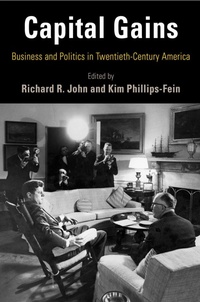
Capital Gains
Business and Politics in Twentieth-Century America
Published on 21. December 2016
Book
Hardback
312 pages
978-0-8122-4882-1 (ISBN)
Description
Recent events-the Citizens United Supreme Court decision, the Occupy Wall Street movement, and efforts to increase the minimum wage, among others-have driven a tremendous surge of interest in the political power of business. Capital Gains collects some of the most innovative new work in the field. The chapters explore the influence of business on American politics in the twentieth century at the federal, state, and municipal levels. From corporate spending on city governments in the 1920s to business support for public universities in the postwar period, and from business opposition to the Vietnam War to the corporate embrace of civil rights, the contributors reveal an often surprising portrait of the nation's economic elite.
Contrary to popular mythology, business leaders have not always been libertarian or rigidly devoted to market fundamentalism. Before, during, and after the New Deal, important parts of the business world sought instead to try to shape what the state could accomplish and to make sure that government grew in ways that were favorable to them. Appealing to historians working in the fields of business history, political history, and the history of capitalism, these essays highlight the causes, character, and consequences of business activism and underscore the centrality of business to any full understanding of the politics of the twentieth century-and today.
Contributors: Daniel Amsterdam, Brent Cebul, Jennifer Delton, Tami Friedman, Eric Hintz, Richard R. John, Pamela Walker Laird, Kim Phillips-Fein, Laura Phillips Sawyer, Elizabeth Tandy Shermer, Eric Smith, Jason Scott Smith, Mark R. Wilson.
Contrary to popular mythology, business leaders have not always been libertarian or rigidly devoted to market fundamentalism. Before, during, and after the New Deal, important parts of the business world sought instead to try to shape what the state could accomplish and to make sure that government grew in ways that were favorable to them. Appealing to historians working in the fields of business history, political history, and the history of capitalism, these essays highlight the causes, character, and consequences of business activism and underscore the centrality of business to any full understanding of the politics of the twentieth century-and today.
Contributors: Daniel Amsterdam, Brent Cebul, Jennifer Delton, Tami Friedman, Eric Hintz, Richard R. John, Pamela Walker Laird, Kim Phillips-Fein, Laura Phillips Sawyer, Elizabeth Tandy Shermer, Eric Smith, Jason Scott Smith, Mark R. Wilson.
Reviews / Votes
"Capital Gains provides nuanced and reasoned assessments which combine to form a great contribution to the history of capitalism and the shifting U.S. political economy." (Reviews in American History) "With Capital Gains: Business and Politics in Twentieth-Century America, Richard John and Kim Phillips-Fein have brought together a collection of important essays on the relationship of business and politics in the twentieth century. Moving well beyond portrayals of business leaders as robber barons or industrial statesmen, the chapters, which proceed in chronological fashion, range in focus from local boosterism to military spending to corporate civil rights. . . . Taken as a whole, the authors sound a clarion call for the new kinds of questions scholars are asking about modern political economy." (Business History Review) "An outstanding book. The volume is sound from a scientific perspective, grounded in primary sources and wide archival research, and, at the same time, contributes remarkably to our knowledge in this field. This is due both to the new empirical evidence provided, and to the fact that it builds on different disciplines such as political history, business history, political science, historical sociology, and history of capitalism. This multidisciplinary attitude allows the reader to reconstruct effectively the complexity of businessmen's approach to the political world, as well as improving our understanding of government interaction with business elites." (The Economic History Review) "The essays collected for Capital Gains are eminently readable. Each stands on its own as a fascinating snapshot into topics as varied as antitrust and patent law, the public-university system, anti-Vietnam protests, and the history of workplace diversity initiatives. More importantly, these essays together help to contextualize the rise of corporate power in the twentieth-century United States." (The Journal of Interdisciplinary History) "With Capital Gains, the scholarly push to revive political economy and craft a new history of twentieth century business, politics, and capitalism has found its vehicle. No longer can we cast 'business elites' as the thoughtless tools of the capitalist machine. Through rich, compelling archival research and authoritative historiographical analysis, these sophisticated essays make a powerful case for business as a multidimensional, ideologically diverse set of historical actors." (Benjamin Waterhouse, University of North Carolina, Chapel Hill) "What is the most productive way to study the history of capitalism? The authors in this volume pursue a multidisciplinary approach and believe in the importance of institutions and public policy. For these reasons, Capital Gains is a valuable contribution to the historiography of the twentieth-century United States." (Kenneth Lipartito, Florida International University)More details
Series
Language
English
Place of publication
Pennsylvania
United States
Target group
College/higher education
Product notice
Paper over boards
Dimensions
Height: 231 mm
Width: 155 mm
Thickness: 30 mm
Weight
590 gr
ISBN-13
978-0-8122-4882-1 (9780812248821)
Copyright in bibliographic data and cover images is held by Nielsen Book Services Limited or by the publishers or by their respective licensors: all rights reserved.
Schweitzer Classification
Other editions
Additional editions
E-Book
11/2016
1st Edition
University of Pennsylvania Press
€33.99
Available for download
Persons
Richard R. John is Professor of History at Columbia University.
Kim Phillips-Fein is Associate Professor in the Gallatin School of Individualized Study at New York University.
Kim Phillips-Fein is Associate Professor in the Gallatin School of Individualized Study at New York University.
Content
Preface
-Kim Phillips-Fein
Introduction. Adversarial Relations? Business and Politics in Twentieth-Century America
-Richard R. John
PART I. THE PROGRESSIVE ERA AND THE 1920s
Chapter 1. Trade Associations, State Building, and the Sherman Act: The U.S. Chamber of Commerce, 1912-25
-Laura Phillips Sawyer
Chapter 2. Toward a Civic Welfare State: Business and City Building in the 1920s
-Daniel Amsterdam
PART II. THE NEW DEAL AND THE SECOND WORLD WAR
Chapter 3. The "Monopoly" Hearings, Its Critics, and the Limits of Patent Reform in the New Deal
-Eric S. Hintz
Chapter 4. Farewell to Progressivism: The Second World War and the Privatization of the "Military-Industrial Complex"
-Mark R. Wilson
Chapter 5. Beyond the New Deal: Thomas K. McCraw and the Political Economy of Capitalism
-Richard R. John and Jason Scott Smith
PART III. THE POSTWAR ERA: ECONOMIC DEVELOPMENT
Chapter 6. "Free Enterprise" or Federal Aid? The Business Response to Economic Restructuring in the Long 1950s
-Tami J. Friedman
Chapter 7. "They Were the Moving Spirits": Business and Supply-Side Liberalism in the Postwar South
-Brent Cebul
Chapter 8. A Fraught Partnership: Business and the Public University Since the Second World War
-Elizabeth Tandy Shermer
PART IV. THE POSTWAR ERA: LIBERALISM AND ITS CRITICS
Chapter 9. The Triumph of Social Responsibility in the National Association of Manufacturers in the 1950s
-Jennifer Delton
Chapter 10. "What Would Peace in Vietnam Mean for You as an Investor?" Business Executives and the Antiwar Movement, 1967-75
-Eric R. Smith
Chapter 11. Entangled: Civil Rights in Corporate America Since 1964
-Pamela Walker Laird
Notes
Contributors
Index
* * * * *
-Kim Phillips-Fein
Introduction. Adversarial Relations? Business and Politics in Twentieth-Century America
-Richard R. John
PART I. THE PROGRESSIVE ERA AND THE 1920s
Chapter 1. Trade Associations, State Building, and the Sherman Act: The U.S. Chamber of Commerce, 1912-25
-Laura Phillips Sawyer
Chapter 2. Toward a Civic Welfare State: Business and City Building in the 1920s
-Daniel Amsterdam
PART II. THE NEW DEAL AND THE SECOND WORLD WAR
Chapter 3. The "Monopoly" Hearings, Its Critics, and the Limits of Patent Reform in the New Deal
-Eric S. Hintz
Chapter 4. Farewell to Progressivism: The Second World War and the Privatization of the "Military-Industrial Complex"
-Mark R. Wilson
Chapter 5. Beyond the New Deal: Thomas K. McCraw and the Political Economy of Capitalism
-Richard R. John and Jason Scott Smith
PART III. THE POSTWAR ERA: ECONOMIC DEVELOPMENT
Chapter 6. "Free Enterprise" or Federal Aid? The Business Response to Economic Restructuring in the Long 1950s
-Tami J. Friedman
Chapter 7. "They Were the Moving Spirits": Business and Supply-Side Liberalism in the Postwar South
-Brent Cebul
Chapter 8. A Fraught Partnership: Business and the Public University Since the Second World War
-Elizabeth Tandy Shermer
PART IV. THE POSTWAR ERA: LIBERALISM AND ITS CRITICS
Chapter 9. The Triumph of Social Responsibility in the National Association of Manufacturers in the 1950s
-Jennifer Delton
Chapter 10. "What Would Peace in Vietnam Mean for You as an Investor?" Business Executives and the Antiwar Movement, 1967-75
-Eric R. Smith
Chapter 11. Entangled: Civil Rights in Corporate America Since 1964
-Pamela Walker Laird
Notes
Contributors
Index
* * * * *