

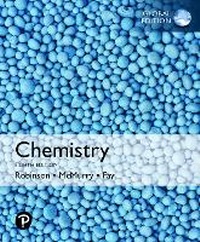
Chemistry, Global Edition + Modified Mastering Chemistry with Pearson eText
8th Edition
Published on 10. September 2020
Book
Mixed media product
978-1-292-37672-1 (ISBN)
More details
Edition
8th edition
Language
English
Place of publication
Harlow
United Kingdom
Target group
College/higher education
Dimensions
Height: 280 mm
Width: 232 mm
Thickness: 44 mm
Weight
2729 gr
ISBN-13
978-1-292-37672-1 (9781292376721)
Copyright in bibliographic data and cover images is held by Nielsen Book Services Limited or by the publishers or by their respective licensors: all rights reserved.
Schweitzer Classification
Other editions
Previous edition
Jill Robinson | John McMurry | Robert Fay
Chemistry plus Pearson MasteringChemistry with Pearson eText, Global Edition
Book
07/2020
8th Edition
Pearson Education Limited
€111.20
Article exhausted; check for reprint
Persons
Jill K. Robinson received her Ph.D. in analytical and atmospheric chemistry from the University of Colorado at Boulder. She is a senior lecturer at Indiana University and teaches general, analytical, and environmental chemistry courses. Her clear and relatable teaching style has been honored with several awards including the President's Award for Distinguished Teaching at Indiana University and the J. Calvin Giddings Award for Excellence in Education from the American Chemical Society Division of Analytical Chemistry. She leads workshops to help faculty transition from lecture-based instruction to student-centered pedagogies.
John McMurry, educated at Harvard and Columbia, has taught more than 20,000 students in general and organic chemistry over a 40-year period. An emeritus professor of chemistry at Cornell University, Dr. McMurry previously spent 13 years on the faculty at the University of California at Santa Cruz. He has received numerous awards, including the Alfred P. Sloan Fellowship (1969-71), the National Institute of Health Career Development Award (1975-80), the Alexander von Humboldt Senior Scientist Award (1986-87), and the Max Planck Research Award (1991).
Robert C. Fay, professor emeritus at Cornell University, taught general and inorganic chemistry at Cornell for 45 years beginning in 1962. Known for his clear, well-organized lectures, Dr. Fay was the 1980 recipient of the Clark Distinguished Teaching Award. He has also taught as a visiting professor at Harvard University and the University of Bologna (Italy). A Phi Beta Kappa graduate of Oberlin College, Dr. Fay received his Ph.D. from the University of Illinois. He has been an NSF Science Faculty Fellow at the University of East Anglia and the University of Sussex (England) and a NATO/Heineman Senior Fellow at Oxford University.
John McMurry, educated at Harvard and Columbia, has taught more than 20,000 students in general and organic chemistry over a 40-year period. An emeritus professor of chemistry at Cornell University, Dr. McMurry previously spent 13 years on the faculty at the University of California at Santa Cruz. He has received numerous awards, including the Alfred P. Sloan Fellowship (1969-71), the National Institute of Health Career Development Award (1975-80), the Alexander von Humboldt Senior Scientist Award (1986-87), and the Max Planck Research Award (1991).
Robert C. Fay, professor emeritus at Cornell University, taught general and inorganic chemistry at Cornell for 45 years beginning in 1962. Known for his clear, well-organized lectures, Dr. Fay was the 1980 recipient of the Clark Distinguished Teaching Award. He has also taught as a visiting professor at Harvard University and the University of Bologna (Italy). A Phi Beta Kappa graduate of Oberlin College, Dr. Fay received his Ph.D. from the University of Illinois. He has been an NSF Science Faculty Fellow at the University of East Anglia and the University of Sussex (England) and a NATO/Heineman Senior Fellow at Oxford University.
Content
1. Chemical Tools: Experimentation and Measurement?
2. Atoms, Molecules, and Ions?
3. Mass Relationships in Chemical Reactions?
4. Reactions in Aqueous Solution?
5. Periodicity and the Electronic Structure of Atoms?
6. Ionic Compounds: Periodic Trends and Bonding Theory?
7. Covalent Bonding and Electron-Dot Structures?
8. Covalent Compounds: Bonding Theories and Molecular Structure?
9. Thermochemistry: Chemical Energy?
10. Gases: Their Properties and Behavior?
11. Liquids and Phase Changes?
12. Solids and Solid-State Materials?
13. Solutions and Their Properties?
14. Chemical Kinetics ?
15. Chemical Equilibrium ?
16. Aqueous Equilibria: Acids and Bases ?
17. Applications of Aqueous Equilibria ?
18. Thermodynamics: Entropy, Free Energy, and Spontaneity
19. Electrochemistry ?
20. Nuclear Chemistry ?
21. Transition Elements and Coordination Chemistry?
22. The Main-Group Elements?
23. Organic and Biological Chemistry
?
2. Atoms, Molecules, and Ions?
3. Mass Relationships in Chemical Reactions?
4. Reactions in Aqueous Solution?
5. Periodicity and the Electronic Structure of Atoms?
6. Ionic Compounds: Periodic Trends and Bonding Theory?
7. Covalent Bonding and Electron-Dot Structures?
8. Covalent Compounds: Bonding Theories and Molecular Structure?
9. Thermochemistry: Chemical Energy?
10. Gases: Their Properties and Behavior?
11. Liquids and Phase Changes?
12. Solids and Solid-State Materials?
13. Solutions and Their Properties?
14. Chemical Kinetics ?
15. Chemical Equilibrium ?
16. Aqueous Equilibria: Acids and Bases ?
17. Applications of Aqueous Equilibria ?
18. Thermodynamics: Entropy, Free Energy, and Spontaneity
19. Electrochemistry ?
20. Nuclear Chemistry ?
21. Transition Elements and Coordination Chemistry?
22. The Main-Group Elements?
23. Organic and Biological Chemistry
?