

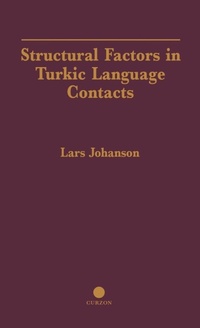
Structural Factors in Turkic Language Contacts
1st Edition
Published on 24. January 2002
Book
Hardback
200 pages
978-0-7007-1182-6 (ISBN)
Description
Turkic languages present particularly rich sources of data for the study of language contact, given the number and diversity of languages with which they have been in contact. Many common, false generalisations are laid bare and the methodology used in evaluating particular instances of language contact can also be used with profit by students of languages other than the Turkic.
More details
Language
English
Place of publication
London
United Kingdom
Publishing group
Taylor & Francis Ltd
Target group
College/higher education
Dimensions
Height: 222 mm
Width: 145 mm
Thickness: 14 mm
Weight
390 gr
ISBN-13
978-0-7007-1182-6 (9780700711826)
Copyright in bibliographic data and cover images is held by Nielsen Book Services Limited or by the publishers or by their respective licensors: all rights reserved.
Schweitzer Classification
Other editions
Additional editions
Lars Johanson
Structural Factors in Turkic Language Contacts
Book
12/2015
1st Edition
Routledge
€71.70
Shipment within 10-20 days
Lars Johanson
Structural Factors in Turkic Language Contacts
E-Book
12/2013
1st Edition
Routledge
€65.99
Available for download
Lars Johanson
Structural Factors in Turkic Language Contacts
E-Book
12/2013
1st Edition
Routledge
€65.99
Available for download
Persons
Content
Introduction By Bernard Comrie 1. Code Copying in Turkic Language Contacts 1.1 Questions 1.2 Turkic language contacts 1.3 Code copying 1.4 Turkic characteristics 2. The Role of Structural Factors 2.1 Suggested restrictions 2.2 Scales of Stability 2.3 Attractiveness 2.4 Attractive features 2.5 Social factors 2.6 Structuredness 2.7 Relative attractiveness 2.8 Differences between languages 2.9 Deep influence 2.10 Types of influence involved in language maintenance and language shift 3. Structural Copying in Various Linguistic Domains 3.1 Turkic-non-Turkic convergence 3.2 Phonological features 3.3 Word structure 3.4 Grammatical categories 3.5 Syntactic combinational patterns 4. General and Areal Tendencies 4.1 General tendencies 4.2 Sources of areal tendencies 4.3 Early levelling of Turkic? 4.4 Similarities in the most stable substructures Notes References Index