

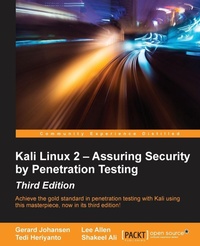
Kali Linux 2 - Assuring Security by Penetration Testing
Achieve the gold standard in penetration testing with Kali using this masterpiece, now in its third edition!
3rd Edition
Published on 22. September 2016
Book
Paperback/Softback
572 pages
978-1-78588-842-7 (ISBN)
Description
Achieve the gold standard in penetration testing with Kali using this masterpiece, now in its third edition!
Key Features
[*] Get a rock-solid insight into penetration testing techniques and test your corporate network against threats like never before
[*] Formulate your pentesting strategies by relying on the most up-to-date and feature-rich Kali version in town-Kali Linux 2 (aka Sana).
[*] Experience this journey with new cutting-edge wireless penetration tools and a variety of new features to make your pentesting experience smoother
Book DescriptionKali Linux is a comprehensive penetration testing platform with advanced tools to identify, detect, and exploit the vulnerabilities uncovered in the target network environment. With Kali Linux, you can apply appropriate testing methodology with defined business objectives and a scheduled test plan, resulting in a successful penetration testing project engagement.
Kali Linux - Assuring Security by Penetration Testing is a fully focused, structured book providing guidance on developing practical penetration testing skills by demonstrating cutting-edge hacker tools and techniques with a coherent, step-by-step approach. This book offers you all of the essential lab preparation and testing procedures that reflect real-world attack scenarios from a business perspective, in today's digital age.
What you will learn
- Find out to download and install your own copy of Kali Linux
- Properly scope and conduct the initial stages of a penetration test
- Conduct reconnaissance and enumeration of target networks
- Exploit and gain a foothold on a target system or network
- Obtain and crack passwords
- Use the Kali Linux NetHunter install to conduct wireless penetration testing
- Create proper penetration testing reports
Who this book is forIf you are an IT security professional or a student with basic knowledge of Unix/Linux operating systems, including an awareness of information security factors, and you want to use Kali Linux for penetration testing, this book is for you.
Key Features
[*] Get a rock-solid insight into penetration testing techniques and test your corporate network against threats like never before
[*] Formulate your pentesting strategies by relying on the most up-to-date and feature-rich Kali version in town-Kali Linux 2 (aka Sana).
[*] Experience this journey with new cutting-edge wireless penetration tools and a variety of new features to make your pentesting experience smoother
Book DescriptionKali Linux is a comprehensive penetration testing platform with advanced tools to identify, detect, and exploit the vulnerabilities uncovered in the target network environment. With Kali Linux, you can apply appropriate testing methodology with defined business objectives and a scheduled test plan, resulting in a successful penetration testing project engagement.
Kali Linux - Assuring Security by Penetration Testing is a fully focused, structured book providing guidance on developing practical penetration testing skills by demonstrating cutting-edge hacker tools and techniques with a coherent, step-by-step approach. This book offers you all of the essential lab preparation and testing procedures that reflect real-world attack scenarios from a business perspective, in today's digital age.
What you will learn
- Find out to download and install your own copy of Kali Linux
- Properly scope and conduct the initial stages of a penetration test
- Conduct reconnaissance and enumeration of target networks
- Exploit and gain a foothold on a target system or network
- Obtain and crack passwords
- Use the Kali Linux NetHunter install to conduct wireless penetration testing
- Create proper penetration testing reports
Who this book is forIf you are an IT security professional or a student with basic knowledge of Unix/Linux operating systems, including an awareness of information security factors, and you want to use Kali Linux for penetration testing, this book is for you.
More details
Edition
3rd Revised edition
Language
English
Place of publication
Birmingham
United Kingdom
Edition type
Revised edition
Dimensions
Height: 235 mm
Width: 191 mm
Thickness: 31 mm
Weight
1054 gr
ISBN-13
978-1-78588-842-7 (9781785888427)
Copyright in bibliographic data and cover images is held by Nielsen Book Services Limited or by the publishers or by their respective licensors: all rights reserved.
Schweitzer Classification
Persons
Gerard Johansen is an incident response professional with over 15 years' experience in areas like penetration testing, vulnerability management, threat assessment modeling, and incident response. Beginning his information security career as a cyber crime investigator, he has built on that experience while working as a consultant and security analyst for clients and organizations ranging from healthcare to finance. Gerard is a graduate of Norwich University's Master of Science in Information Assurance program and a certified information systems security professional.
He is currently employed as a senior incident response consultant with a large technology company, focusing on incident detection, response, and threat intelligence integration. Lee Allen is the associate director at Ohio State University. He specializes in information security, penetration testing, security research, task automation, risk management, data analysis, and 3D application development. Tedi Heriyanto currently works as an information security analyst at a Fortune 500 company. He has experience of designing secure network architectures, deploying and managing enterprise-wide security systems, developing information security policies and procedures, performing various network, web, and mobile application penetration testing, and giving information security training. In his spare time, he deepens his knowledge and skills in information fields. Shakeel Ali is a senior cybersecurity consultant at a global Fortune 500 organization. His expertise in the security industry markedly exceeds the standard number of security assessments, audits, attack simulations, SOC/CSIRC facilitation, incident response, and forensic projects that he carries out in day-to-day operations. He is an independent researcher who writes various articles and white papers to provide insights into threat intelligence, and also provides constant security support to various businesses globally.
He is currently employed as a senior incident response consultant with a large technology company, focusing on incident detection, response, and threat intelligence integration. Lee Allen is the associate director at Ohio State University. He specializes in information security, penetration testing, security research, task automation, risk management, data analysis, and 3D application development. Tedi Heriyanto currently works as an information security analyst at a Fortune 500 company. He has experience of designing secure network architectures, deploying and managing enterprise-wide security systems, developing information security policies and procedures, performing various network, web, and mobile application penetration testing, and giving information security training. In his spare time, he deepens his knowledge and skills in information fields. Shakeel Ali is a senior cybersecurity consultant at a global Fortune 500 organization. His expertise in the security industry markedly exceeds the standard number of security assessments, audits, attack simulations, SOC/CSIRC facilitation, incident response, and forensic projects that he carries out in day-to-day operations. He is an independent researcher who writes various articles and white papers to provide insights into threat intelligence, and also provides constant security support to various businesses globally.
Content
Table of Contents
Beginning with Kali Linux
Penetration Testing Methodology
Target Scoping
Information Gathering
Target Discovery
Enumeration
Vulnerability Mapping
Social Engineering
Target Exploitation
Privilege Escalation
Maintaining Access
Wireless Penetration Testing
Kali NetHunter
Documentation and Reporting
Appendix A: Supplementary Tools
Appendix B: Key Resources
Beginning with Kali Linux
Penetration Testing Methodology
Target Scoping
Information Gathering
Target Discovery
Enumeration
Vulnerability Mapping
Social Engineering
Target Exploitation
Privilege Escalation
Maintaining Access
Wireless Penetration Testing
Kali NetHunter
Documentation and Reporting
Appendix A: Supplementary Tools
Appendix B: Key Resources