

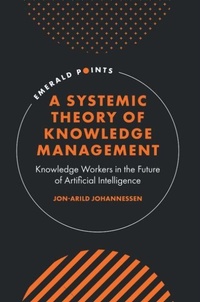
A Systemic Theory of Knowledge Management
Knowledge Workers in the Future of Artificial Intelligence
Published on 20. January 2025
Book
Hardback
136 pages
978-1-83608-891-2 (ISBN)
Description
The Fourth Industrial Revolution while creating many new opportunities, is inevitably going to lead to uncertainty around specific jobs and roles, particularly those of knowledge workers and in the innovation economy.
To understand which jobs will be uncertain as society moves towards the Fourth Industrial Revolution, Johannessen adopts three time-perspectives. The short-term perspective, five to fifteen years. The medium-term perspective, fifteen to thirty years. Currently there is little interest in the long term-perspective, but this time perspective extends from approximately thirty to fifty years ahead. In the short and accessible text, Johannessen answers the question of which jobs will be uncertain regarding these timelines with the main focus on the short and medium-term perspectives.
A forewarning of possible future competences, by means of expectation signals, will enable people to acquire the competences that will be demanded by the new technology. This can be of benefit to students when planning their studies, so they can adapt their education to future changes; it can also be of benefit to schools and universities, so they can make changes to their curricula. In addition, it will also be of relevance to the authorities, so that they can provide more high-tech educations, with a focus on the new technology that is emerging.
To understand which jobs will be uncertain as society moves towards the Fourth Industrial Revolution, Johannessen adopts three time-perspectives. The short-term perspective, five to fifteen years. The medium-term perspective, fifteen to thirty years. Currently there is little interest in the long term-perspective, but this time perspective extends from approximately thirty to fifty years ahead. In the short and accessible text, Johannessen answers the question of which jobs will be uncertain regarding these timelines with the main focus on the short and medium-term perspectives.
A forewarning of possible future competences, by means of expectation signals, will enable people to acquire the competences that will be demanded by the new technology. This can be of benefit to students when planning their studies, so they can adapt their education to future changes; it can also be of benefit to schools and universities, so they can make changes to their curricula. In addition, it will also be of relevance to the authorities, so that they can provide more high-tech educations, with a focus on the new technology that is emerging.
More details
Series
Language
English
Place of publication
Bingley
United Kingdom
Target group
Professional and scholarly
Dimensions
Height: 157 mm
Width: 238 mm
Thickness: 15 mm
Weight
322 gr
ISBN-13
978-1-83608-891-2 (9781836088912)
Copyright in bibliographic data and cover images is held by Nielsen Book Services Limited or by the publishers or by their respective licensors: all rights reserved.
Schweitzer Classification
Other editions
Additional editions
Jon-Arild Johannessen
A Systemic Theory of Knowledge Management
Knowledge Workers in the Future of Artificial Intelligence
E-Book
01/2025
1st Edition
Emerald Publishing Limited
€100.99
Available for download
Person
Jon-Arild Johannessen is a Professor in Leadership at Kristiania University College, Oslo, Norway. He holds a Ph.D. from Stockholm University in Systemic thinking. He was previously a Professor Knowledge Management at the Norwegian School of Management.
Content
Chapter 1. A theoretical reflection
Chapter 2. Infrastructure
Chapter 3. Info-Structure
Chapter 4. Infrastructure and Info-Structure
Chapter 5. A journey through time to 2050
Chapter 6. Concepts
Chapter 2. Infrastructure
Chapter 3. Info-Structure
Chapter 4. Infrastructure and Info-Structure
Chapter 5. A journey through time to 2050
Chapter 6. Concepts