

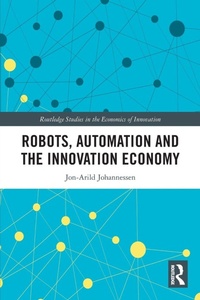
Robots, Automation and the Innovation Economy
1st Edition
Will be published approx. on 20. July 2026
Book
Paperback/Softback
210 pages
978-1-032-93716-8 (ISBN)
Description
Cascades of new technologies and innovations are entering our lives so fast that it is difficult for us to adapt to one innovation before the next becomes embedded into our everyday lives. What happens when the changes brought by technology are so profound that they affect all aspects of our lives? This book explores the potential impact of artificial intelligence (AI) and intelligent robots on individuals, organizations and society, specifically examining the impact on jobs and workplaces in the future. It provides an understanding of how we can adapt to changes that appear like flocks of black swans.
Five key areas are unpacked in the book: automation, AI, (the significance of AI technology), innovation, competence transformation, and the fact that the pace of change is so rapid that it outstrips our ability to adapt to consecutive changes. The main objective is to show how AI will change society and how we as individuals and society must adapt in order to survive what the author terms 'robot shock', together with its consequences and after-effects. It offers a greater understanding of resistance to change and how we need to adopt strategies for adapting to major changes. Each of the book's six chapters also contains policy inputs, framed as propositions, that are intended specifically for decision-makers. The book concludes by offering possible strategies for overcoming the negative effects of 'robot shock'.
The book intends to send a message to leaders of institutions, decision-makers and anyone attempting to understand and explain how we - as a social system - can succeed in tackling the many major challenges and crises faced by humanity.
Five key areas are unpacked in the book: automation, AI, (the significance of AI technology), innovation, competence transformation, and the fact that the pace of change is so rapid that it outstrips our ability to adapt to consecutive changes. The main objective is to show how AI will change society and how we as individuals and society must adapt in order to survive what the author terms 'robot shock', together with its consequences and after-effects. It offers a greater understanding of resistance to change and how we need to adopt strategies for adapting to major changes. Each of the book's six chapters also contains policy inputs, framed as propositions, that are intended specifically for decision-makers. The book concludes by offering possible strategies for overcoming the negative effects of 'robot shock'.
The book intends to send a message to leaders of institutions, decision-makers and anyone attempting to understand and explain how we - as a social system - can succeed in tackling the many major challenges and crises faced by humanity.
More details
Series
Language
English
Place of publication
London
United Kingdom
Publishing group
Taylor & Francis Ltd
Target group
College/higher education
Postgraduate
Illustrations
21 s/w Zeichnungen, 21 s/w Abbildungen
21 Line drawings, black and white; 21 Illustrations, black and white
Dimensions
Height: 234 mm
Width: 156 mm
ISBN-13
978-1-032-93716-8 (9781032937168)
Copyright in bibliographic data and cover images is held by Nielsen Book Services Limited or by the publishers or by their respective licensors: all rights reserved.
Schweitzer Classification
Other editions
Additional editions
Jon-Arild Johannessen
Robots, Automation and the Innovation Economy
E-Book
12/2024
1st Edition
Routledge
€60.49
Available for download
Jon-Arild Johannessen
Robots, Automation and the Innovation Economy
E-Book
12/2024
1st Edition
Routledge
€60.49
Available for download
Jon-Arild Johannessen
Robots, Automation and the Innovation Economy
Book
12/2024
1st Edition
Routledge
€197.30
Shipment within 10-20 days
Person
Jon-Arild Johannessen is a Professor at Kristiania University College, Oslo, Norway.
Content
1. Robot Shock 2. Automation is here to stay 3. Artificial intelligence 4. Innovation 5. Competence transformation 6. Waves of black swan events