

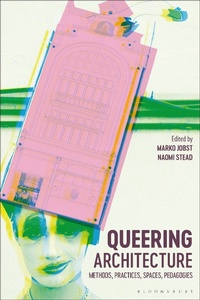
Queering Architecture
Methods, Practices, Spaces, Pedagogies
Published on 23. February 2023
Book
Hardback
296 pages
978-1-350-26704-6 (ISBN)
Description
Featuring contributions from a range of significant voices in the field, this volume renews the conversation around what it means to speak of the 'queer' in the context of architecture, and offers a fresh take on the methodological and epistemological challenges this poses to the discipline of architectural theory.
Architecture as a discipline, a profession and an applied practice is always subordinate to its own conceptual framework, which is one of orderliness. It refers to buildings, but also to infrastructures of thought and knowledge, to conventions and taxonomies, to structures of governance, hierarchies of power and systems of administration. How, then, can one look at queering architectural discourse when the very term 'queer', celebrated for its elusive nature, resists and attacks such order?
Divided into four subsections, the essays in this anthology each pursue a distinct line of inquiry - methods, practices, spaces and pedagogies - in order to help particularize the proposed queering of architecture. They demonstrate the paradoxical nature of the endeavour from a diverse range of perspectives - from questions of mapping queer theory in architecture; to issues of queer architectural archives, or lack thereof; to non-Western challenges to the very term queer, and the queering of basic assumptions across affiliated disciplines.
Queering Architecture not only provides a bold challenge to the normative methods employed in architectural discourse but also addresses how establishing 'queer' methodologies is a paradox in itself.
Architecture as a discipline, a profession and an applied practice is always subordinate to its own conceptual framework, which is one of orderliness. It refers to buildings, but also to infrastructures of thought and knowledge, to conventions and taxonomies, to structures of governance, hierarchies of power and systems of administration. How, then, can one look at queering architectural discourse when the very term 'queer', celebrated for its elusive nature, resists and attacks such order?
Divided into four subsections, the essays in this anthology each pursue a distinct line of inquiry - methods, practices, spaces and pedagogies - in order to help particularize the proposed queering of architecture. They demonstrate the paradoxical nature of the endeavour from a diverse range of perspectives - from questions of mapping queer theory in architecture; to issues of queer architectural archives, or lack thereof; to non-Western challenges to the very term queer, and the queering of basic assumptions across affiliated disciplines.
Queering Architecture not only provides a bold challenge to the normative methods employed in architectural discourse but also addresses how establishing 'queer' methodologies is a paradox in itself.
Reviews / Votes
We are in a renaissance of queer methods, surveying mis/alignments between slippery queerness and orderly methods. From physical places to digital spaces, the contributors of this multivalent, delightfully unruly volume amplify the unique voices of architectural disciplines. * Amin Ghaziani, Professor of Sociology and Canada Research Chair in Urban Sexualities, University of British Columbia, Canada * This collection of essays makes a significant contribution to the evolving discourse/methodology relating to queer space and queer architectural practice. It focuses on new critical and theoretical approaches, and brings to light a range of little known sites, interventions, and publications. I found the proposal very rich and challenging.. . . Both the editors and the contributors are leading voices in the fields of criticism, pedagogy, and design practice with demonstrated track records in this area.
. . . moves the conversation about queer space/architecture forward while building on previous work. * Alice T. Friedman, Grace Slack McNeil Professor of American Art; Professor of Art, Wellesley College, USA * I am impressed by the range of approaches and case studies found here and I would have thought it would provide a thought-provoking stimulus to a wide range of academic and critical practice . . . It be might expected to quickly establish a position of some importance within this developing field.
. . . It does appear to be a key volume in relation to methods and methodologies.
. . . This is a lively and interesting range of approaches to the methodology of queer architecture. * Professor Dominic Janes, School of Humanities, Keele University, UK * This book will certainly contribute to research in the overlapping fields of queer theory and architecture. This is definitely an under-researched area and could easily benefit from such a collection. * Jack Halberstam, Director of the Institute for Research on Women, Gender and Sexuality; Professor of English and Gender Studies, Columbia University, USA *
More details
Language
English
Place of publication
London
United Kingdom
Publishing group
Bloomsbury Publishing PLC
Target group
Professional and scholarly
Product notice
sewn/stitched
Cloth over boards
With dust jacket
Illustrations
47 bw illus
Dimensions
Height: 234 mm
Width: 156 mm
Thickness: 25 mm
Weight
454 gr
ISBN-13
978-1-350-26704-6 (9781350267046)
Copyright in bibliographic data and cover images is held by Nielsen Book Services Limited or by the publishers or by their respective licensors: all rights reserved.
Schweitzer Classification
Other editions
Additional editions
E-Book
01/2023
1st Edition
Bloomsbury Visual Arts
€28.49
Available for download
Persons
Marko Jobst is an independent lecturer and researcher based in Scotland. He has taught at a number of schools of architecture in London, most prominently as Architecture Undergraduate Theory Coordinator at the University of Greenwich.
Naomi Stead is Professor of Architecture and Director of the Design and Creative Practice Enabling Capability Platform at RMIT, Australia.
Naomi Stead is Professor of Architecture and Director of the Design and Creative Practice Enabling Capability Platform at RMIT, Australia.
Content
Figures
Contributors
Introduction - Marko Jobst and Naomi Stead
I: Methods
1. On the Uses of Queer Space Thinking - Olivier Vallerand
2. Queer Encounters in the Archive: Misplaced Love Letters and Autobiographical Homes - Dirk van den Heuvel and Martin van Wijk
3. Queering Architectural History: Anomalous histories and historiographies of the Baroque - Marko Jobst
4. Notes From Transient Spaces, Anachronic Times: An architectural exercise - Ece Canli
II: Practices
5. El Site: Queer approximations on fragments and writing - Regner Ramos
6. After the party with the lights on: A case study of queering architecture - Timothy Moore and Adam Nathaniel Furman
7. Fabulous Facades - Ben Campkin and Lo Marshall
8. From STUD to Stalled!: Embodied identity through a queer lens 1996-2021 - Joel Sanders
III: Spaces
9. Architectures of Darkness in Derek Jarman and Mark Bradford - Nicholas Gamso
10. Queer Space in a Peripheral Modernity - Sarah Nicholus
11. Music as a Site of Transing - Simona Castricum
12. Queer Spaces, Queer Readings, Queer Lodgings - Naomi Stead
IV: Pedagogies
13. [Spatial] Pedagogic readings of Queer Theory: Experimental Realism and opportunities for teaching and learning - Gem Barton
14. Teacher/student: Queer practices to dismantle hierarchies in studio culture - A.L. Hu
15. Taking Architecture from Behind - Colin Ripley
Index
Contributors
Introduction - Marko Jobst and Naomi Stead
I: Methods
1. On the Uses of Queer Space Thinking - Olivier Vallerand
2. Queer Encounters in the Archive: Misplaced Love Letters and Autobiographical Homes - Dirk van den Heuvel and Martin van Wijk
3. Queering Architectural History: Anomalous histories and historiographies of the Baroque - Marko Jobst
4. Notes From Transient Spaces, Anachronic Times: An architectural exercise - Ece Canli
II: Practices
5. El Site: Queer approximations on fragments and writing - Regner Ramos
6. After the party with the lights on: A case study of queering architecture - Timothy Moore and Adam Nathaniel Furman
7. Fabulous Facades - Ben Campkin and Lo Marshall
8. From STUD to Stalled!: Embodied identity through a queer lens 1996-2021 - Joel Sanders
III: Spaces
9. Architectures of Darkness in Derek Jarman and Mark Bradford - Nicholas Gamso
10. Queer Space in a Peripheral Modernity - Sarah Nicholus
11. Music as a Site of Transing - Simona Castricum
12. Queer Spaces, Queer Readings, Queer Lodgings - Naomi Stead
IV: Pedagogies
13. [Spatial] Pedagogic readings of Queer Theory: Experimental Realism and opportunities for teaching and learning - Gem Barton
14. Teacher/student: Queer practices to dismantle hierarchies in studio culture - A.L. Hu
15. Taking Architecture from Behind - Colin Ripley
Index